What is René Magritte's most famous painting?
Short answer
René Magritte’s most famous painting is The Treachery of Images, created in 1929. It depicts a realistic pipe accompanied by the French text "Ceci n’est pas une pipe," which translates to "This is not a pipe." This iconic work challenges the relationship between language, visual representation, and the objects they claim to describe.
On this page
Why is The Treachery of Images so famous?
The painting gained worldwide recognition because it fundamentally altered how viewers perceive art. By pairing a lifelike image of a tobacco pipe with a contradictory statement, Magritte forced his audience to acknowledge the gap between a physical object and its artistic representation. The pipe is merely a painted image on a canvas; it cannot be smoked, held, or filled with tobacco.
This work serves as a cornerstone of Surrealism, a movement that sought to release the creative potential of the unconscious mind. Magritte’s approach was less about dreamlike chaos and more about philosophical inquiry into the nature of reality. His ability to use simple, clean imagery to convey complex intellectual concepts remains his most enduring legacy. The painting is currently housed in the Los Angeles County Museum of Art, where it continues to influence modern semiotics and conceptual art.
How to interpret Magritte’s work
To understand Magritte’s philosophy, one must look past the literal subject matter. He often used common objects—apples, bowler hats, clouds, and pipes—to disrupt the viewer's sense of normalcy. When viewing his work, consider these steps to decode his intentions:
- Identify the object being depicted and compare it to the text or title provided.
- Question the context by asking if the object is performing its expected function.
- Analyze the juxtaposition of elements to see if they create a sense of mystery or impossibility.
- Reflect on the artist's goal: to make the familiar seem strange and the strange seem familiar.
By following this process, you can move beyond the surface-level imagery and engage with the underlying logic. Magritte wanted to provoke thought rather than provide easy answers, encouraging viewers to question the validity of their own perceptions.
What are other famous paintings by Magritte?
While The Treachery of Images is his most cited work, Magritte produced several other masterpieces that are equally significant in the art world. These works often feature his signature bowler-hatted man or his fascination with the sky and hidden identities. Some of his most notable paintings include:
- The Son of Man (1964): A self-portrait featuring a man in a bowler hat whose face is obscured by a floating green apple.
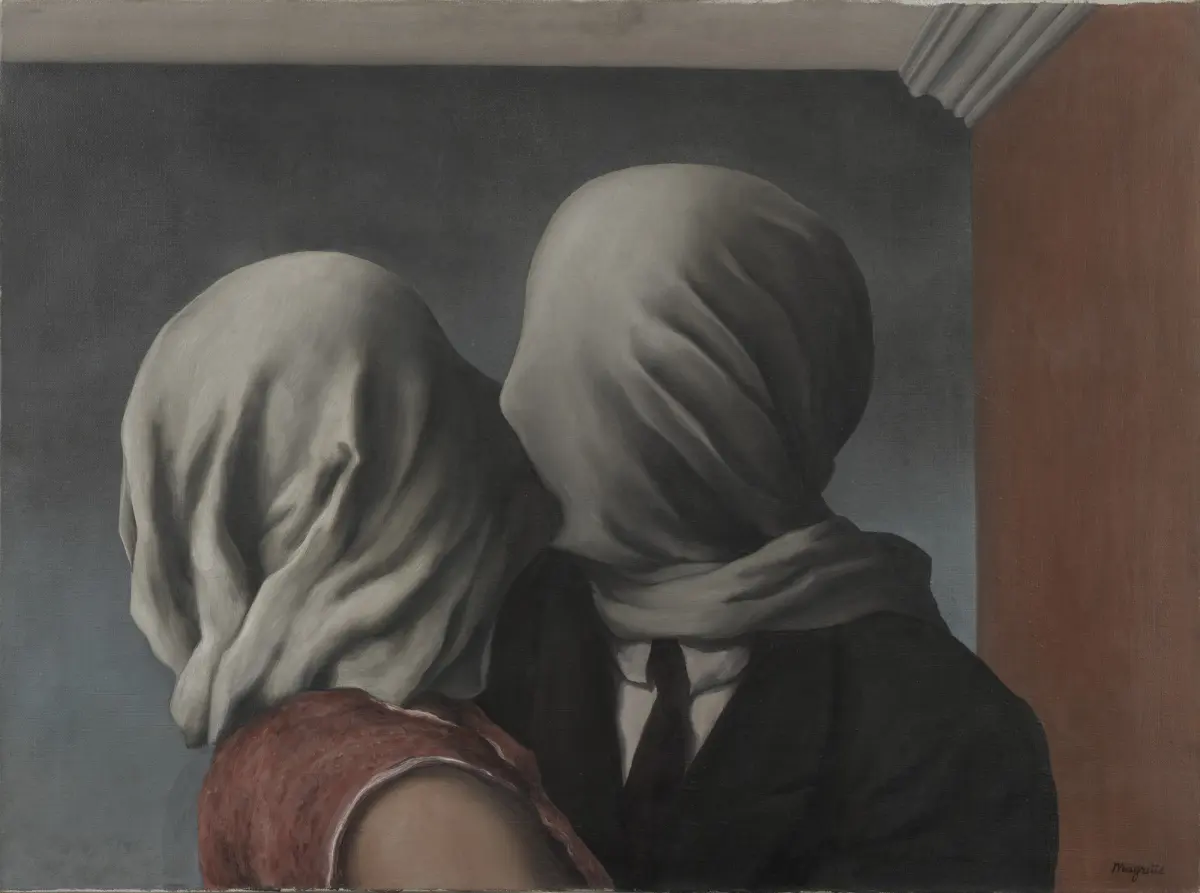
- The Lovers (1928): A haunting image of two figures kissing with their heads covered by white fabric, suggesting the impossibility of true intimacy.
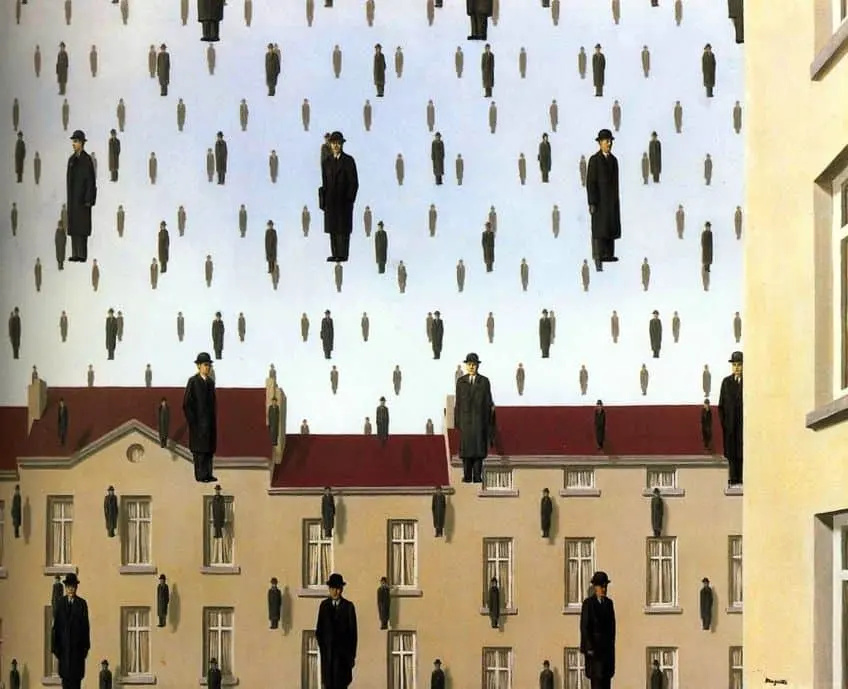
- Golconda (1953): A scene depicting a rain of identical men in overcoats and bowler hats suspended in the air.
- The Empire of Light (1954): A paradoxical landscape showing a dark, nighttime street scene beneath a bright, sunny daytime sky.
These works share a common thread of visual irony, challenging the viewer to find meaning in the impossible.
Common mistakes when studying Surrealism
Many people mistakenly assume that Surrealist paintings are simply random or nonsensical. In reality, artists like Magritte were highly deliberate and calculated in their compositions. A common error is trying to find a singular "correct" meaning for an image. Because Surrealism is rooted in the subconscious, the interpretation is often intended to be open-ended and subjective.
Another mistake is ignoring the historical context of the movement. Surrealism emerged in the early 20th century as a reaction against the rationalism that many believed led to the horrors of World War I. By embracing the irrational, artists sought to bypass the constraints of logic and social norms. When studying these works, avoid the temptation to look for hidden codes or secret messages. Instead, focus on how the artist uses visual tension to make the viewer feel uncomfortable or curious about the nature of reality.
Where can you see Magritte’s art today?
If you wish to see these works in person, you must visit major global institutions, as his paintings are dispersed across several continents. The Magritte Museum in Brussels, Belgium, holds the world's most extensive collection of his work, offering a comprehensive look at his evolution as an artist. Other significant collections can be found in museums across the United States and Europe.
To plan a successful visit, follow these practical tips:
- Check the museum’s website in advance to confirm if a specific painting is currently on display or on loan.
- Book tickets online to avoid long queues, especially at high-traffic institutions like the Museum of Modern Art in New York.
- Utilize audio guides, which often provide essential context regarding the artist’s life and the philosophical themes behind his surrealist compositions.
- Allow ample time to sit with individual pieces, as Magritte’s work requires quiet contemplation to fully appreciate the cleverness of his visual puzzles.
By visiting these galleries, you can experience the scale and texture of the original canvases, which digital reproductions often fail to capture accurately.
Key facts
- The most famous painting by René Magritte is The Treachery of Images (1929), which depicts a realistic pipe above the text "Ceci n'est pas une pipe" (This is not a pipe).
- Magritte intended the painting to illustrate that a representation of an object is not the object itself, as one cannot smoke the painted pipe.
- The original oil-on-canvas work measures approximately 23.7 by 37 inches and is currently housed in the Los Angeles County Museum of Art.
- A common mistake is interpreting the work as a literal statement rather than a philosophical exploration of semiotics and the relationship between language and reality.
- To appreciate Magritte’s work, look for his recurring motifs, such as bowler hats, green apples, and clouded skies, which he used to challenge viewer perceptions.
- When viewing his art, avoid searching for a single "correct" meaning, as Magritte intentionally crafted his images to be enigmatic and open to subjective interpretation.
The bottom line
René Magritte’s The Treachery of Images remains his most iconic contribution to art history. By challenging the viewer to distinguish between an object and its representation, he pioneered a conceptual approach that defined Surrealism. Understanding this masterpiece requires moving beyond literal interpretation to appreciate the philosophical depth of his work. Ultimately, Magritte invites us to question the nature of reality and our perception of symbols.
People also ask
Why did Magritte include the phrase "This is not a pipe" in his painting?
He included it to remind viewers that the image is merely a canvas covered in paint, not the physical object it represents. It serves as a critique of how humans conflate symbols with reality.
What art movement is René Magritte associated with?
Magritte was a prominent figure in the Surrealist movement. He focused on placing ordinary objects in unusual contexts to create thought-provoking, dreamlike imagery.
Where can I see The Treachery of Images in person?
The painting is part of the permanent collection at the Los Angeles County Museum of Art (LACMA). It is frequently displayed in the museum's galleries dedicated to modern art.
Did Magritte paint other versions of his most famous work?
Yes, Magritte created several variations of the pipe theme throughout his career. These include different sizes, color palettes, and slight adjustments to the text and composition.
What is the significance of the bowler hat in Magritte's paintings?
The bowler hat was a symbol of the ordinary middle-class man, which Magritte used to mask identity. It appears in many of his works, most notably in The Son of Man.
How did Magritte influence modern culture?
His work has profoundly influenced graphic design, advertising, and popular media by demonstrating how visual irony and juxtaposition can challenge conventional thought.
This answer was created with the help of AI research tools and reference sources. Spotted an error? Let us know — we correct mistakes quickly. See our editorial policy.