What is Sandro Botticelli's most famous painting?
Short answer
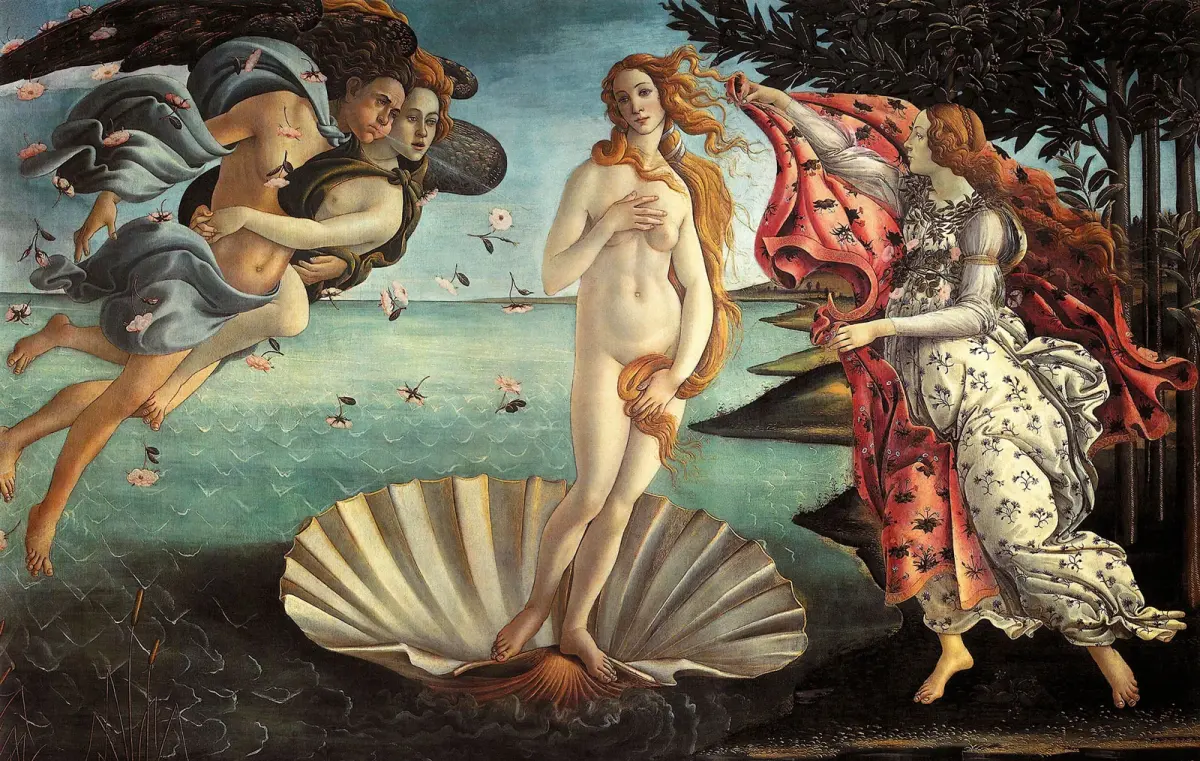
The Birth of Venus is Sandro Botticelli’s most famous painting. Created in the mid-1480s, this tempera-on-canvas masterpiece depicts the goddess Venus arriving at the shore after her birth. Housed in the Uffizi Gallery in Florence, it remains an iconic symbol of the Italian Renaissance, celebrated for its grace, mythological depth, and technical beauty.
On this page
What is the significance of The Birth of Venus?
The Birth of Venus represents a pivotal moment in Western art history, marking the transition from medieval traditions to the humanistic focus of the Renaissance. Painted around 1485, the work depicts the goddess Venus standing on a giant scallop shell, being blown toward the shore by wind deities. It was one of the first large-scale paintings on canvas in Tuscany, a medium that was then gaining popularity over traditional wood panels.
The painting is celebrated for its departure from purely religious subject matter, reflecting the influence of Neoplatonic philosophy in the Medici court. By centering the composition on a nude pagan deity, Botticelli challenged the artistic norms of his time. The work is not merely a portrait of a goddess; it is an allegory of divine love and the beauty of the human spirit. Its enduring fame stems from this bold synthesis of classical mythology and technical mastery.
Where can I see The Birth of Venus today?
The painting is permanently housed in the Uffizi Gallery in Florence, Italy. It is displayed in a dedicated room alongside other major works by Botticelli, including his equally famous Primavera. Because the Uffizi is one of the most visited museums in the world, viewing the painting requires careful planning to ensure a rewarding experience.
If you are planning a visit, consider these steps to make the most of your time:
- Book your tickets several weeks in advance through the official Uffizi website to avoid long queues.
- Visit during the early morning or late afternoon on weekdays to experience smaller crowds in the Botticelli rooms.
- Rent an official audio guide to understand the complex mythological symbolism present in the figures.
- Check the museum’s website for temporary closures or special exhibition notices before you travel.
How to interpret the symbolism in the painting?
Understanding the painting requires looking beyond the central figure of Venus. Botticelli filled the canvas with allegorical elements that convey specific meanings rooted in the poetry and philosophy of 15th-century Florence. The figures surrounding Venus are not merely decorative but serve to narrate the arrival of beauty into the world.
Key symbols include:
- The wind deities, Zephyrus and Aura, representing the physical forces of nature that propel beauty toward humanity.
- The figure on the right, often identified as one of the Horae (goddesses of the seasons), offering a cloak embroidered with flowers to cover the goddess.
- The rose petals falling through the air, which, according to myth, were created at the same time as Venus.
- The stylized waves and the shoreline, which ground the mythological event in a recognizable, albeit idealized, natural landscape.
Why is Botticelli's style considered unique?
Botticelli’s artistic identity is defined by his fluid, rhythmic line work and an emphasis on grace over strict anatomical realism. Unlike some of his contemporaries who focused heavily on scientific perspective and muscular volume, Botticelli favored elongated limbs and delicate features. This "linear" style gives his figures an ethereal, almost weightless quality that distinguishes his work from the heavier, more grounded paintings of the era.
His use of color also sets him apart. In The Birth of Venus, he utilizes a bright, luminous palette that emphasizes the clarity of the scene. He famously used gold highlights in the hair and foliage, a technique that adds a shimmering, divine quality to the composition. This aesthetic choice ensures that even centuries later, the painting retains a sense of freshness and vitality that continues to captivate modern viewers.
Common mistakes when studying Botticelli's work
A frequent error when viewing or studying this painting is assuming it was intended to be a realistic representation of a human body. Botticelli intentionally distorted proportions to achieve a sense of elegance and movement rather than biological accuracy. If you judge the painting solely by the standards of anatomical precision, you miss the artist's intent to convey an idealized, spiritual concept of beauty.
Another mistake is viewing the work in isolation from its historical context. Many observers fail to realize that the painting was a private commission for the Medici family, not a public altarpiece. Understanding the intellectual environment of the Medici court is essential for grasping why such a provocative mythological subject was acceptable. To avoid these pitfalls, always research the patron’s motivations and the prevailing philosophical trends of the period before forming a final opinion on the work’s artistic merit.
Key facts
- Sandro Botticelli’s most famous painting is The Birth of Venus, created in the mid-1480s.
- The masterpiece is currently housed in the Uffizi Gallery in Florence, Italy.
- It depicts the goddess Venus arriving at the shore after her birth, standing on a giant scallop shell.
- The painting measures approximately 172.5 cm by 278.5 cm and was painted using tempera on canvas.
- Avoid confusing this work with Primavera, another of Botticelli’s iconic allegorical paintings also located in the Uffizi.
- When visiting the Uffizi to see it, arrive early in the morning to avoid the largest crowds in the Botticelli rooms.
The bottom line
The Birth of Venus remains the definitive masterpiece of Sandro Botticelli, capturing the elegance and intellectual curiosity of the Italian Renaissance. By blending classical mythology with innovative artistic techniques, Botticelli created an enduring icon of Western art. Today, it serves as a testament to the cultural flourishing of 15th-century Florence and continues to influence modern perceptions of beauty, grace, and the power of visual storytelling.
People also ask
What does the painting symbolize?
It represents the Neoplatonic idea of divine love and the birth of beauty into the world. The figures are inspired by classical mythology, reflecting the intellectual climate of the Renaissance in Florence.
Who commissioned The Birth of Venus?
While historical records are not definitive, it is widely believed that a member of the Medici family commissioned the work. The Medici were prominent patrons of the arts who supported Botticelli throughout his career.
Why is the painting considered revolutionary for its time?
It was one of the first large-scale paintings in Tuscany to be executed on canvas rather than wood panel. Furthermore, it features a full-length female nude, which was a rare subject in Western art during the 15th century.
Is the painting a religious work?
No, it is a secular, mythological scene. Unlike many other works from the period, it focuses on pagan deities rather than Christian iconography, showcasing the humanist interests of the era.
How long did it take Botticelli to paint it?
Scholars estimate that the painting was completed between 1484 and 1486. Botticelli likely worked on it alongside other projects, as was common for masters operating large workshops in Florence.
Are there any hidden meanings in the figures?
The figure on the right is often identified as the Hora of Spring, who offers Venus a flowered cloak. The wind gods on the left, Zephyrus and Aura, represent the breath of life that brings the goddess to land.
This answer was created with the help of AI research tools and reference sources. Spotted an error? Let us know — we correct mistakes quickly. See our editorial policy.