What is Paula Modersohn-Becker known for?
Short answer
Paula Modersohn-Becker was a pioneering German Expressionist painter known for her raw, simplified style and profound self-portraits. She was the first woman in art history to paint a series of self-portraits in the nude. Her work bridged the gap between late 19th-century Impressionism and the radical subjectivity of 20th-century modernism.
On this page
Why is Paula Modersohn-Becker important to art history?
Modersohn-Becker is widely recognized as one of the most significant figures in early German Expressionism. Working at the turn of the 20th century, she broke away from the traditional, academic expectations placed upon female artists of her era. Her work is characterized by a deliberate rejection of delicate, decorative styles in favor of heavy, earthy forms and bold, simplified geometry.
Her artistic evolution was deeply influenced by her stays in Paris, where she encountered the works of Paul Cézanne, Paul Gauguin, and Henri Matisse. By synthesizing these influences with her own vision, she developed a unique visual language that prioritized emotional truth over photographic realism. Today, she is celebrated for her:
- Development of a primitive, raw aesthetic that influenced later Expressionist movements.
- Courageous exploration of the female form and the human condition.
- Ability to capture psychological depth through stark, unadorned portraiture.
How did she change the tradition of self-portraiture?
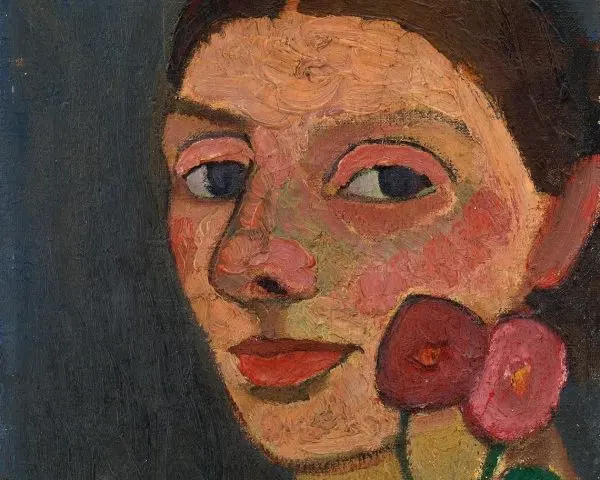
Before Modersohn-Becker, self-portraits by women were generally expected to be modest, decorative, or performative. She defied these conventions by creating approximately 50 self-portraits that explored her identity with unflinching honesty. She frequently depicted herself in states of vulnerability, including pregnancy and nudity, which was unprecedented for a female artist at the time.
Her approach to the self-portrait was not about vanity, but about the search for a core, authentic self. By stripping away background detail and focusing on the weight of the body and the intensity of the gaze, she transformed the genre into a tool for existential inquiry. Her work influenced the way future generations of artists approached the representation of the female body, shifting the focus from the "object" of the male gaze to the "subject" of the woman’s own experience.
What are the key characteristics of her painting style?
Her style is defined by a distinct "primitive" quality, characterized by thick, sculptural brushwork and a muted, earthy color palette. She often used ochres, deep greens, and browns, which gave her subjects a sense of permanence and connection to the land. Her compositions are intentionally flat, avoiding the illusion of depth to emphasize the tactile quality of the painted surface.
- Focus on simplified, monumental forms that emphasize volume.
- Use of heavy outlines to define figures against stark backgrounds.
- Minimalist settings that strip away narrative distractions to highlight the subject.
- A rejection of the "pretty" aesthetic in favor of raw, psychological intensity.
These techniques allowed her to convey a sense of gravitas and timelessness in her portraits of peasants, children, and herself. By ignoring the popular trends of the day, she created a body of work that feels remarkably modern even by contemporary standards.
How to appreciate her work as a beginner?
To truly understand her art, one must look past the initial "roughness" of the figures and focus on the emotional weight of the composition. Start by observing the eyes in her portraits; she often painted them with a piercing intensity that invites the viewer to engage with the subject’s inner world. Do not look for technical perfection or smooth blending, as these were intentionally avoided to maintain the integrity of the paint.
When viewing her work, consider the following steps to gain a deeper perspective:
- Research the context of the Worpswede art colony where she lived, as it shaped her early connection to nature.
- Compare her self-portraits to those of her contemporaries to see how radically she departed from traditional gender roles.
- Pay attention to the texture of the paint, noting how the physical application contributes to the mood of the piece.
By focusing on the artist’s intent rather than traditional beauty standards, you will find that her work speaks directly to the human experience of solitude and transformation.
Common mistakes when studying Modersohn-Becker
A frequent error is viewing her work solely through the lens of her tragic, short life. While she died at age 31 due to complications from childbirth, focusing only on her biography ignores her technical contributions to modern art. She was a deliberate, highly disciplined artist who spent years refining her style, not merely a spontaneous talent who produced work by accident.
Another mistake is mislabeling her work as purely "primitive" without acknowledging her sophisticated understanding of French Post-Impressionism. She was well-read and deeply engaged with the artistic debates of her time, making informed choices about color and form. Avoid assuming that her simplified style was due to a lack of training; it was a conscious, radical choice to strip away the artifice of the 19th century. By recognizing her as a calculated innovator, you can better appreciate her role as a bridge between the old world and the modern era.
Key facts
- Paula Modersohn-Becker was a pioneer of German Expressionism and one of the first women to paint major nudes.
- She created approximately 750 paintings and 1,000 drawings during her short career, which lasted roughly a decade.
- Her work is characterized by simplified forms, bold outlines, and a restricted, earthy color palette.
- She was the first female artist to have a museum dedicated entirely to her work, the Paula Modersohn-Becker Museum in Bremen, Germany.
- When studying her portraits, focus on the direct, unidealized gaze of her subjects, which broke from traditional academic portraiture.
- Avoid the mistake of viewing her work solely through the lens of her marriage; she was an independent artist who frequently traveled to Paris to study modern art.
The bottom line
Paula Modersohn-Becker remains a foundational figure in modern art, celebrated for her bold departure from traditional realism toward a raw, expressive aesthetic. By focusing on the human form with honesty and simplicity, she challenged the gender norms of her era. Her legacy endures through her vast collection of paintings and drawings, which continue to inspire artists and historians who value authentic, emotionally resonant visual storytelling.
People also ask
Why is she considered a pioneer of Expressionism?
She moved away from the realistic depiction of nature to focus on emotional intensity and simplified, monumental forms. Her early adoption of these techniques influenced the development of the broader Expressionist movement in early 20th-century Germany.
What was her relationship with the Worpswede artist colony?
She moved to the rural village of Worpswede in 1897 to join a group of landscape painters seeking a simpler life. While she initially learned from them, she eventually rejected their sentimental approach in favor of a more modern, raw style.
Did she receive recognition during her lifetime?
She struggled to gain acceptance from the male-dominated art establishment and sold only a few paintings before her death. Her reputation grew significantly in the decades following her passing as critics recognized her innovative contributions to modernism.
What subjects did she paint most frequently?
She is best known for her intimate portraits of the local peasant children and women in Worpswede. She also produced a significant series of self-portraits, which are considered among the most important in the history of modern art.
How did her time in Paris influence her style?
She visited Paris four times between 1900 and 1907, where she encountered the works of Paul Cézanne, Paul Gauguin, and Henri Matisse. These encounters encouraged her to use flatter planes of color and more expressive, non-naturalistic brushwork.
How did she die?
She died in 1907 at the age of 31 due to complications from childbirth. Her final words were reportedly, "What a pity!" reflecting her deep passion for the life and art she was leaving behind.
This answer was created with the help of AI research tools and reference sources. Spotted an error? Let us know — we correct mistakes quickly. See our editorial policy.