What is Georges Seurat known for?
Short answer
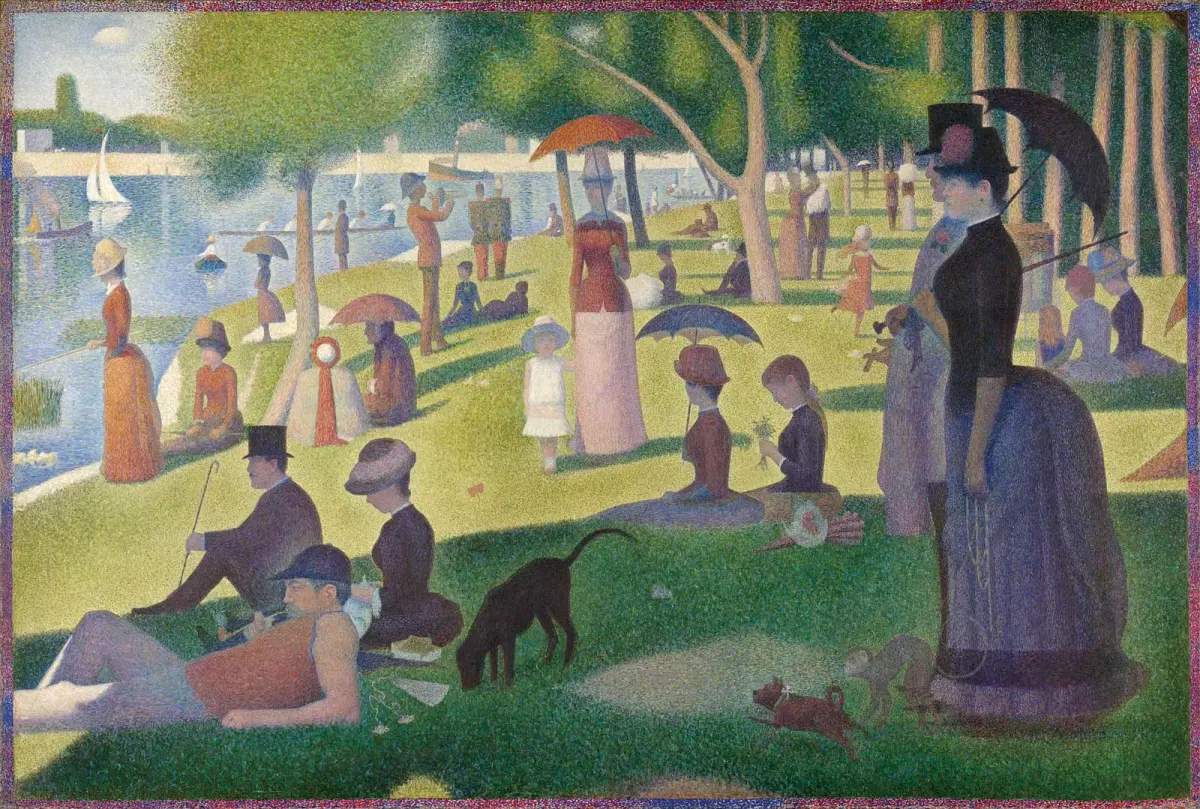
Georges Seurat is best known as the pioneer of Pointillism, a revolutionary technique involving the application of tiny, distinct dots of color to form a cohesive image. His 1884 masterpiece, A Sunday Afternoon on the Island of La Grande Jatte, remains one of the most iconic and influential paintings in modern art history.
On this page
What is the Pointillist technique?
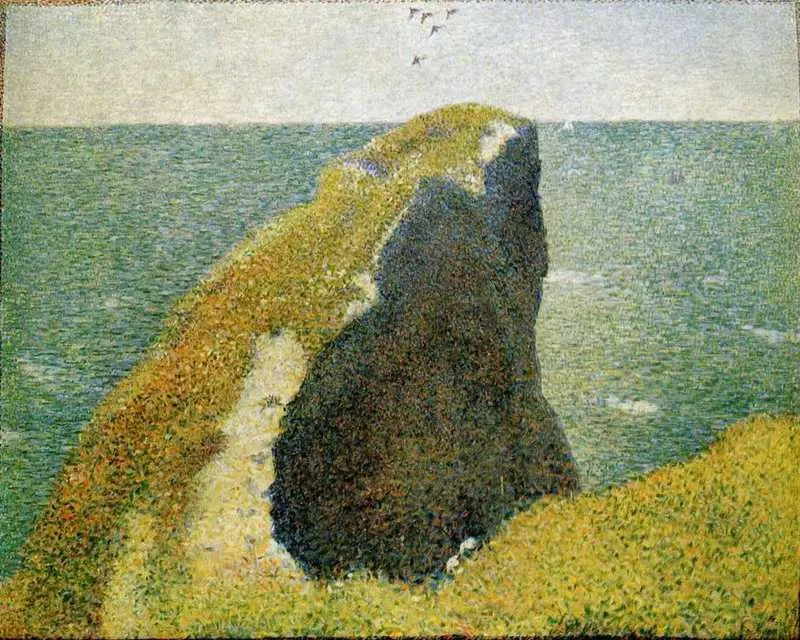
Pointillism is a systematic method of painting that relies on the viewer's eye to blend individual dots of pure color into a unified scene. Developed by Seurat in the mid-1880s, this approach was rooted in contemporary color theory, specifically the scientific research of Michel Eugène Chevreul and Ogden Rood. Seurat believed that placing complementary colors side by side would create a more vibrant, luminous effect than mixing pigments directly on a palette.
By applying thousands of small, precise dots, Seurat achieved a shimmering quality that traditional brushwork could not replicate. This technique required immense patience and a rigorous, almost mathematical approach to composition. While it appeared mechanical to some critics, it allowed Seurat to control the optical interaction of light and shadow with unprecedented precision. The result was a static, serene atmosphere that transformed the spontaneity of Impressionism into a calculated, permanent structure.
How did Seurat change modern art?
Seurat’s primary contribution to modern art was the transition from the fleeting, subjective impressions of the Impressionists to a more objective, scientific framework known as Neo-Impressionism. He rejected the loose, gestural brushstrokes of artists like Claude Monet in favor of a structured, analytical method. This shift influenced generations of painters, including Paul Signac, Henri-Edmond Cross, and even the early experiments of Vincent van Gogh and Henri Matisse.
His work challenged the boundaries between art and science, proving that painting could be as disciplined as physics. By emphasizing the optics of color perception, he paved the way for later movements like Fauvism and Op Art. His influence remains visible in:
- The development of color separation in modern printing processes.
- The pixel-based imaging used in digital screens today.
- The evolution of abstract art that prioritizes formal elements over narrative.
What are Seurat's most famous paintings?
Seurat’s career was brief, as he died at the age of 31, but he produced several monumental works that define his legacy. His most famous piece, A Sunday Afternoon on the Island of La Grande Jatte, took two years to complete and measures nearly ten feet wide. It depicts a cross-section of Parisian society relaxing along the Seine, rendered with a rigid, frieze-like quality that evokes the stillness of ancient Egyptian art.
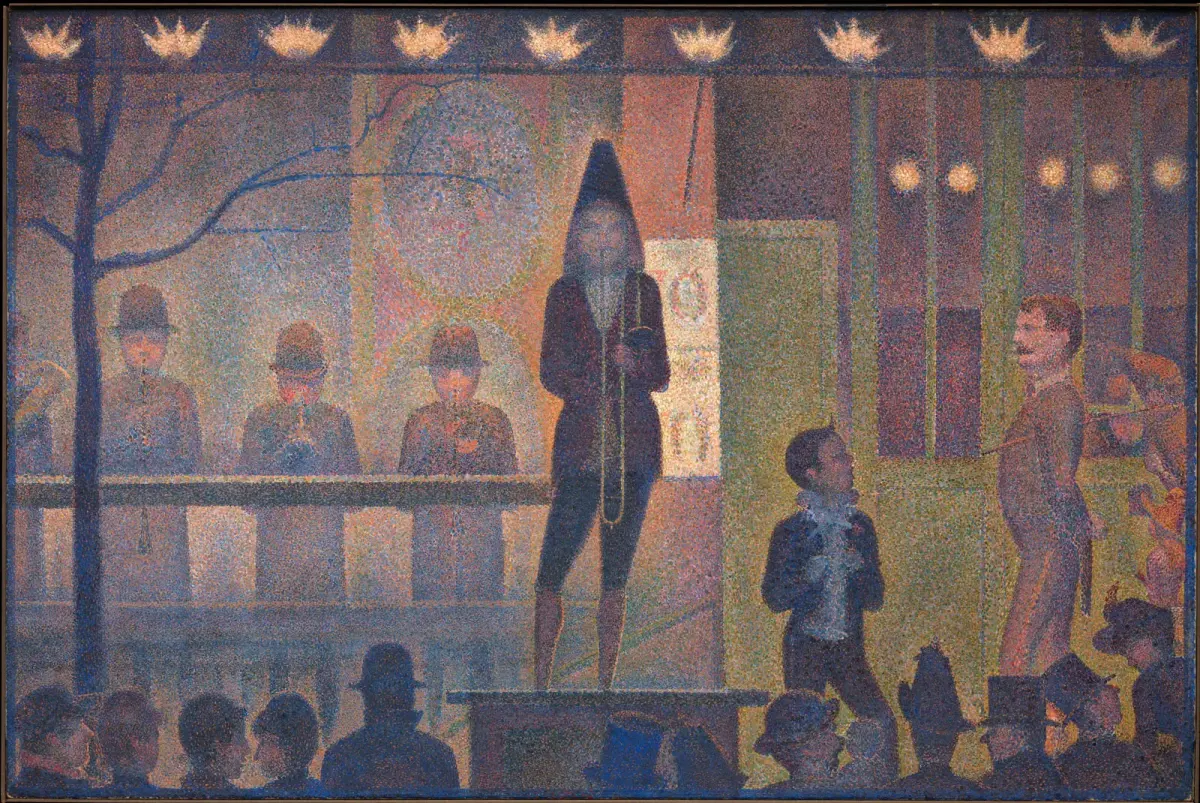
Other significant works include Bathers at Asnières, which predates his full commitment to Pointillism, and The Circus, his final, unfinished painting. These works demonstrate his obsession with balance, geometry, and the contrast between light and dark. His portfolio is characterized by:
- A Sunday Afternoon on the Island of La Grande Jatte (1884–1886): A defining work of Neo-Impressionism.
- Bathers at Asnières (1884): A large-scale study of working-class leisure.
- Le Chahut (1889–1890): A dynamic depiction of cabaret dancers.
- The Circus (1891): A vibrant exploration of movement and performance.
How to practice Pointillism for beginners
If you are interested in trying the Pointillist technique, start with a simple subject, such as a piece of fruit or a basic landscape. The goal is not to draw lines, but to build form through the accumulation of dots. Use high-quality acrylic or oil paints, as their thickness helps maintain the integrity of the individual dots. Avoid using too much water or medium, as this will cause the dots to bleed into one another and muddy the colors.
Follow these steps to begin your first piece:
- Sketch your subject lightly in pencil to establish the basic proportions.
- Select a limited palette of primary and secondary colors to ensure color harmony.
- Apply dots of pure color, placing them closer together in shadows and further apart in highlights.
- Step back frequently to observe how the colors blend at a distance.
- Layer additional dots to adjust the hue or intensity once the first layer is dry.
Common mistakes when painting with dots
The most common error beginners make is "over-mixing" colors by placing dots too close together or using brushes that are too large. If the dots are not distinct, the optical mixing effect fails, and the painting simply looks blurry. It is essential to maintain a consistent dot size throughout the work to ensure a uniform texture. Patience is the most critical tool; rushing the process often leads to messy, overlapping marks that destroy the intended luminosity.
Another frequent mistake is failing to account for the "halation" effect, where colors appear to vibrate against each other. Beginners often choose colors that are too similar in value, which results in a flat, dull image. To avoid this, ensure there is a strong contrast between your light and dark areas. Remember that Pointillism is a slow, deliberate process, and trying to speed up the application will inevitably compromise the clarity and scientific precision that made Seurat’s work so revolutionary.
Key facts
- Georges Seurat was a French Post-Impressionist painter who founded the technique known as Pointillism.
- His most famous work, A Sunday Afternoon on the Island of La Grande Jatte, measures approximately 6.75 by 10 feet.
- Pointillism involves applying small, distinct dots of pure color onto a canvas rather than mixing them on a palette.
- Seurat believed that the viewer's eye would optically blend these dots to create more vibrant, luminous colors.
- He was deeply influenced by scientific color theories published by Michel Eugène Chevreul and Ogden Rood.
- To practice Pointillism, use a small, stiff-bristled brush and apply colors side-by-side without blending them while wet.
The bottom line
Georges Seurat revolutionized modern art by replacing fluid brushwork with a rigorous, scientific approach to color known as Pointillism. By meticulously placing thousands of tiny, unmixed dots on the canvas, he created images that shimmer with optical intensity. His disciplined methodology and dedication to color theory transformed the artistic landscape, leaving a lasting legacy that bridged the gap between Impressionism and the abstract movements of the 20th century.
People also ask
Why did Seurat use dots instead of traditional brushstrokes?
He wanted to achieve a scientific precision in color application that traditional mixing could not provide. By placing complementary colors next to each other, he allowed the human eye to perform the mixing, resulting in a perceived increase in light and intensity.
How long did it take Seurat to paint his largest works?
Seurat was a notoriously slow and methodical worker who spent years on single canvases. He spent two full years, from 1884 to 1886, completing A Sunday Afternoon on the Island of La Grande Jatte.
What is the difference between Pointillism and Divisionism?
While often used interchangeably, Divisionism refers to the broader scientific theory of color separation. Pointillism is the specific stylistic application of that theory using distinct, small dots of paint.
Did Seurat have any followers who adopted his style?
Yes, he inspired a group of artists known as the Neo-Impressionists, including Paul Signac and Henri-Edmond Cross. They further developed his techniques and applied them to landscapes and seascapes.
What are common mistakes when trying to paint in the style of Seurat?
A common error is blending the dots together while the paint is still wet, which creates muddy colors. Another mistake is failing to consider the distance from which the viewer will observe the painting, as the optical effect requires a specific viewing range.
Why did Seurat die at such a young age?
Seurat died in 1891 at the age of 31 from an unspecified illness, often theorized to be meningitis, diphtheria, or pneumonia. His sudden death cut short a career that was just beginning to gain significant critical recognition.
This answer was created with the help of AI research tools and reference sources. Spotted an error? Let us know — we correct mistakes quickly. See our editorial policy.