What is Paul Signac known for?
Short answer
Paul Signac was a pioneering French Neo-Impressionist painter who developed the technique of Pointillism alongside Georges Seurat. He is best known for his vivid, luminous landscapes created by applying small, distinct dots of pure color. His work transformed modern art by emphasizing scientific color theory and the emotional power of light.
On this page
What is the Pointillist technique?
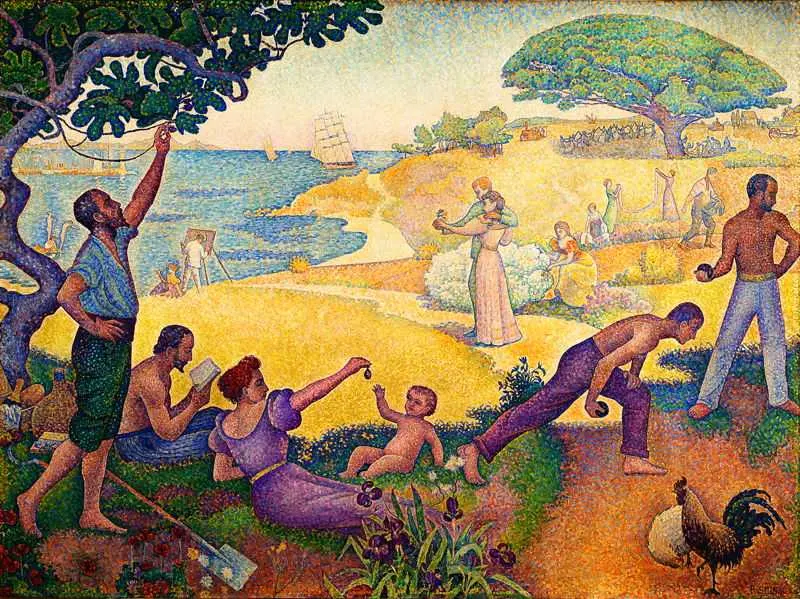
Pointillism is a painting method where artists apply small, distinct dots of color to a canvas rather than mixing pigments on a palette. Signac and his contemporary, Georges Seurat, developed this style in the mid-1880s based on the scientific color theories of Michel Eugène Chevreul. The goal was to achieve maximum luminosity by allowing the viewer’s eye to optically blend the colors from a distance.
To master this technique, artists must follow a systematic approach to color placement:
- Select complementary colors to place side-by-side to increase vibrancy.
- Use a white or light-colored ground to ensure the colors remain bright.
- Vary the size of the dots to create depth and texture within the composition.
By avoiding physical color mixing, Signac ensured that the light reflected off the canvas remained pure. This rigorous, almost mathematical approach moved painting away from the spontaneous brushwork of traditional Impressionism toward a more calculated, structural aesthetic.
How did Signac influence modern art?
Signac played a crucial role in transitioning art from the 19th-century focus on realism to the expressive color palettes of the 20th century. After Seurat’s early death in 1891, Signac became the primary theorist and leader of the Neo-Impressionist movement. His book, From Eugène Delacroix to Neo-Impressionism, published in 1899, served as a foundational manifesto for the movement, explaining how color could be used to evoke specific emotional responses.
His influence extended to the next generation of painters, most notably Henri Matisse and André Derain. By encouraging these younger artists to use bold, non-naturalistic colors, Signac helped pave the way for Fauvism. His legacy is defined by:
- The liberation of color from its descriptive, realistic function.
- The promotion of scientific rigor in the creative process.
- The establishment of a new visual language that prioritized harmony and rhythm.
What are his most famous paintings?
Signac’s body of work is extensive, but certain pieces stand out for their technical mastery and vibrant use of light. Many of his most celebrated paintings depict harbors, boats, and coastal scenes, reflecting his lifelong passion for sailing. He traveled extensively along the French Mediterranean coast, which provided him with the intense sunlight necessary to experiment with his signature dotting technique.
Key works that define his career include:
- The Papal Palace, Avignon (1900): A brilliant example of his mature style, featuring mosaic-like squares of color.
- The Port of Saint-Tropez (1893): This work captures the shimmering water and harbor life that became a recurring theme in his portfolio.
- Portrait of Félix Fénéon (1890): A striking, stylized portrait that demonstrates his ability to apply scientific theories to human subjects.
These works demonstrate his evolution from the tight, tiny dots of his early years to the larger, bolder "tesserae" or mosaic-like blocks of his later period.
Common mistakes when painting in his style
Aspiring artists often struggle when attempting to replicate Signac’s technique because they misunderstand the relationship between color and distance. A frequent error is applying dots that are too uniform in size or color, which results in a flat, static image rather than one that vibrates with light. Another common mistake is failing to consider the "optical mixture" effect, where colors look muddy instead of luminous because the pigments were not chosen based on their complementary properties.
To avoid these pitfalls, keep these guidelines in mind:
- Do not use black to darken colors; instead, use the complementary color of the hue you wish to shade.
- Maintain consistent spacing between dots to ensure the eye can successfully perform the optical blend.
- Work from the background to the foreground to establish the correct light values before adding detail.
Patience is essential, as the Pointillist process is significantly more time-consuming than traditional alla prima painting methods.
Why did he focus on maritime subjects?
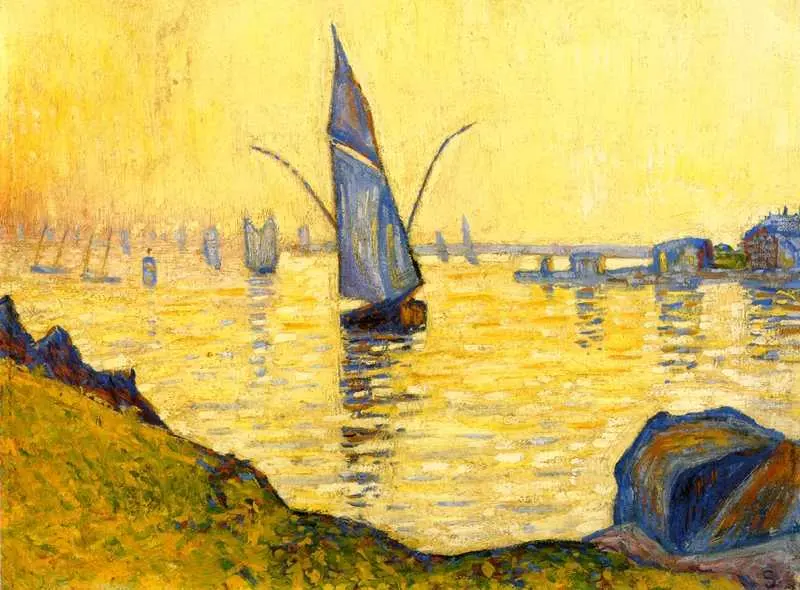
Signac’s obsession with the sea was both a personal passion and a professional aesthetic choice. He owned over thirty boats during his lifetime and spent much of his time sailing, which allowed him to observe the complex, changing light on the water. For Signac, the sea was the perfect subject to explore the refraction of light, as the surface of the water acts as a natural mirror for the sky.
His maritime paintings allowed him to push the boundaries of his technique, using color to convey the movement of waves and the heat of the Mediterranean sun. By focusing on ports like Saint-Tropez, Marseille, and La Rochelle, he could contrast the rigid, man-made structures of ships and piers with the fluid, shimmering nature of the ocean. This thematic consistency allowed him to refine his color theories over several decades, ultimately creating a cohesive body of work that remains a high point in the history of French landscape painting.
Key facts
- Paul Signac (1863–1935) was a French Neo-Impressionist painter who helped develop the Pointillist technique alongside Georges Seurat.
- He favored the application of small, distinct dots of pure color that blend in the viewer's eye, a process known as optical mixing.
- Signac moved away from Seurat’s rigid, scientific dots toward larger, mosaic-like squares of pigment, which he called "tesserae."
- He served as the president of the Société des Artistes Indépendants from 1908 until 1934, significantly influencing the trajectory of modern art.
- His most famous works often feature vibrant harbor scenes, such as The Papal Palace, Avignon (1900) and The Port of Saint-Tropez (1893).
- To practice his style, avoid blending paint directly on the palette; instead, place unmixed colors side-by-side on the canvas to maintain luminosity.
The bottom line
Paul Signac remains a pivotal figure in art history for his mastery of color theory and his role in advancing Neo-Impressionism. By shifting from minute dots to bold, mosaic-like brushstrokes, he transformed the way artists approached light and luminosity. His dedication to the Société des Artistes Indépendants and his theoretical writings ensured that his innovative, scientific approach to painting left an enduring legacy on modern art.
People also ask
How did Signac’s style differ from Georges Seurat’s?
While Seurat used tiny, precise dots to create a tight, scientific appearance, Signac eventually adopted larger, rectangular brushstrokes. This evolution gave his later works a more rhythmic, mosaic-like quality that felt less rigid than Seurat’s early experiments.
What was the primary goal of Neo-Impressionism?
The movement aimed to replace the intuitive, spontaneous brushwork of Impressionism with a systematic, color-theory-based approach. Artists sought to achieve maximum brilliance and light intensity by applying complementary colors in specific, calculated patterns.
Did Signac write about his artistic theories?
Yes, he authored the influential essay From Eugène Delacroix to Neo-Impressionism in 1899. This text served as a manifesto for the movement, explaining the scientific principles behind color harmony and optical contrast.
What subjects did Signac paint most frequently?
He was captivated by the sea and spent much of his life traveling along the French coast. Harbor scenes, sailboats, and coastal towns provided him with the ideal light and water reflections to showcase his vibrant color palettes.
How did Signac influence later generations of artists?
His bold use of non-naturalistic color and structured composition paved the way for Fauvism and abstract art. Henri Matisse, in particular, was heavily influenced by Signac’s techniques after visiting him in Saint-Tropez in 1904.
Was Signac involved in politics?
Signac was a committed anarchist throughout his life and believed that art should be free from state control. He often supported fellow artists who were rejected by the official government-sponsored art salons of the time.
This answer was created with the help of AI research tools and reference sources. Spotted an error? Let us know — we correct mistakes quickly. See our editorial policy.