What is Frida Kahlo known for?
Short answer
Frida Kahlo is globally celebrated for her uncompromising, surrealist-influenced self-portraits that explore identity, physical pain, and Mexican heritage. Her work, characterized by vibrant colors and symbolic imagery, challenged traditional gender roles and artistic conventions. Beyond her canvas, she remains a powerful cultural icon representing resilience, feminism, and the intersection of personal trauma.
On this page
Why is Frida Kahlo famous?
Frida Kahlo’s fame stems from her ability to translate intense emotional and physical suffering into visceral, highly personal art. Born in 1907 in Coyoacán, Mexico, she lived a life marked by medical challenges, including childhood polio and a catastrophic bus accident at age 18. These events left her with lifelong chronic pain and required over 30 surgeries, forcing her to spend long periods bedridden. She famously remarked, "I paint my own reality," using her canvases to document her internal world rather than adhering to the objective realism popular in her era.
Her work is deeply rooted in Mexicanidad, a cultural movement that sought to reclaim indigenous Mexican identity following the Mexican Revolution. She often incorporated pre-Columbian artifacts, traditional Tehuana costumes, and local flora and fauna into her compositions. By blending these cultural markers with surrealist elements—such as floating objects or anatomical distortions—she created a unique visual language. Her legacy has grown significantly since her death in 1954, transforming her from a regional painter into a global symbol of resilience and feminist empowerment.
What are Frida Kahlo’s most famous paintings?
Kahlo produced approximately 143 paintings, with over a third being self-portraits. Her technique combined meticulous detail with bold, symbolic color palettes that reflected her moods and experiences. Her most recognizable works often feature her own likeness, reflecting her deep introspection and the isolation she frequently endured.
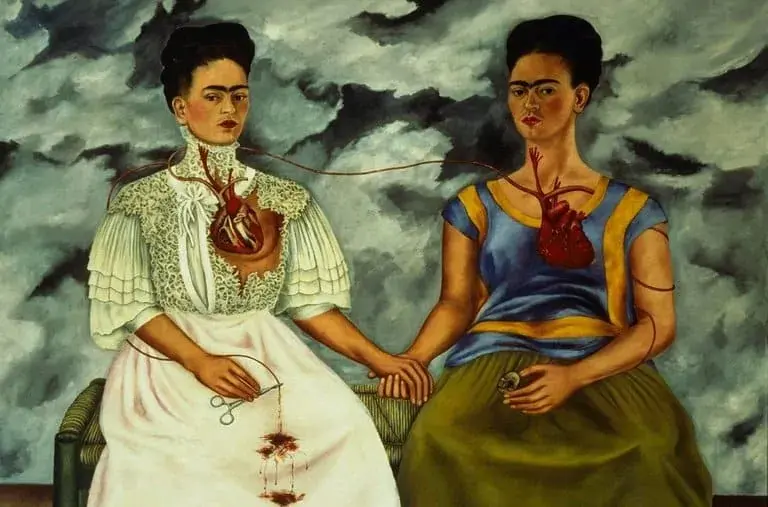
- The Two Fridas (1939): A monumental double self-portrait painted after her divorce from Diego Rivera, depicting her dual heritage and fractured heart.
- The Broken Column (1944): A stark portrayal of her physical agony, showing her torso split open to reveal a crumbling Ionic column held together by straps.
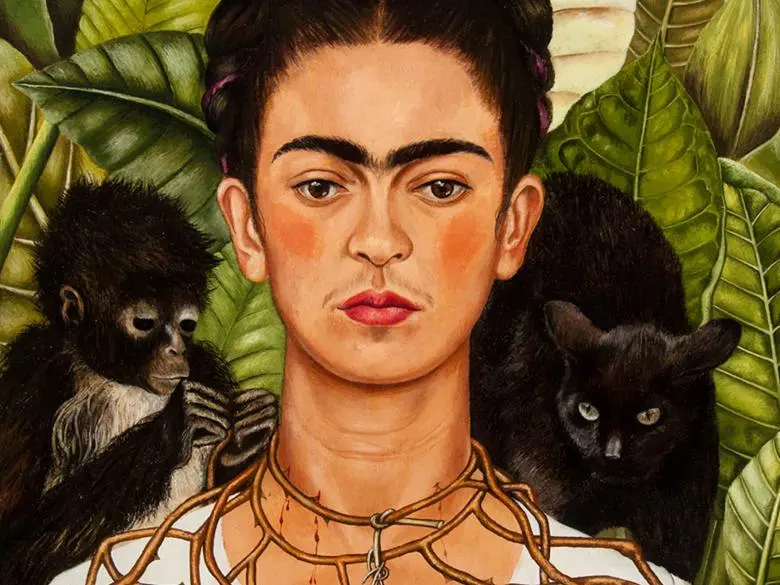
- Self-Portrait with Thorn Necklace and Hummingbird (1940): A complex piece featuring religious and indigenous symbolism, highlighting her endurance through suffering.
- Henry Ford Hospital (1932): A raw, unflinching depiction of her miscarriage, which broke taboos regarding the representation of female reproductive trauma.
These works are held in prestigious collections worldwide, including the Museo Dolores Olmedo and the Museo Frida Kahlo, also known as La Casa Azul, where she was born and died.
How to appreciate Frida Kahlo’s art
To truly understand Kahlo’s work, you must look beyond the aesthetic beauty of her portraits and consider the context of her life. Her paintings are not merely depictions of her face; they are visual diaries that document her turbulent marriage to muralist Diego Rivera, her political activism, and her struggles with infertility. When viewing her art, focus on the specific symbols she employs. For instance, monkeys often represent her pets, while thorns and blood symbolize the pain she felt from her injuries and her failed pregnancies.
If you are new to her work, follow these steps to deepen your engagement:
- Research the specific period of her life during which a painting was created to understand the emotional context.
- Identify the traditional Mexican elements she includes, such as the Tehuana dress, which she wore to express her political identity and assert her independence.
- Contrast her surrealist elements with her realistic facial expressions to see how she balances internal chaos with outward composure.
- Visit a digital archive or museum gallery to view the high-resolution details of her brushwork and color choices.
Common mistakes when interpreting Frida Kahlo
A frequent error is labeling Kahlo strictly as a "Surrealist." While André Breton, the founder of the Surrealist movement, famously applied this label to her, Kahlo rejected it. She insisted that her work was not about dreams or the subconscious, but rather a literal, albeit symbolic, representation of her lived experience. Dismissing her work as "dreamlike" ignores the harsh, clinical reality of the medical trauma she endured.
Another mistake is focusing exclusively on her relationship with Diego Rivera. While their marriage was undeniably central to her life, viewing her art solely through the lens of her husband’s influence diminishes her individual genius and technical skill. She was a sophisticated artist who engaged with global art movements while maintaining a distinct, independent voice. Finally, avoid romanticizing her pain. While her resilience is inspiring, her art was a survival mechanism for a woman in constant, agonizing physical distress. Treating her suffering as a mere stylistic choice ignores the profound human struggle that defined her existence.
What is the legacy of Frida Kahlo?
Today, Kahlo is a fixture in popular culture, appearing on everything from postage stamps to high-fashion runways. Her image, characterized by her signature unibrow and floral headpieces, has become a shorthand for artistic authenticity and nonconformity. This commodification has sparked debate about the balance between celebrating her as a feminist icon and maintaining the integrity of her complex, often painful, artistic output. Despite this, her influence on contemporary art remains undeniable.
Her legacy continues to evolve through the lens of modern identity politics. Scholars and activists frequently cite her as a pioneer who broke silences regarding female anatomy, disability, and sexual fluidity. By unapologetically presenting her body as a site of both power and vulnerability, she paved the way for future generations of artists to explore the politics of the body. Ultimately, her work endures because it speaks to the universal human experience of navigating suffering and reclaiming one's identity in the face of immense adversity.
Key facts
- Frida Kahlo was a Mexican painter born in 1907, best known for her uncompromising and brilliantly colored self-portraits.
- She created approximately 143 paintings during her lifetime, with 55 of them being self-portraits that explored themes of identity, pain, and the human body.
- A near-fatal bus accident at age 18 left her with lifelong physical disabilities, which became a central subject of her artistic work.
- She was married to the famous muralist Diego Rivera; their tumultuous relationship, marked by infidelity and divorce, deeply influenced her emotional expression.
- Kahlo is widely celebrated as an icon of feminist, LGBTQ+, and Chicano movements for her defiance of traditional beauty standards and gender roles.
- Her former home in Mexico City, known as La Casa Azul (The Blue House), is now a popular museum dedicated to her life and work.
The bottom line
Frida Kahlo is remembered as a transformative figure whose art turned personal suffering into a profound exploration of identity and culture. By blending traditional Mexican aesthetics with raw, autobiographical vulnerability, she challenged societal norms and redefined the self-portrait. Today, she remains a powerful symbol of resilience, celebrated not only for her technical skill but for her unwavering courage in documenting the complexities of the human experience.
People also ask
Why is Frida Kahlo's art considered surrealist?
While Kahlo often rejected the label, her work is frequently grouped with Surrealism because it blends realistic imagery with dreamlike, symbolic, and psychological elements. She famously stated that she never painted dreams, but rather her own reality.
What techniques did Frida Kahlo use in her paintings?
She primarily used oil paints on small canvases, often incorporating metal sheets or masonite boards. Her style is characterized by precise, detailed brushwork influenced by Mexican folk art, religious retablo paintings, and European Renaissance portraiture.
How did her physical pain affect her art?
Her chronic pain, resulting from multiple surgeries and spinal issues, is depicted through raw, visceral imagery. She often painted herself wearing orthopedic corsets or surrounded by medical symbols to externalize her internal suffering.
What is the significance of her traditional Mexican clothing?
Kahlo wore Tehuana dresses, which are traditional garments from the Isthmus of Tehuantepec region. This choice served as a political statement of Mexican identity, a way to hide her physical injuries, and a tribute to the matriarchal culture of that region.
Did Frida Kahlo achieve fame during her lifetime?
She gained significant recognition in the 1930s and 1940s, exhibiting her work in New York, Paris, and Mexico City. However, she did not reach the global, iconic status she holds today until the feminist art movement of the 1970s brought her work back into the spotlight.
What are some of her most famous paintings?
Her most renowned works include "The Two Fridas," which explores her dual heritage and emotional heartbreak, and "The Broken Column," a stark representation of her physical trauma. Both pieces are essential for understanding her unique visual language.
This answer was created with the help of AI research tools and reference sources. Spotted an error? Let us know — we correct mistakes quickly. See our editorial policy.