What is Caspar David Friedrich known for?
Short answer
Caspar David Friedrich is the preeminent German Romantic landscape painter, celebrated for his evocative, spiritual depictions of nature. He is best known for his "Rückenfigur" technique, where solitary figures face vast, sublime landscapes. His work emphasizes themes of human insignificance, melancholy, and the divine presence within the natural world.
On this page
Why is Caspar David Friedrich famous?
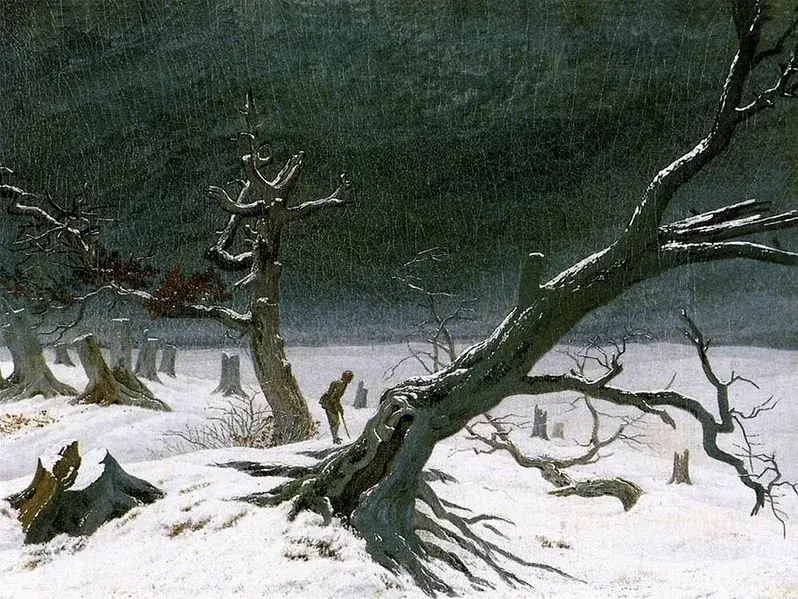
Caspar David Friedrich, born in 1774, transformed landscape painting from a mere backdrop into a profound vehicle for religious and psychological introspection. Unlike his contemporaries who focused on classical ruins or idealized pastoral scenes, Friedrich sought to capture the "inner life" of the viewer through the vastness of the German countryside. He believed that an artist should paint not just what they see before them, but what they see within themselves.
His fame rests on his ability to evoke a sense of the sublime—a feeling of awe mixed with terror when confronting the infinite power of nature. By utilizing muted palettes, atmospheric lighting, and precise detail, he created scenes that felt both grounded in reality and deeply mystical. His work remains a cornerstone of 19th-century art history because it shifted the focus of landscape art from objective documentation to subjective emotional expression.
What are his most famous paintings?
Friedrich’s portfolio contains several iconic images that define the Romantic movement. These works often feature stark compositions that force the viewer to contemplate their place in the universe. His most celebrated pieces include:
- Wanderer above the Sea of Fog (1818): A man stands atop a jagged precipice, gazing out over a swirling, mist-covered mountain range.
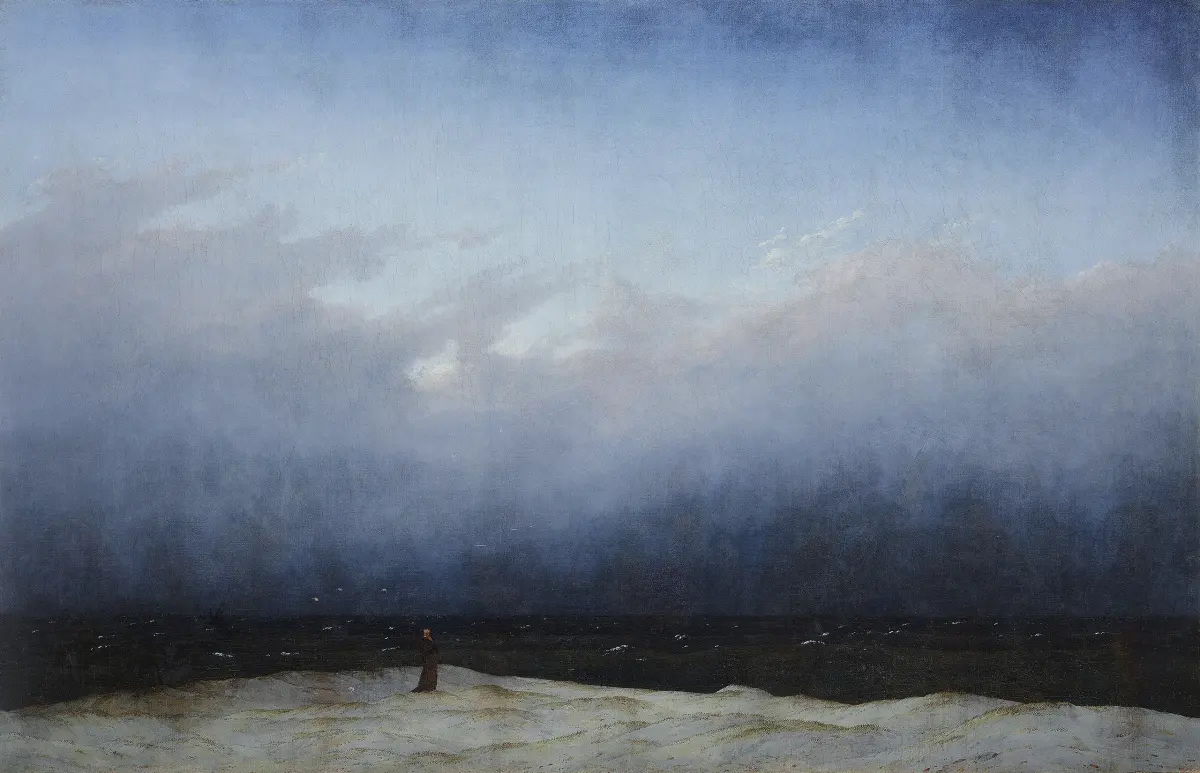
- The Monk by the Sea (1808–1810): A tiny, dark figure stands on a thin strip of shore against a massive, dark sky and ocean.
- The Sea of Ice (1823–1824): A dramatic depiction of a shipwreck crushed by massive, jagged shards of ice.
- Cross in the Mountains (1808): An altarpiece featuring a crucifix atop a mountain peak, bathed in the light of the setting sun.
These paintings are characterized by their stillness and silence. They do not depict action; instead, they invite the viewer to stand alongside the subject and participate in a quiet, meditative experience.
How to identify a Caspar David Friedrich painting?
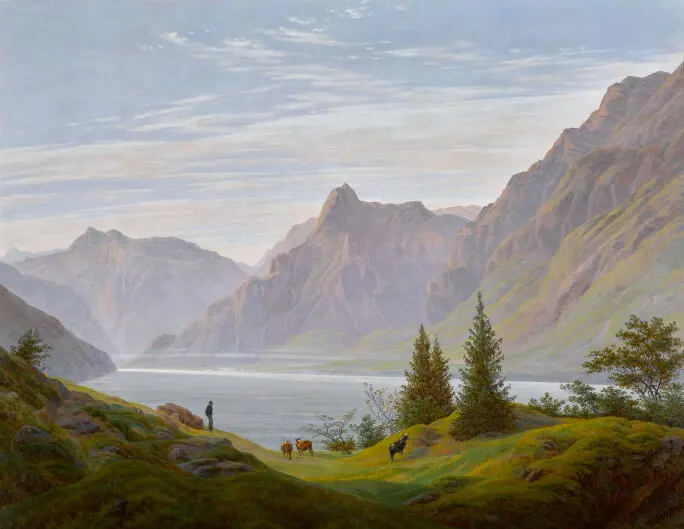
To recognize a Friedrich work, look for specific stylistic markers that he refined throughout his career. He frequently employed the "Rückenfigur," a compositional device where a figure is shown from behind, looking into the landscape. This allows the viewer to identify with the figure and adopt their perspective, effectively placing the viewer inside the painting.
When analyzing his compositions, observe these key elements:
- Low horizons: He often placed the horizon line very low to emphasize the vastness of the sky.
- Symbolic light: He used light—specifically dawn, dusk, or moonlight—to represent spiritual transition or hope.
- Minimalist human presence: Humans are almost always small, solitary, and overwhelmed by the scale of their environment.
- Muted colors: His palette typically relies on deep blues, grays, and browns to create a somber, reflective mood.
By focusing on these structural choices, you can distinguish his work from the more vibrant, dramatic landscapes of his peers.
Common mistakes when interpreting his art
A frequent error is viewing Friedrich’s landscapes as simple nature studies. While he sketched extensively outdoors, his final canvases were carefully constructed studio compositions designed to convey specific philosophical or religious messages. He often combined elements from different locations into a single, idealized scene to achieve a desired emotional effect.
Another mistake is misinterpreting his work as purely pessimistic. While his paintings often deal with death, loneliness, and the passage of time, they are also deeply rooted in Christian theology and the hope for salvation. For instance, the cross in his landscapes is rarely a sign of despair; rather, it serves as a beacon of faith amidst the overwhelming indifference of the physical world. Understanding this duality is essential for grasping the true intent behind his somber, quiet scenes.
How to appreciate his work today
To fully appreciate Friedrich, one must approach his paintings with patience. These are not works that reveal themselves at a glance; they require the viewer to slow down and engage with the silence of the canvas. Many of his works are held in German museums, such as the Hamburger Kunsthalle and the Alte Nationalgalerie in Berlin, where they are displayed to encourage quiet contemplation.
If you are visiting a gallery to view his work, follow these steps:
- Stand at a distance first to take in the overall scale and atmospheric effect of the landscape.
- Move closer to examine the minute details of the rock formations, trees, or distant ships.
- Focus on the figure in the foreground and imagine yourself standing in their exact position.
- Consider the time of day depicted and how the light influences the emotional tone of the scene.
By following this approach, you will better understand why Friedrich’s work continues to resonate with modern audiences who seek meaning in the natural world.
Key facts
- Caspar David Friedrich (1774–1840) was the leading figure of German Romantic landscape painting.
- He is best known for the "Rückenfigur," a technique where a figure is depicted from behind, looking out into a vast landscape.
- His most iconic work, Wanderer above the Sea of Fog (1818), symbolizes the Romantic ideal of the solitary individual confronting the sublime.
- Friedrich often infused his landscapes with religious or existential symbolism, using elements like ruins, crosses, and dead trees to represent mortality.
- He spent most of his professional life in Dresden, where he became a central figure in the city's artistic circle.
- To appreciate his work, look for the contrast between the small, human scale of his subjects and the immense, awe-inspiring power of nature.
The bottom line
Caspar David Friedrich transformed landscape painting into a medium for profound philosophical reflection. By placing solitary figures against vast, atmospheric backdrops, he captured the essence of the human condition and the awe-inspiring power of nature. His work invites viewers to look beyond the physical world, finding spiritual depth in the quiet, melancholic beauty of the German landscape. He remains a defining voice of Romanticism.
People also ask
Why are there so many ruins in his paintings?
Friedrich used ruins, particularly Gothic architecture, to represent the passage of time and the decline of human institutions compared to the eternal nature of the divine. These structures often serve as a bridge between the earthly world and the spiritual realm.
Did he paint from life or from his imagination?
While he made detailed sketches of nature during his travels, he composed his final paintings in the studio. He synthesized these observations into idealized landscapes that prioritized emotional and spiritual resonance over strict topographical accuracy.
What is the significance of the "sublime" in his art?
The sublime refers to the feeling of overwhelming awe mixed with terror when facing nature's vastness. Friedrich aimed to evoke this sensation to remind viewers of their smallness in the universe and the presence of a higher power.
Why did his popularity decline during his lifetime?
By the 1830s, the art world shifted toward more realistic and social-themed subjects. Friedrich’s introspective, melancholic style fell out of favor, and he lived his final years in relative obscurity and financial hardship.
Where can I see his original paintings today?
His works are held in major international collections, with the largest holdings located in Germany. The Staatliche Kunstsammlungen in Dresden and the Alte Nationalgalerie in Berlin are the most significant repositories for his masterpieces.
How should a beginner analyze a Friedrich painting?
Start by identifying the focal point, usually the solitary figure or a central symbol like a cross. Then, observe the light and color transitions, which often move from dark, earthly foregrounds to luminous, infinite horizons representing hope or eternity.
This answer was created with the help of AI research tools and reference sources. Spotted an error? Let us know — we correct mistakes quickly. See our editorial policy.