What is Joan Miró known for?
Short answer
Joan Miró was a Spanish Catalan painter, sculptor, and ceramicist known for his pioneering role in Surrealism. He is celebrated for his whimsical, abstract style characterized by vibrant colors, biomorphic shapes, and celestial motifs. His work often explored the subconscious mind, blending childlike spontaneity with sophisticated technical mastery of various artistic media.
On this page
What defines Joan Miró’s artistic style?
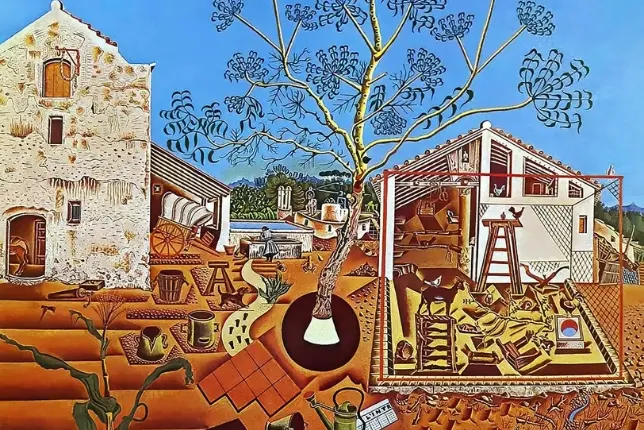
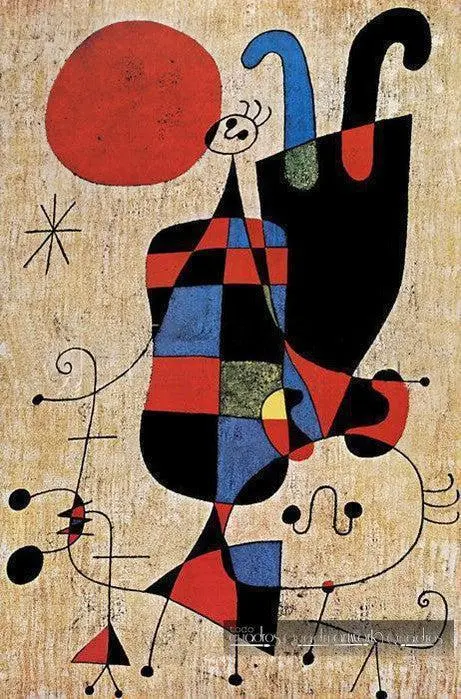
Miró’s work is instantly recognizable for its "pictographic" language, which features simplified, floating forms that resemble amoebas, stars, eyes, and ladders. He rejected traditional painting techniques in favor of what he called the "assassination of painting," seeking to liberate art from the constraints of realism and bourgeois expectations. His palette was typically limited to primary colors—red, blue, yellow—set against stark black, white, or earthy backgrounds, creating a sense of rhythmic energy.
His process was deeply rooted in automatism, a technique favored by Surrealists to bypass the conscious mind and tap into raw, unfiltered creativity. By allowing his hand to move freely across the canvas, he produced fluid, organic shapes that feel both alien and intimate. This approach allowed him to bridge the gap between the physical world and the dreamscape, resulting in compositions that feel like visual poetry rather than literal representations of reality.
How to identify a Joan Miró painting
If you are looking at a work by Miró, you will often find a balance between chaotic energy and meticulous composition. He frequently used thick, bold black lines to anchor his floating figures, providing structure to otherwise ethereal scenes. His works often feel light and airy, yet they are underpinned by a rigorous understanding of space and balance that prevents them from feeling cluttered or aimless.
When examining his paintings, look for these specific characteristics:
- Biomorphic forms that suggest animals, plants, or human anatomy.
- Celestial elements such as crescent moons, suns, and constellations.
- A sense of "floating" where figures are not grounded by a horizon line.
- The frequent use of handprints or bold, calligraphic marks.
- A playful, almost musical arrangement of shapes that suggests movement.
Why Miró shifted to sculpture and ceramics
While he is most famous for his canvases, Miró spent the latter half of his career experimenting with three-dimensional media. He believed that traditional art had become too elitist, and he wanted his work to inhabit public spaces where it could be experienced by everyone. By turning to bronze, clay, and found objects, he brought his surreal, dreamlike creatures into the physical world, giving them weight and presence.
His transition into sculpture followed a specific progression of creative exploration:
- Collecting found objects on beaches, such as stones, shells, and driftwood.
- Casting these natural forms in bronze to preserve their organic texture.
- Painting the sculptures in bright, primary colors to maintain his signature aesthetic.
- Installing these works in public plazas to interact directly with the urban environment.
This shift demonstrated his versatility and his commitment to breaking down the barriers between the artist, the art object, and the public audience.
Common mistakes when interpreting Miró’s work
A frequent error viewers make is attempting to find a literal narrative or a specific "hidden message" in Miró’s paintings. Because his work is based on the subconscious, it is not meant to be decoded like a riddle or a map. Treating his paintings as puzzles to be solved often leads to frustration, as the artist intentionally avoided fixed meanings to keep the work open to individual interpretation.
Another mistake is assuming that his childlike style reflects a lack of technical skill. In reality, Miró was a highly trained artist who spent years studying classical techniques before choosing to abandon them. His simplicity was a hard-won achievement, a deliberate reduction of form that required immense discipline to execute effectively. When viewing his work, it is better to focus on the emotional response it evokes rather than searching for an intellectual explanation that does not exist.
How to appreciate his legacy today
Miró’s influence is visible in modern graphic design, abstract expressionism, and even children’s book illustration. His ability to distill complex emotions into simple, iconic shapes changed the way we think about visual communication. To appreciate his legacy, one should visit the Fundació Joan Miró in Barcelona, which houses the largest collection of his work and provides a comprehensive look at his evolution from early realism to his final, expansive abstract style.
To better understand his impact, consider these steps:
- Visit a museum to see the physical scale of his large-format murals.
- Compare his early, detailed landscapes with his later, minimalist works.
- Observe how his use of color influences the mood of a room or space.
- Read his personal letters to understand his philosophy on artistic freedom.
- Research how his Catalan heritage influenced his connection to the natural landscape.
By engaging with his work on these levels, you gain a deeper appreciation for an artist who remained profoundly curious and experimental until his death in 1983.
Key facts
- Joan Miró was a Spanish painter, sculptor, and ceramicist born in Barcelona in 1893 who became a leading figure of the Surrealist movement.
- His signature style features a limited palette of primary colors—red, blue, yellow—combined with black, white, and organic, biomorphic shapes.
- Miró famously declared his intent to "assassinate painting" by rejecting traditional techniques in favor of spontaneous, subconscious expression.
- He created over 2,000 paintings, 500 sculptures, and 400 ceramics throughout his prolific career, which spanned more than seven decades.
- When viewing his work, look for recurring symbols such as stars, birds, eyes, and ladders, which represent his connection to the cosmos and the earth.
- To appreciate his art, avoid looking for realistic depictions; instead, focus on the rhythmic flow of his lines and the emotional impact of his color arrangements.
The bottom line
Joan Miró remains one of the most influential artists of the 20th century, celebrated for his whimsical, abstract visual language. By blending subconscious impulses with meticulous craftsmanship, he transformed modern art. Whether through his vibrant paintings or monumental sculptures, Miró invited viewers to explore a dreamlike universe. His legacy serves as a testament to the power of imagination and the liberation of artistic expression from reality.
People also ask
Was Joan Miró a surrealist?
Yes, he was a pivotal member of the Surrealist group in Paris during the 1920s. His practice of "automatic drawing"—creating art without conscious control—aligned perfectly with the movement's goal of tapping into the unconscious mind.
What are the most famous paintings by Joan Miró?
His most iconic works include The Hunter (Catalan Landscape) from 1924, The Tilled Field from 1923, and the large-scale Constellations series created between 1940 and 1941. These pieces showcase his transition from detailed realism to his mature, abstract symbolic language.
Did Miró create public art?
He was a major proponent of public art and believed it should be accessible to everyone. Famous examples include the large ceramic mural at the UNESCO building in Paris and the Woman and Bird sculpture located in Barcelona’s Parc de Joan Miró.
How did the Spanish Civil War affect his work?
The conflict deeply disturbed Miró, leading to a period of somber, intense expression in his art. Works from this time, such as Aidez l'Espagne (Help Spain), demonstrate his political engagement and the psychological toll of the war on his creative output.
What materials did Miró use besides oil paint?
Miró was highly experimental and worked with bronze, terracotta, tapestry, and collage. He often incorporated found objects into his sculptures, blurring the line between traditional fine art and everyday materials.
Where can I see his art today?
The Fundació Joan Miró in Barcelona houses the largest collection of his work, established by the artist himself. Other significant holdings are located at the Museum of Modern Art in New York and the Centre Pompidou in Paris.
This answer was created with the help of AI research tools and reference sources. Spotted an error? Let us know — we correct mistakes quickly. See our editorial policy.