What is a rainbow made of?
Short answer
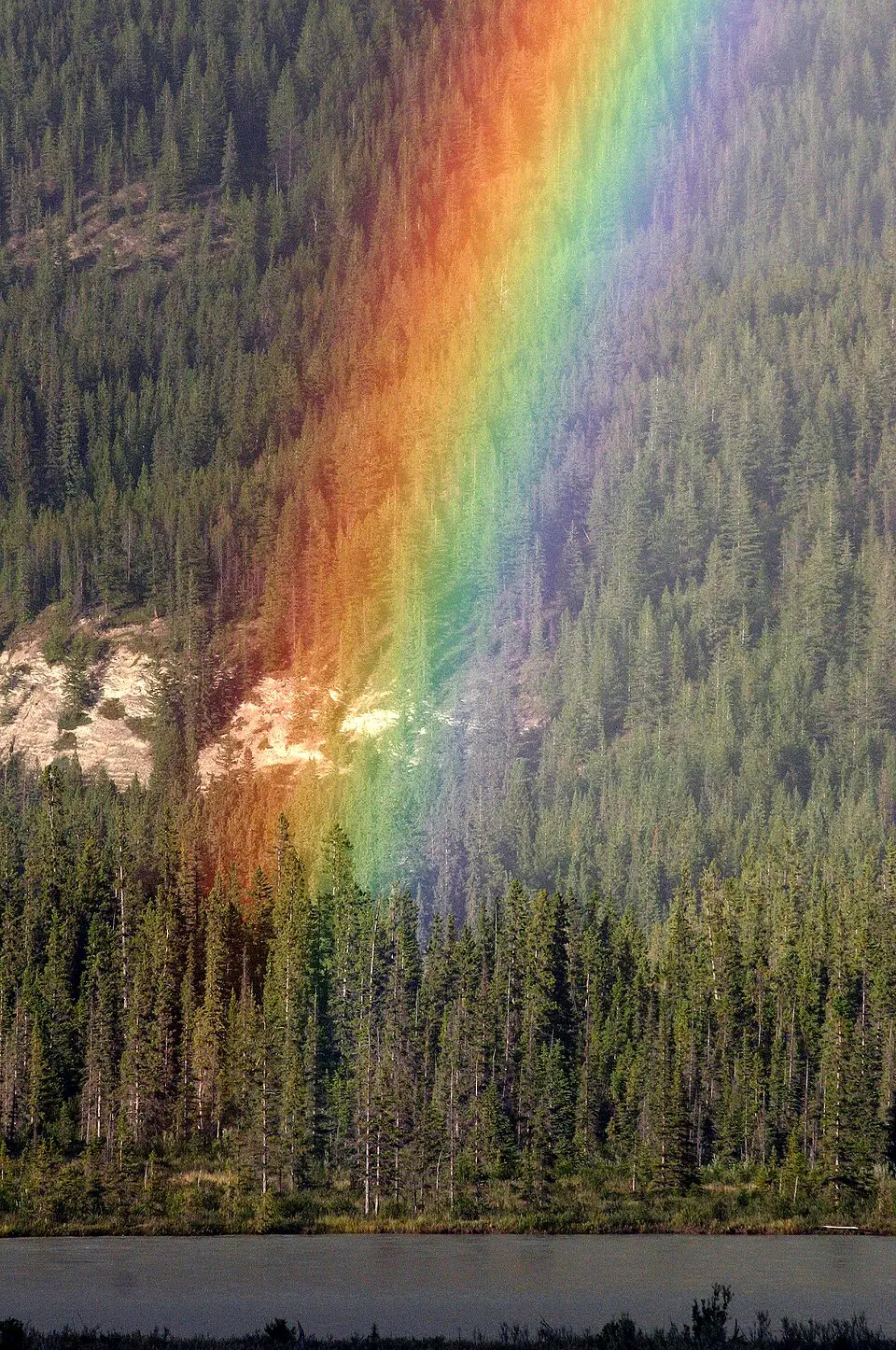
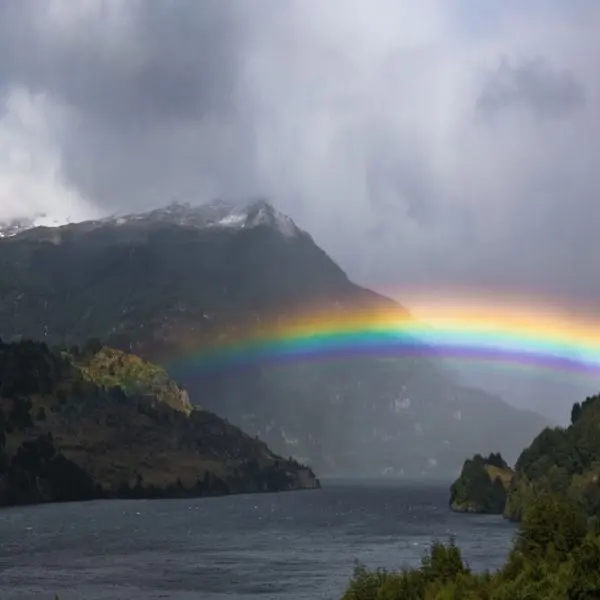
A rainbow is an optical phenomenon made of sunlight interacting with water droplets. It is not a physical object but a spectrum of light separated into its component colors: red, orange, yellow, green, blue, indigo, and violet. These colors appear when light refracts, reflects, and disperses inside millions of suspended raindrops.
On this page
Why a rainbow happens
A rainbow occurs when sunlight enters a spherical raindrop and undergoes a series of physical changes. As light enters the drop, it slows down and bends, a process known as refraction. Because different colors of light travel at slightly different wavelengths, they bend at different angles, causing the white light to separate into the visible spectrum. This separation is called dispersion.
Once the light hits the back of the raindrop, it reflects off the inner surface like a mirror. As the light exits the drop, it refracts again, further spreading the colors. To see this effect, the sun must be behind you, and the rain must be in front of you. The light exits the droplets at specific angles, typically 40 to 42 degrees, which is why rainbows appear as circular arcs rather than straight lines.
What colors are in a rainbow
The visible spectrum of a rainbow is traditionally divided into seven distinct colors, a convention popularized by Sir Isaac Newton in the 17th century. While the human eye perceives these as separate bands, the transition between them is actually a continuous gradient. The specific order of these colors is determined by their unique wavelengths, with red having the longest and violet having the shortest.
- Red: Longest wavelength, appears on the outer edge of the arc.
- Orange: A blend of red and yellow light.
- Yellow: A primary color in the additive light spectrum.
- Green: The central color of the visible light spectrum.
- Blue: Shorter wavelength, sits toward the inner side.
- Indigo: A deep blue-violet hue.
- Violet: Shortest wavelength, appears on the innermost edge.
How to see a rainbow
Finding a rainbow requires specific atmospheric conditions and a precise orientation relative to the sun. You must be positioned between the sun and the rain, with the sun at a low angle in the sky. If the sun is too high, the rainbow will be below your horizon, making it impossible to see unless you are at a high altitude, such as on a mountain or in an airplane.
- Locate the sun and ensure it is behind your back.
- Look toward a region of the sky where rain is falling or mist is present.
- Keep your gaze directed at the antisolar point, the exact spot opposite the sun.
- Scan the area at an angle of approximately 42 degrees from the antisolar point.
- Use polarized sunglasses if you want to see the colors more clearly, as they can reduce glare from the water droplets.
Common mistakes when viewing rainbows
Many observers fail to see a rainbow because they look in the wrong direction or expect the phenomenon to appear as a solid, tangible object. A common error is looking toward the sun, which makes it impossible to see the arc. Additionally, people often expect to see a full circle, but the ground usually obstructs the bottom half of the arc.
Another mistake is assuming that every raindrop contributes to the rainbow you see. In reality, each observer sees their own unique rainbow based on their specific position relative to the light source. If you move, the rainbow moves with you because the light is reflecting off a different set of droplets. Avoid looking for rainbows during midday when the sun is at its peak, as the geometry rarely aligns to create a visible arc.
How to make a rainbow at home
You can replicate the physics of a rainbow using a simple garden hose or a spray bottle. This experiment demonstrates how light disperses through water droplets in a controlled environment. By creating a fine mist, you simulate the conditions of a rain shower, allowing you to observe the refraction and reflection of sunlight on a much smaller, more accessible scale.
- Use a garden hose with a nozzle set to the "mist" or "fog" setting.
- Stand with your back to the sun on a clear, bright day.
- Spray the mist into the air in front of you.
- Adjust the angle of the spray until the colors become visible within the mist.
- Observe how the colors shift as you move the spray nozzle or change your own position.
- Avoid spraying water toward electrical outlets or windows to ensure safety while conducting this optical experiment.
Key facts
- A rainbow is not a physical object but an optical illusion created by light interacting with water droplets.
- Sunlight is composed of a spectrum of colors, each with a different wavelength, ranging from red at approximately 700 nanometers to violet at 400 nanometers.
- To see a rainbow, the sun must be behind you and the rain must be in front of you at an angle of about 42 degrees.
- The colors appear in a specific order—red, orange, yellow, green, blue, indigo, and violet—due to the varying degrees of refraction.
- You can create a miniature rainbow using a garden hose by spraying a fine mist of water with your back to the sun.
- Rainbows are actually full circles, but the ground usually obstructs the bottom half from the perspective of an observer.
The bottom line
Rainbows are beautiful manifestations of physics, occurring when sunlight enters millions of suspended water droplets and undergoes refraction, reflection, and dispersion. By separating white light into its constituent wavelengths, nature creates a vibrant spectrum visible only at specific angles. Understanding that these arcs are personal, moving optical illusions helps clarify why they remain elusive, yet consistently predictable, features of our natural world after a rainstorm.
People also ask
Why do rainbows have a specific color order?
Light bends, or refracts, as it enters a water droplet and reflects off the back. Because shorter wavelengths like violet bend more than longer wavelengths like red, the light separates into its component colors in a consistent sequence.
Can you ever reach the end of a rainbow?
No, you cannot reach the end of a rainbow because it is an optical phenomenon that depends entirely on your specific position relative to the light source. As you move, the rainbow moves with you, maintaining its distance from your line of sight.
What is a double rainbow?
A double rainbow occurs when light reflects twice inside the water droplets before exiting. This secondary arc is fainter and features the colors in reverse order, with red on the inside and violet on the outside.
Can rainbows appear at night?
Yes, lunar rainbows or "moonbows" can occur when moonlight is bright enough to be refracted by water droplets. They are typically much fainter than solar rainbows and often appear white to the human eye because moonlight is less intense.
Why do rainbows sometimes look like just a single color?
Atmospheric conditions, such as the presence of dust or the specific angle of the sun at sunset, can filter out certain wavelengths. This results in a monochromatic rainbow, where the shorter blue and violet wavelengths are scattered away, leaving only the red spectrum.
Is there a way to photograph a rainbow clearly?
To capture a sharp image, use a polarizing filter on your camera lens to enhance the contrast of the colors against the sky. Avoid using a wide-angle lens if you want to capture the arc's detail, as it may distort the shape of the bow.
This answer was created with the help of AI research tools and reference sources. Spotted an error? Let us know — we correct mistakes quickly. See our editorial policy.