How do you paint a rainbow in watercolor?
Short answer
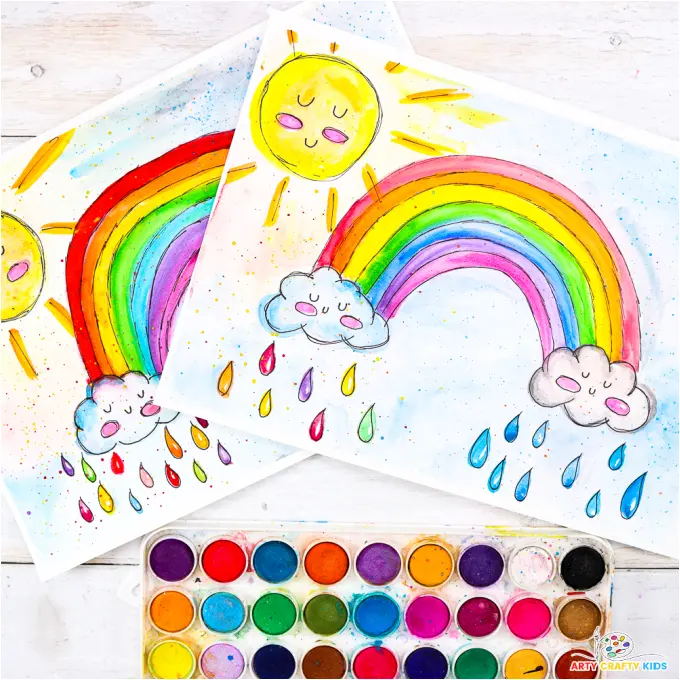
Painting a rainbow in watercolor requires layering transparent pigments in the traditional spectral order: red, orange, yellow, green, blue, indigo, and violet. By using the wet-on-wet technique, you allow colors to bleed into one another naturally, creating a soft, luminous transition that mimics the atmospheric phenomenon of light refraction.

On this page
How to paint a rainbow in watercolor
Achieving a vibrant rainbow begins with selecting professional-grade transparent watercolors. Unlike opaque paints, transparent watercolors allow light to reflect off the white paper, which is essential for the brilliance of a rainbow. You will need a round brush, preferably size 8 or 10, to hold enough water to keep the paper consistently damp during the application process.
Prepare your workspace by taping your watercolor paper to a board to prevent warping. Ensure you have a clean jar of water and a palette with wells for mixing. Organizing your colors in the order of the spectrum—Red, Orange, Yellow, Green, Blue, Indigo, and Violet—will help you maintain a smooth workflow as you transition across the arc.
- Lightly sketch a faint arc with a hard graphite pencil to act as a guide.
- Wet the entire arc area with clean, clear water using your brush.
- Apply the red pigment at the top, followed by each subsequent color in the sequence.
- Allow the colors to touch slightly so they merge without becoming muddy.
Best watercolor techniques for beginners
The wet-on-wet technique is the most effective method for creating a seamless rainbow. By applying pigment to a pre-moistened surface, you encourage the paint to spread and soften, which eliminates harsh lines between colors. This mimics the ethereal quality of a real rainbow, where colors appear to fade into each other rather than existing as distinct, separated bands.
If you struggle with controlling the flow, try the wet-on-dry technique for the initial outline, then soften the edges with a damp, clean brush. This gives you more precision while still allowing for the necessary blending. Always test your color intensity on a scrap piece of paper before applying it to your main painting, as watercolor pigments often dry lighter than they appear when wet.
- Use high-quality cold-press paper for better water absorption and texture.
- Keep a paper towel nearby to dab your brush if you pick up too much water.
- Work quickly to ensure the paper remains damp throughout the entire color application process.
Why colors bleed into each other
Color bleeding, or blooming, occurs when wet paint is introduced to a surface that is already saturated with water. In watercolor, this is a desirable effect that creates soft gradients. The pigment particles move along the water paths, naturally settling where the paper is most absorbent. If your rainbow colors look muddy, it is usually because you are over-mixing or using colors that are complementary, such as red and green, which create brown when combined.
To maintain clarity, rinse your brush thoroughly between each color. If you notice the colors muddying, stop immediately and let the section dry completely before attempting to lift the pigment or add a new layer. Understanding the color wheel is vital; by keeping the transition colors adjacent to their neighbors in the spectrum, you ensure that the mixing remains harmonious rather than chaotic.
Common mistakes when painting rainbows
One frequent error is using too much paint and not enough water, which results in a heavy, opaque look that lacks the luminosity of a rainbow. Another mistake is overworking the paper, which can cause the fibers to pill and the colors to look dull. Always aim for a light touch, letting the water do the work of moving the pigment across the surface.
Avoid using a brush that is too small, as this forces you to apply paint in short, choppy strokes that break the continuity of the arc. Furthermore, failing to let the paper dry between layers—if you decide to add a second pass for intensity—can lead to unwanted blooms or backruns. Patience is your greatest tool; if you feel frustrated, step away and let the paint settle naturally before making adjustments.
How to fix mistakes in watercolor
If you make a mistake, such as an incorrect color placement or a dark smudge, you can often lift the pigment while it is still damp. Gently press a clean, slightly damp paper towel or a dry brush against the area to absorb the excess moisture and color. This "lifting" method is highly effective for correcting minor errors before the paint sets into the paper fibers.
For mistakes that have already dried, you can try "scrubbing" the area with a stiff-bristled brush and clean water, though this may damage the paper surface if done too aggressively. If the error is significant, it is often better to incorporate it into a cloud or atmospheric effect rather than trying to erase it entirely. Embracing the unpredictable nature of watercolor is part of the artistic process, and sometimes, the most beautiful results come from correcting an unexpected bleed or flow.
Key facts
- The traditional color sequence of a rainbow is red, orange, yellow, green, blue, indigo, and violet, often remembered by the acronym ROYGBIV.
- Watercolor paint is transparent, meaning colors will blend and change if applied while the previous layer is still wet.
- To create a smooth transition, use the "wet-on-wet" technique by dampening your paper with clean water before applying pigment.
- Use a round brush size 6 or 8 to allow for both broad strokes and fine control when blending the edges of each color band.
- Start with the lightest color, yellow, and work outward to ensure your brush remains clean throughout the process.
- Allow each color to dry slightly before adding the next if you want distinct bands, or work quickly if you prefer a soft, blended gradient.
The bottom line
Painting a rainbow in watercolor requires patience and an understanding of how pigments interact on damp paper. By mastering the wet-on-wet technique and maintaining clean brushes, you can achieve vibrant, flowing transitions between colors. Remember to work from light to dark and allow for drying time to prevent muddy mixes. With these fundamental steps, you can create a beautiful, luminous arc of color with ease.
People also ask
Why do my colors turn brown when I try to paint a rainbow?
Mixing too many complementary colors, such as blue and orange, creates muddy, brownish tones. Ensure your brush is thoroughly rinsed between colors and avoid over-blending where the edges meet.
Should I use cold-press or hot-press watercolor paper?
Cold-press paper has a textured surface that helps hold pigment in place, making it ideal for beginners. Hot-press paper is smooth and causes paint to flow more freely, which can be harder to control.
How do I get the rainbow to form a perfect arc?
Use a compass or a circular object to lightly trace a pencil guideline on your paper before painting. This provides a structural boundary to help keep your brush strokes consistent.
Can I use tube paints instead of pan paints for this?
Yes, tube paints are highly concentrated and perfect for creating vibrant, saturated colors. Simply squeeze a small amount onto a palette and dilute with water to achieve the desired intensity.
What is the best way to fix a mistake in a watercolor rainbow?
If the paint is still wet, you can lift it off by dabbing the area with a clean, dry paper towel. Once dried, watercolor is difficult to remove, so it is best to work in thin, buildable layers.
Do I need to paint all seven colors of the rainbow?
You do not have to include every color if you prefer a more stylized look. Many artists choose to simplify the rainbow into three or four primary and secondary colors for a cleaner aesthetic.
This answer was created with the help of AI research tools and reference sources. Spotted an error? Let us know — we correct mistakes quickly. See our editorial policy.