What is a laser?
Short answer
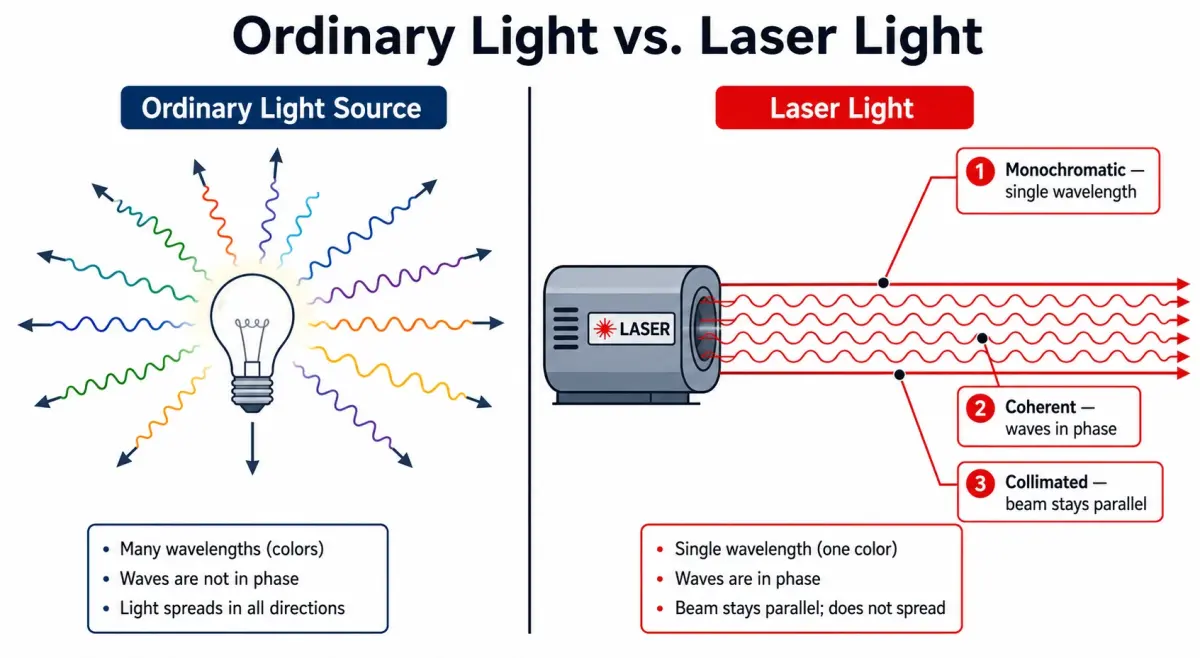
A laser is a device that emits light through a process of optical amplification based on the stimulated emission of electromagnetic radiation. Unlike ordinary light sources, laser light is coherent, monochromatic, and highly directional. This unique concentration of energy allows it to perform precise tasks ranging from medical surgery to industrial manufacturing.

On this page
How does a laser work?
The term laser is an acronym for Light Amplification by Stimulated Emission of Radiation. At its core, the process involves an energy source, an active medium, and an optical cavity. When energy is pumped into the medium—which can be a gas, crystal, or semiconductor—atoms become excited and reach a higher energy state. As these atoms return to their ground state, they release photons that bounce between mirrors, triggering further emissions.
This chain reaction creates a concentrated beam of light where all waves are perfectly synchronized in both phase and frequency. Because the photons travel in a single, narrow direction, the beam does not spread out significantly over long distances. This coherence is what distinguishes a laser from a standard light bulb, which emits light in many directions with varying wavelengths and phases.
Who invented the laser?
The development of the laser was a collaborative scientific effort that culminated in the 1950s and 1960s. Charles Townes and Arthur Schawlow are credited with the theoretical framework for the device, while Theodore Maiman built the first functional ruby laser in 1960. Their work built upon Albert Einstein’s earlier 1917 hypothesis regarding stimulated emission, which provided the fundamental physics necessary for the invention.
The rapid evolution of laser technology followed these milestones:
- 1958: Townes and Schawlow publish their paper on the infrared and optical maser.
- 1960: Theodore Maiman successfully demonstrates the first working laser at Hughes Research Laboratories.
- 1961: The first gas laser is invented, allowing for continuous-wave operation.
- 1962: Semiconductor lasers are developed, paving the way for modern fiber-optic communications.
These early experiments transformed theoretical physics into a revolutionary tool that now underpins global telecommunications, precision medicine, and advanced manufacturing processes across the world.
How are lasers used today?
Lasers have become indispensable in modern society due to their ability to deliver intense energy to microscopic spots. In medicine, they are used for delicate eye surgeries, such as LASIK, and for removing skin lesions without damaging surrounding tissue. Industrial applications include cutting, welding, and drilling through thick metal plates with extreme accuracy, often controlled by computerized systems to ensure perfect repeatability.
Beyond industry, lasers facilitate daily life through various consumer technologies:
- Optical data storage, such as Blu-ray players, uses lasers to read information from discs.
- Barcode scanners in retail stores use low-power lasers to identify product information instantly.
- Fiber-optic cables use laser pulses to transmit vast amounts of data across the internet at the speed of light.
- Laser pointers and leveling tools provide high-visibility references for construction and presentations.

What are the safety risks of lasers?
Laser safety is categorized by the potential for injury, primarily to the eyes and skin. The classification system ranges from Class 1, which is considered safe under all normal conditions, to Class 4, which is hazardous even from scattered reflections. High-power lasers can cause permanent retinal damage in a fraction of a second, as the concentrated beam can burn the sensitive tissue at the back of the eye.
To maintain a safe environment when working with lasers, follow these standard protocols:
- Always wear laser-specific safety goggles that are rated for the wavelength and power of your device.
- Never look directly into the aperture of a laser beam, even if it appears low-powered.
- Ensure that the beam path is terminated by a non-reflective, fire-resistant surface to prevent accidental exposure.
- Keep the work area clear of shiny objects, such as watches or jewelry, which can cause dangerous reflections.
Common mistakes when using lasers
One of the most frequent errors is underestimating the power of a laser based on its size or color. Many users assume that small, cheap laser pointers are harmless, but even low-cost devices can exceed safety regulations and cause significant eye damage. Another common mistake is failing to account for ambient reflections; a beam hitting a polished metal surface can be just as dangerous as the primary beam itself.
When operating laser equipment, avoid these pitfalls to ensure optimal performance and safety:
- Do not operate a laser in an environment with flammable gases or dust, as the heat can ignite these materials.
- Avoid bypassing safety interlocks on laser enclosures, as these are designed to prevent accidental exposure during operation.
- Do not assume a laser is off just because the visible light is not apparent; invisible infrared lasers are particularly dangerous because they do not trigger the natural blink reflex.
- Neglecting regular maintenance of the optical lenses can lead to beam distortion and increased heat buildup, potentially damaging the internal components of the laser system.
Key facts
- The word LASER is an acronym for Light Amplification by Stimulated Emission of Radiation.
- Theodore Maiman built the first functional laser in 1960 at Hughes Research Laboratories using a synthetic ruby crystal.
- Unlike a lightbulb, which emits light in all directions, a laser produces a narrow, highly focused beam of coherent light.
- Lasers operate by exciting atoms to release photons, which bounce between mirrors to amplify the light intensity.
- Laser light is monochromatic, meaning it consists of a single specific wavelength or color.
- Never look directly into a laser beam or its reflection, as the concentrated energy can cause permanent retinal damage.
The bottom line
A laser is a sophisticated device that generates a concentrated, coherent beam of light through stimulated emission. By precisely controlling the energy of atoms within a specific medium, lasers produce light that is both intense and uniform. From scanning barcodes at the grocery store to performing delicate surgeries, this technology remains a fundamental pillar of modern engineering, communication, and scientific research across the globe.
People also ask
How do lasers differ from regular LED lights?
LEDs emit light in many directions and contain multiple wavelengths, creating a broad glow. Lasers emit light in a single, parallel beam of one wavelength, allowing the energy to remain focused over long distances.
Are all lasers dangerous to human skin and eyes?
Laser safety is categorized by classes ranging from Class 1, which is safe under all conditions, to Class 4, which can cause severe skin burns and eye injuries. Always check the safety label on a device before use to understand its specific power level.
How are lasers used in modern medicine?
Surgeons use lasers as precision tools for tasks like correcting vision, removing skin lesions, or cauterizing blood vessels during surgery. The focused heat allows for high accuracy while minimizing damage to the surrounding healthy tissue.
Can lasers be used to store information?
Yes, optical storage media like CDs, DVDs, and Blu-ray discs use lasers to read and write microscopic pits of data on a reflective surface. The laser detects these pits to translate digital information into audio or video.
Why do some lasers appear as different colors?
The color of a laser is determined by the medium used to generate the light, such as a gas, crystal, or semiconductor. Each material has specific energy levels that dictate the exact wavelength and resulting color of the beam.
What is the purpose of the mirrors inside a laser?
The mirrors form an optical cavity that forces photons to bounce back and forth through the gain medium. This process triggers more atoms to release light, effectively amplifying the beam before it exits through a partially transparent mirror.
This answer was created with the help of AI research tools and reference sources. Spotted an error? Let us know — we correct mistakes quickly. See our editorial policy.