What is a hologram?
Short answer
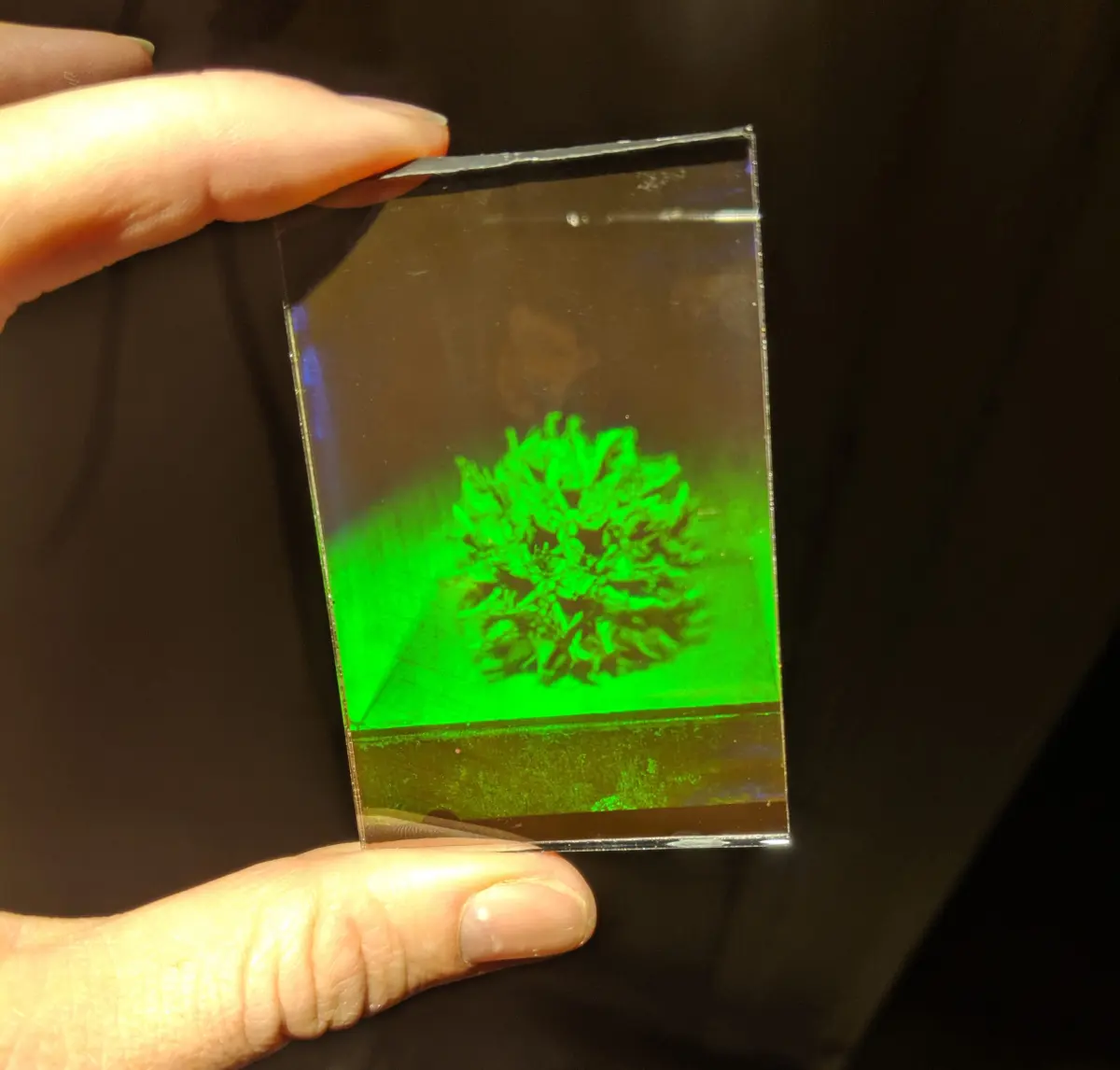
A hologram is a photographic recording of a light field rather than a flat image. By capturing the interference pattern of laser light, it stores three-dimensional information on a two-dimensional surface. When illuminated correctly, this recording reconstructs the original light waves, allowing the viewer to perceive depth and perspective from different angles.
On this page
How does a hologram work?
Holography relies on the principles of wave interference. To create a hologram, a laser beam is split into two separate paths: the reference beam and the object beam. The reference beam travels directly to the recording medium, such as a photographic plate, while the object beam reflects off the subject. When these two beams meet at the plate, they create an interference pattern that encodes both the intensity and the phase of the light.
The resulting image is not a standard photograph but a complex microscopic pattern of fringes. Because this pattern contains spatial information about the light waves, the brain interprets the reconstructed image as having physical depth. This is why a hologram appears to change as the viewer moves their head, mimicking the way we perceive real-world objects.
Who invented the hologram?
The concept of holography was developed by Hungarian-British physicist Dennis Gabor in 1947. Gabor was working at the British Thomson-Houston company in Rugby, England, while attempting to improve the resolution of electron microscopes. He coined the term "hologram" from the Greek words holos (whole) and gramma (message). For his pioneering work, Gabor was awarded the Nobel Prize in Physics in 1971.
Practical holography remained limited until the invention of the laser in 1960. Lasers provided the coherent, monochromatic light necessary to produce high-quality interference patterns. In 1962, Emmett Leith and Juris Upatnieks at the University of Michigan applied laser technology to create the first three-dimensional laser transmission holograms of everyday objects, such as a toy train.
How to make a hologram at home
Creating a professional-grade hologram requires a stable environment and specialized equipment, but you can simulate the effect using a smartphone and a clear plastic pyramid. This method, often called the "Pepper’s Ghost" illusion, reflects light from a screen to create a floating 3D effect.
- Clean a piece of clear, rigid plastic or a CD case.
- Cut four identical trapezoid shapes with a height of 3.5 centimeters, a top base of 1 centimeter, and a bottom base of 6 centimeters.
- Tape the edges of these four pieces together to form a four-sided pyramid with the top cut off.
- Place the pyramid upside down on your smartphone screen.
- Play a "hologram pyramid video" from a video-sharing platform to see the image appear to float inside the plastic.

Common mistakes when making holograms
When attempting to capture a real hologram using traditional optical methods, the most frequent error is vibration. Because the interference fringes are measured in nanometers, even a microscopic tremor from a passing truck or a cooling fan can ruin the exposure. Professionals typically use heavy, vibration-dampened optical tables to ensure the setup remains perfectly still during the exposure process.
Another common mistake involves the coherence length of the laser. If the path difference between the reference beam and the object beam exceeds the coherence length of the laser, the interference pattern will not form. Beginners often struggle with:
- Using unstable light sources that flicker or shift in frequency.
- Failing to clean optical components, which introduces dust artifacts into the final image.
- Improper exposure times, which lead to either underexposed plates or saturated, blurry results.
Why do holograms appear on credit cards?
Holograms are widely used in security because they are difficult to forge using standard printing equipment. These are known as rainbow holograms, which are embossed onto a thin metallic foil. They are designed to be viewed under white light, such as sunlight or overhead lamps, rather than a specialized laser. This makes them highly practical for everyday verification of authenticity.
The security features of these holograms include:
- Multi-channel imagery that changes appearance when tilted.
- Micro-text that is only visible under high magnification.
- Kinetic effects that simulate movement when the card is rotated.
- Depth-coded layers that prevent high-resolution scanners from capturing the full 3D data.
Because the manufacturing process requires a master hologram created with precise laser equipment, counterfeiting these images is prohibitively expensive for most criminals. This technology remains a primary defense against the duplication of banknotes, passports, and identification cards globally. As digital security evolves, these physical optical features continue to provide a reliable, non-electronic layer of protection that is instantly verifiable by the human eye.
Key facts
- A hologram is a photographic recording of a light field, rather than an image formed by a lens.
- Dennis Gabor invented holography in 1947, earning a Nobel Prize in Physics for his work.
- Holograms require a coherent light source, typically a laser, to create the necessary interference patterns.
- True holograms appear three-dimensional because they record the phase and amplitude of reflected light waves.
- You can view a hologram from different angles to see depth, unlike a standard flat photograph.
- To make a DIY hologram, you need a dark room, a vibration-free table, and a laser pointer.
The bottom line
A hologram is a sophisticated optical recording that captures the full light field of an object, enabling a realistic three-dimensional experience. Unlike standard photography, it preserves the phase of light waves to provide depth and perspective. While often confused with simple mirror illusions, true holography remains a precise scientific process that relies on laser interference to store and reconstruct complex visual information for the human eye.
People also ask
How does a hologram differ from a 3D movie?
A 3D movie uses two slightly offset images to trick your brain into perceiving depth on a flat screen. A hologram records the actual light interference pattern, allowing you to move your head and see the object from different perspectives.
Can holograms be seen in daylight?
Transmission holograms require a laser to be viewed, while reflection holograms can be seen under ordinary white light. However, direct, bright sunlight often washes out the delicate interference patterns, making them difficult to view clearly.
Are Pepper’s Ghost illusions actually holograms?
No, the "holograms" used in concerts to project deceased performers are usually Pepper’s Ghost illusions. This technique uses a transparent screen or glass angled at 45 degrees to reflect a 2D image, creating the appearance of a 3D figure.
What materials are needed to create a hologram?
You need a high-quality laser, a beam splitter to divide the light, mirrors to direct it, and a holographic plate or film. The setup must be extremely stable, as even a microscopic vibration will ruin the recording.
Why do holograms often appear monochromatic?
Most holograms are recorded using a single-color laser, which results in a monochromatic image. While full-color holograms exist, they require multiple lasers of different wavelengths, which significantly increases the complexity and cost of the process.
Can holograms be printed on paper?
Embossed holograms, such as those found on credit cards or security labels, are mass-produced using a master hologram. These are printed onto thin layers of plastic or foil rather than traditional photographic film.
This answer was created with the help of AI research tools and reference sources. Spotted an error? Let us know — we correct mistakes quickly. See our editorial policy.