What is a core shadow?
Short answer
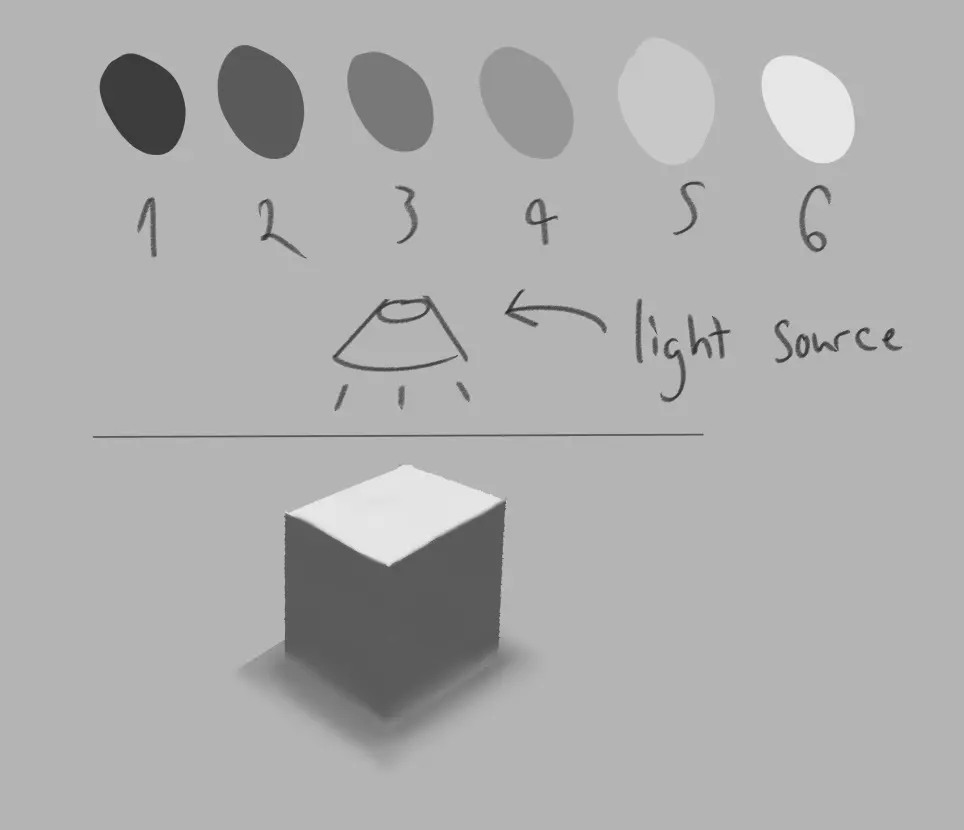
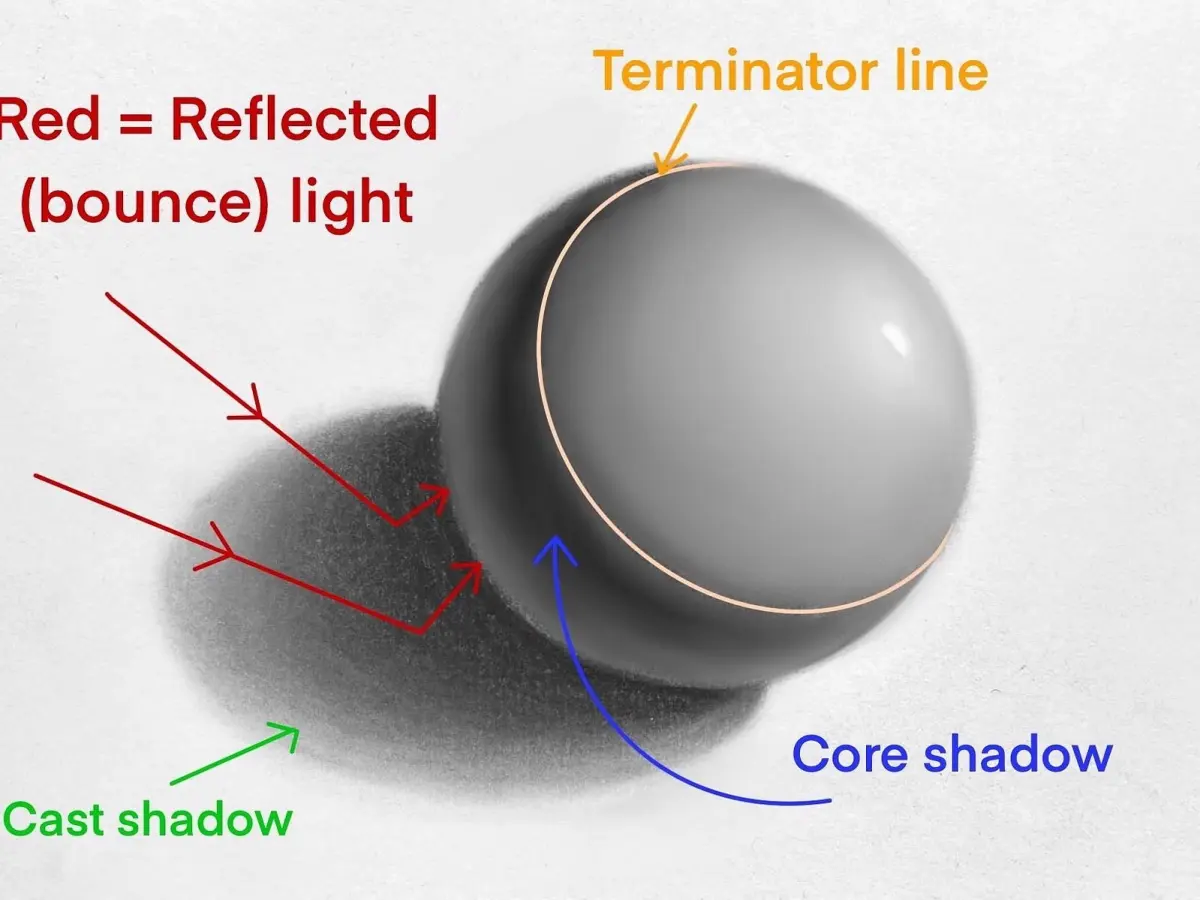
A core shadow is the darkest part of a shadow cast on an object itself, located between the highlight and the reflected light. It represents the area where light rays from a source are completely blocked by the object's form, creating a distinct transition that defines the object's three-dimensional volume.
On this page
Why does a core shadow happen?
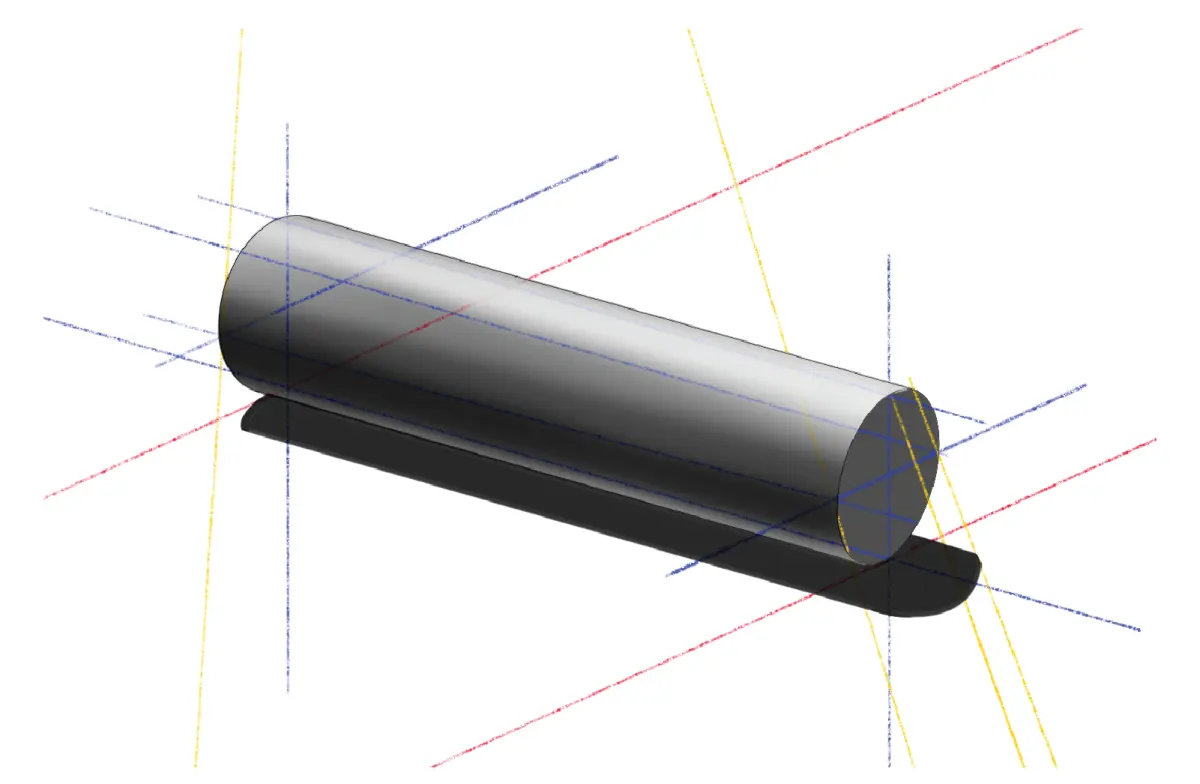
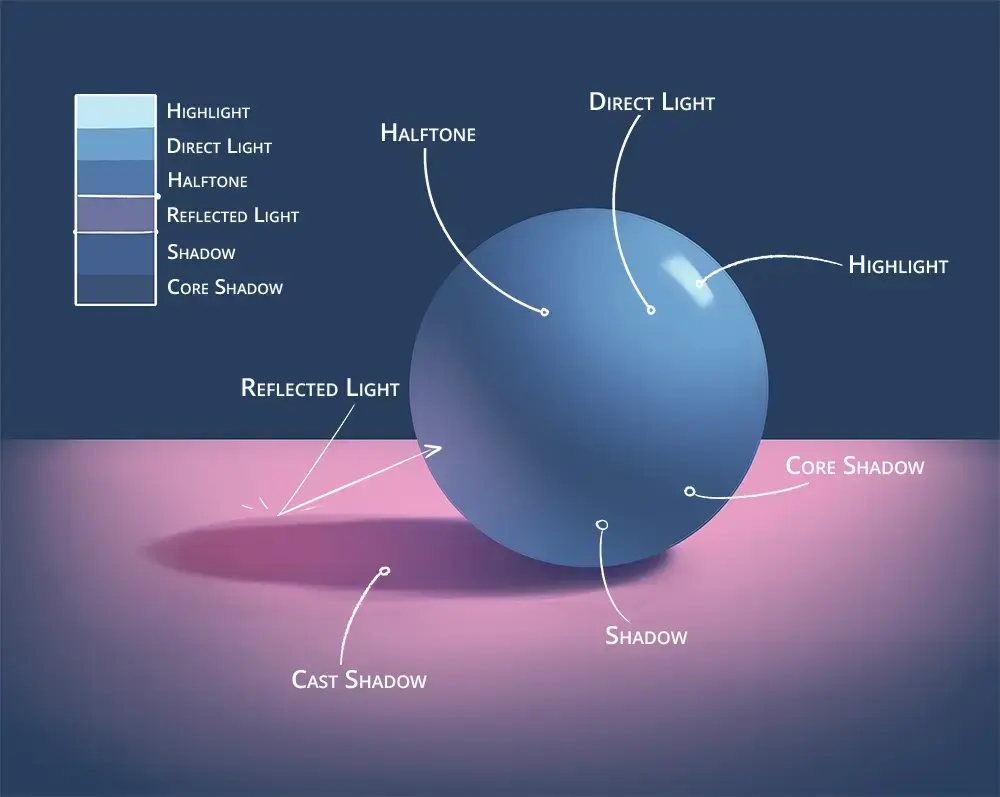
The core shadow occurs because light travels in straight lines. When a light source strikes a curved or rounded object, the rays hit the surface at different angles. The area directly facing the light becomes the highlight, while the areas curving away receive less illumination. Eventually, the surface turns away from the light source entirely, creating a region of total shadow.
This phenomenon is governed by the physics of optics. As light wraps around an object, there is a specific point where the light can no longer reach the surface. This boundary is known as the terminator. The core shadow sits just past this terminator, representing the deepest point of darkness before light bounces back from surrounding surfaces to create reflected light. Understanding this transition is essential for any artist attempting to render realistic forms on a two-dimensional surface.
How to identify a core shadow?
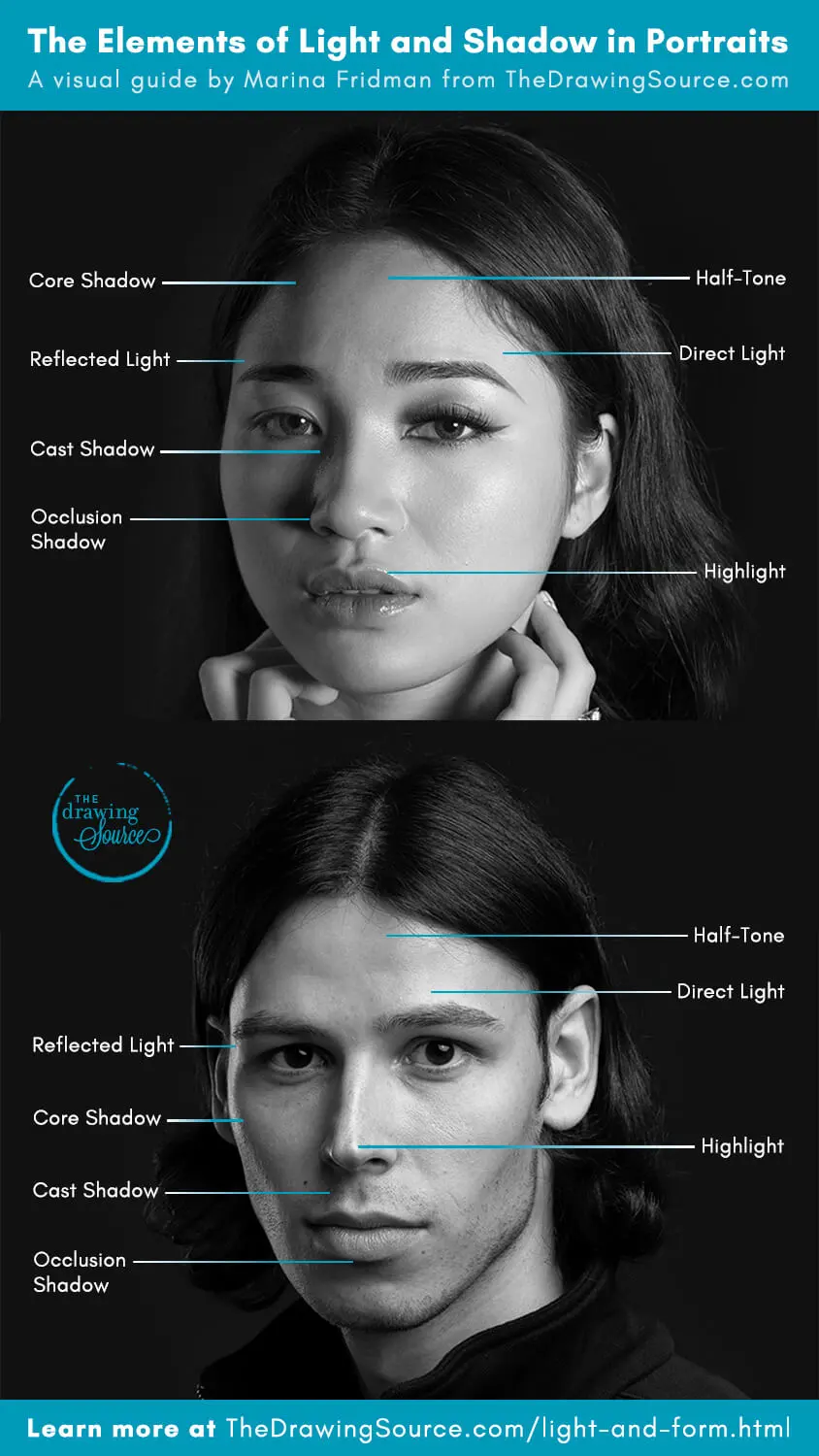
Identifying a core shadow requires observing how light interacts with volume. You can find it by looking for the darkest concentration of tone on the shaded side of an object. It is rarely a solid black line; instead, it is usually a soft, graduated band that follows the contour of the shape.
To locate it accurately, follow these observational steps:
- Observe the light source and determine its primary direction.
- Locate the highlight, which is the brightest point on the object.
- Find the terminator, the line where light stops hitting the surface directly.
- Look just past the terminator to find the darkest area, which is your core shadow.
- Note how the shadow lightens slightly toward the edge due to ambient light bouncing off the table or nearby walls.
Best techniques for drawing core shadows?
Rendering a core shadow effectively requires a delicate touch with your drawing medium. Beginners often make the mistake of drawing the core shadow as a harsh, dark outline, but it should actually be a soft transition. Using a blending stump or a soft graphite pencil, you can build up the value gradually to ensure the shadow feels integrated into the object's surface.
Consider these technical approaches to improve your shading:
- Start with a light base layer of graphite to establish the overall value of the shadow.
- Gradually darken the core shadow area by layering strokes in the direction of the object’s curve.
- Use a kneaded eraser to lift out the reflected light area, which helps the core shadow pop.
- Compare your values frequently; the core shadow should be significantly darker than the reflected light but lighter than the cast shadow on the ground.
Common mistakes when painting core shadows?
One of the most frequent errors is making the core shadow too uniform. In reality, the core shadow changes in intensity depending on the texture of the object and the environment. If the shadow is perfectly flat and dark across the entire shaded side, the object will look like a cutout rather than a solid, three-dimensional form. You must allow for subtle variations in tone.
Another common mistake is neglecting the reflected light. Many artists forget that light bounces off surfaces and hits the underside of the object. If you paint the entire shaded side in one dark color, you lose the sense of depth. Always ensure there is a lighter, thinner band of reflected light along the edge of the object. This detail is what separates the core shadow from the surrounding space and gives the object its weight and density.
How to use core shadows to show volume?
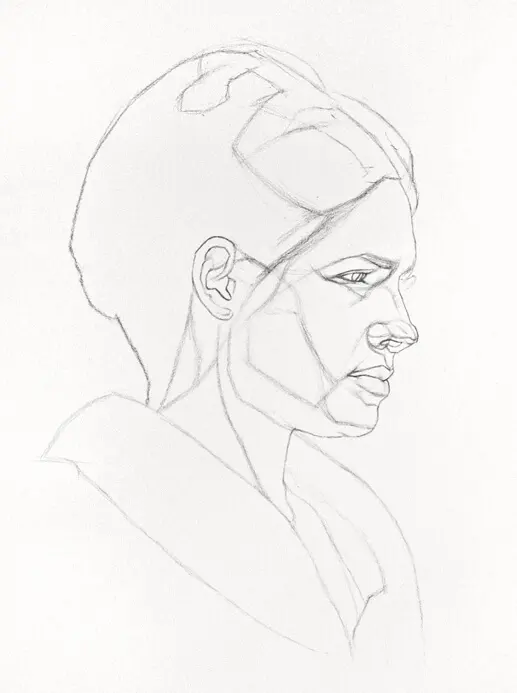
The core shadow is the primary tool for convincing the human eye that a flat image has depth. By carefully placing the core shadow, you define the curvature and mass of an object. A sharp, narrow core shadow suggests a hard-edged object like a cube, while a wide, soft core shadow indicates a rounded, organic shape like a sphere or a human limb.
Mastering this concept allows you to manipulate the viewer's perception of light and space. When you exaggerate the contrast between the core shadow and the adjacent highlight, the object appears to have more volume and presence. Conversely, softening the transition creates a sense of diffused light and gentler form. By practicing these techniques on simple geometric shapes, you will eventually be able to apply these principles to complex subjects like portraits or landscapes, ensuring that every element in your composition feels grounded and physically substantial within the scene.
Key facts
- A core shadow is the darkest part of a shadow found on the surface of a three-dimensional object.
- It occurs on the side of the object facing away from the light source, bordering the transition into the reflected light.
- The core shadow is most intense where the object turns away from the light, typically just before the area of reflected light begins.
- Unlike a cast shadow, which appears on a separate surface, the core shadow remains attached to the object itself.
- To draw it accurately, observe the "terminator line," which is the boundary where light stops hitting the object and the shadow begins.
- Avoid making the core shadow a solid, flat black; it should contain subtle variations in tone to maintain the object's volume and depth.
The bottom line
The core shadow is the essential dark region on an object that defines its three-dimensional form. By identifying the terminator line and balancing the core shadow with reflected light, you can create a realistic sense of volume in your drawings. Mastering this technique prevents your work from looking flat, allowing you to accurately represent how light interacts with physical objects in any given space.
People also ask
How does a core shadow differ from a cast shadow?
A core shadow exists on the object itself, while a cast shadow is projected by the object onto another surface. The core shadow defines the object's form, whereas the cast shadow provides context about the environment and light direction.
Why does a core shadow have a gradient instead of a hard edge?
The transition depends on the light source's size and distance. A small, distant light source creates a sharper core shadow, while a large or diffused light source creates a soft, gradual transition known as the "terminator."
What is reflected light in relation to the core shadow?
Reflected light is illumination that bounces off surrounding surfaces and hits the shadowed side of an object. It sits right next to the core shadow, preventing the dark area from appearing like a flat, featureless hole.
Can an object have more than one core shadow?
Yes, if there are multiple light sources, each will create its own set of highlights and core shadows. Complex lighting setups require careful observation of how these different shadows overlap and interact on the object's surface.
Why is the core shadow important for realistic drawing?
Without a core shadow, an object appears flat and two-dimensional on the page. Including it allows the artist to describe the curvature and mass of the object, effectively tricking the eye into seeing volume.
Does the color of the object affect the core shadow?
Yes, the local color of the object influences the shadow's appearance. A dark-colored object will have a darker core shadow than a light-colored object under the exact same lighting conditions.
This answer was created with the help of AI research tools and reference sources. Spotted an error? Let us know — we correct mistakes quickly. See our editorial policy.