What do walruses eat?
Short answer
Walruses are specialized carnivores that primarily consume benthic invertebrates found on the ocean floor. Their diet consists mostly of bivalve mollusks like clams and mussels, supplemented by snails, sea cucumbers, and occasionally fish or seals. They use their sensitive whiskers to detect prey in dark, murky arctic waters while foraging.
On this page
What do walruses eat in the wild?
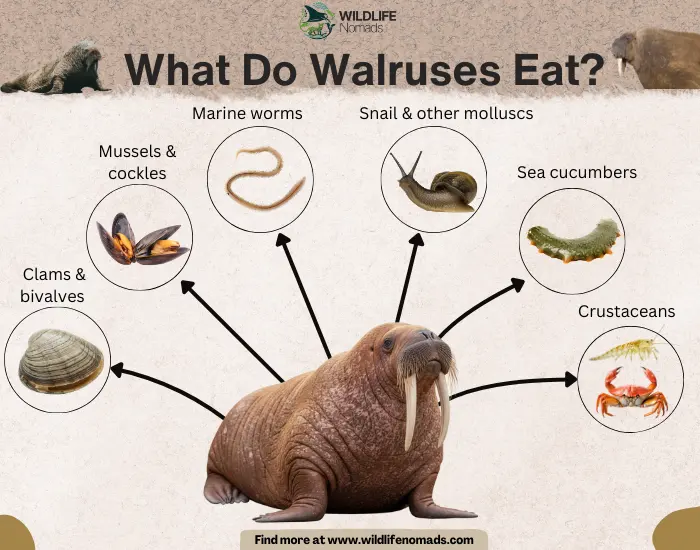
Walruses are opportunistic foragers that spend much of their time diving to the seafloor to locate food. Their primary diet consists of benthic organisms, which are animals that live on or in the sediment at the bottom of shallow arctic shelves. Clams are their preferred food source, and a single adult walrus can consume thousands of clams in a single feeding session.
Beyond clams, these marine mammals exhibit a diverse palate that includes various soft-bodied and shelled creatures. Their diet typically includes:
- Clams and mussels
- Marine snails and whelks
- Sea cucumbers and polychaete worms
- Tunicates and crustaceans
- Small amounts of fish or carrion
When food is scarce, walruses have been observed preying on ringed seals or even young seabirds. While these instances are less common, they demonstrate the animal's ability to adapt its hunting strategies to survive in harsh, changing environments where their primary food sources might be temporarily unavailable.
How do walruses find food?
Walruses possess highly specialized sensory adaptations that allow them to locate prey in the pitch-black conditions of the arctic seafloor. Their most important tools are their vibrissae, or whiskers, which are extremely sensitive to touch and vibration. As a walrus swims along the bottom, it drags its muzzle through the sediment, using these whiskers to detect the subtle movements and shapes of buried mollusks.
Once a walrus identifies a potential meal, it employs a unique suction-feeding method to extract the prey. By creating a vacuum with its powerful tongue and mouth, the animal pulls the clam out of the sediment. The walrus then uses its lips to suck the soft meat out of the shell, effectively discarding the hard exterior. This method is highly efficient, allowing them to process large quantities of food without needing to ingest the heavy, indigestible shells.
How much do walruses eat daily?
Maintaining such a massive body size requires a significant caloric intake. An adult walrus can weigh between 800 and 1,700 kilograms, necessitating a daily consumption of approximately 3 to 6 percent of its total body weight. This translates to roughly 40 to 80 kilograms of food per day for a fully grown individual.
To meet these high energy demands, walruses must spend significant portions of their day foraging. During peak feeding seasons, they may spend up to 10 to 12 hours underwater searching for sustenance. This constant cycle of diving and feeding is essential for building the thick layer of blubber that provides insulation against freezing arctic temperatures and serves as an energy reserve during periods when food is difficult to find.
Common mistakes when observing walrus feeding
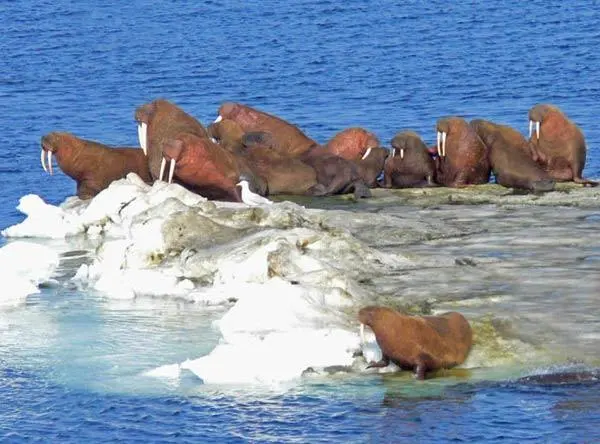
Many people incorrectly assume that walruses use their long tusks to dig for food. While the tusks are iconic features of the animal, they are primarily used for hauling their heavy bodies onto ice floes, defending against predators, or establishing social dominance within a herd. Using the tusks to excavate the seafloor would be inefficient and potentially damaging to the animal.
Another common misconception is that walruses are aggressive predators that hunt large fish or whales. In reality, they are relatively slow-moving foragers that prefer slow-moving or stationary prey. If you are observing these animals in the wild, avoid these common errors:
- Assuming tusks are used for digging; they are actually for social and physical navigation.
- Expecting to see them hunting like dolphins or sharks, as they are benthic feeders.
- Approaching resting herds, as this disrupts their energy conservation efforts.
- Overestimating the role of fish in their diet, which is usually minimal compared to mollusks.
Why do walruses migrate for food?
Walrus populations are intrinsically linked to the seasonal movement of sea ice. Because they rely on shallow shelf areas for foraging, they must follow the ice edge as it expands and retreats throughout the year. If the ice recedes too far from the productive shallow waters, the walruses are forced to swim much longer distances to reach their feeding grounds, which depletes their energy reserves.
This migration pattern is critical for the survival of the species, as it ensures they stay within reach of their primary food sources. When the ice is stable, they can rest on the surface and dive short distances to feed. However, if the ice disappears, they are forced to haul out on land in massive, crowded groups. This behavior, known as "land-based haul-outs," often leads to increased stress and limited access to the rich, clam-filled seafloor habitats they require to thrive.
Key facts
- Walruses are benthic foragers, meaning they primarily feed on organisms living on the ocean floor.
- Their diet consists mostly of bivalve mollusks, such as clams, mussels, and cockles.
- An adult walrus can consume between 3,000 and 6,000 clams in a single feeding session.
- They use their sensitive whiskers, called vibrissae, to detect prey in dark or murky water.
- Walruses do not chew their food; they use suction to pull the soft bodies of clams out of their shells.
- While rare, some walruses may opportunistically eat fish, crustaceans, or even seal carcasses if food is scarce.
The bottom line
Walruses are specialized marine mammals that rely almost exclusively on seafloor-dwelling invertebrates for survival. By utilizing their sensitive whiskers and powerful suction, they efficiently harvest thousands of clams daily. This diet provides the necessary caloric intake to support their massive size in freezing Arctic waters. Understanding their reliance on benthic habitats is essential for protecting the delicate ecosystems that sustain these iconic marine animals.
People also ask
How do walruses find food in the dark ocean?
Walruses use their highly sensitive whiskers to feel for movement and texture along the seabed. They also use their tusks to plow through sediment, stirring up hidden prey.
Do walruses eat penguins?
No, walruses and penguins live at opposite ends of the Earth. Walruses inhabit the Arctic, while penguins are found primarily in the Southern Hemisphere.
How much food does a walrus need per day?
A walrus typically consumes about 3% to 6% of its total body weight daily to maintain its energy levels. For a large male, this can amount to over 100 pounds of food per day.
Do walruses use their tusks to hunt?
No, walruses do not use their tusks to spear prey. The tusks are primarily used for hauling their heavy bodies onto ice, social displays, and clearing paths through thick ice.
Can walruses eat starfish?
Yes, walruses are known to consume various echinoderms, including starfish and sea cucumbers. These serve as a secondary food source when their preferred clam beds are depleted.
Why do walruses swallow clam shells?
They generally do not; they use their powerful tongues to create a vacuum that sucks the clam meat out of the shell. The empty shells are left on the seafloor, which scientists often use to map walrus feeding grounds.
This answer was created with the help of AI research tools and reference sources. Spotted an error? Let us know — we correct mistakes quickly. See our editorial policy.