How many layers of watercolor can you do?
Short answer
There is no fixed limit to the number of watercolor layers you can apply, as it depends entirely on your paper quality, pigment transparency, and technique. While artists often limit themselves to three or four glazes to maintain luminosity, professional painters can successfully apply dozens of layers if they manage moisture levels correctly.
On this page
How many layers can watercolor paper handle?
The physical durability of your paper is the primary constraint when layering watercolors. Standard cellulose paper often pills or tears after only two or three washes because the fibers are not strong enough to withstand repeated wetting and scrubbing. In contrast, high-quality 100% cotton cold-press or hot-press paper, typically 300 gsm or heavier, can support a significant number of layers. The sizing—a gelatinous coating that prevents paint from soaking too deeply into the fibers—is what allows the paper to remain workable.
When you apply too many layers, the paper's sizing can break down, causing the surface to become "dead" or muddy. If you intend to use many layers, choose a heavy-duty paper like 640 gsm (300 lb) or stretched watercolor blocks. These surfaces are designed to endure extensive water exposure without buckling or disintegrating. Always test the limits of your specific brand, as some papers are engineered specifically for multi-layered glazing techniques while others are intended for quick, direct applications.
Why do watercolor layers become muddy?
Muddy colors occur when you apply too many layers of opaque or granulating pigments, or when you disturb the underlying layer before it is fully dry. Watercolor is a transparent medium; its beauty relies on light passing through the pigment and reflecting off the white paper. If you apply a second layer while the first is still damp, the pigments mix on the paper rather than sitting on top of each other, creating a dull, greyish tone. This is often called "overworking" the painting.
To prevent this, you must understand the transparency of your specific paints. Some pigments are staining, meaning they sink into the paper immediately, while others are sedimentary and sit on the surface. If you layer a heavy, opaque pigment over a delicate wash, you will lose the luminosity of the initial layer. By keeping your palette limited and ensuring each layer is bone-dry, you can maintain clarity even after applying ten or more glazes.
How to layer watercolor without lifting
Mastering the art of layering requires patience and a light touch. The goal is to add depth without reactivating the paint already on the page. If you press too hard with your brush, you will inevitably lift the previous color, resulting in a patchy or streaky appearance. Using a soft, high-quality sable or synthetic brush will help you deposit pigment gently without disturbing the base.
- Ensure the first layer is completely dry to the touch; use a cool hairdryer if necessary.
- Mix your next color with enough water to create a thin, transparent consistency.
- Charge your brush with a generous amount of paint, but do not overload it.
- Apply the paint using light, single strokes rather than scrubbing back and forth.
- Let the layer air dry naturally to allow the pigment particles to settle into the paper fibers.

Best practices for glazing techniques
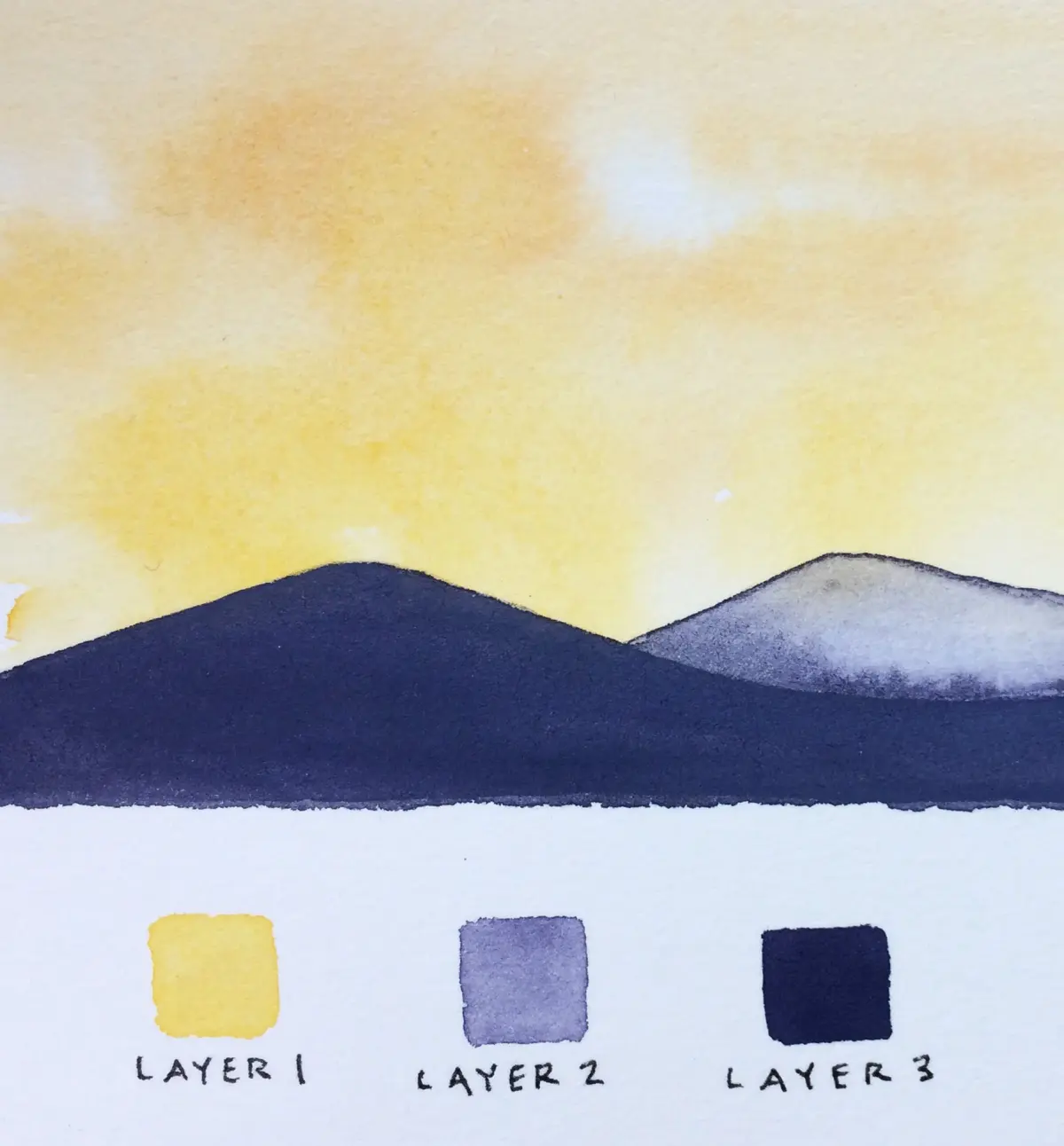
Glazing is the process of applying a thin, transparent wash over a dry layer of paint to alter its hue or value. This technique is what allows artists to achieve complex, jewel-like colors that cannot be mixed directly on the palette. When glazing, the key is to use a large brush and work quickly to avoid creating hard edges. If you take too long to cover an area, the paint will begin to dry, leaving visible brush marks that ruin the smooth transition of the glaze.
- Use a limited palette of transparent pigments to avoid murky results.
- Always work from the lightest values to the darkest values.
- Keep a clean brush handy to soften any edges that appear too sharp.
- Test your glaze on a scrap piece of the same paper before applying it to your final piece.
- Avoid using opaque colors like Cadmiums or Cerulean Blue for the final layers if you want to maintain a transparent look.
Common mistakes when layering watercolors
Many beginners struggle with layering because they try to force the paint to do too much at once. One of the most frequent errors is using a brush that is too dry, which prevents the paint from flowing smoothly and leads to "skipping" on the paper. Another mistake is failing to wait for the paper to return to room temperature after using a hairdryer, which can cause the next layer of paint to dry unevenly or bloom unexpectedly.
Finally, do not be afraid to stop. Many paintings are ruined because the artist felt they needed "one more layer" to fix a minor imperfection. If a layer does not look right, it is often better to leave it alone or use a lifting technique to remove excess pigment rather than trying to cover it up with more paint. Remember that watercolor is a medium of suggestion; the white of the paper is your most valuable tool, and covering it entirely with layers will eventually diminish the brilliance of your work.
Key facts
- There is no fixed limit to watercolor layers, but the paper’s physical integrity dictates the practical maximum.
- Applying too many layers can cause the paper fibers to pill or disintegrate, resulting in a muddy, dull appearance.
- Artists typically work in three to five stages to maintain transparency and luminosity, which is the medium's defining characteristic.
- Using high-quality, cold-press or hot-press watercolor paper with a weight of at least 300 gsm (140 lb) allows for more layering.
- Staining pigments, such as Phthalo Blue, are harder to lift and can easily create muddy layers if applied too early.
- Allowing each layer to dry completely before adding the next is essential to prevent unwanted bleeding and color mixing.
The bottom line
While watercolor does not have a strict numerical limit for layers, the quality of your paper and the transparency of your pigments are the true constraints. Aim for a deliberate, phased approach to preserve the medium's inherent light and clarity. By allowing each application to dry thoroughly and avoiding excessive scrubbing, you can build depth and complexity without sacrificing the vibrant, luminous quality of your work.
People also ask
Why does my watercolor painting look muddy after adding several layers?
Mud occurs when you overwork the paper or mix too many complementary colors, which neutralize each other into gray or brown. To avoid this, use a clean brush, limit your color palette, and ensure each layer is bone-dry before proceeding.
Can I use a hair dryer to speed up the drying process between layers?
Yes, using a hair dryer on a low, cool setting is a common professional practice to save time. Avoid high heat, as it can cause the gum arabic binder to become brittle or affect the paper's sizing.
What is the difference between transparent and opaque watercolors?
Transparent colors allow light to reflect off the white paper, creating the medium's signature glow. Opaque colors, such as cadmium pigments, sit on top of the paper and can block light, which makes layering more complex.
How do I fix a layer that has become too dark?
If the paint is still damp, you can lift it with a clean, slightly damp brush or a paper towel. If the layer is dry, you may be able to gently "scrub" the area with a stiff brush and water, though this risks damaging the paper surface.
Does the type of watercolor paper affect how many layers I can apply?
Absolutely; professional-grade, 100% cotton paper is significantly more durable than wood-pulp paper. Cotton fibers can withstand repeated wetting and scrubbing without tearing or losing their structural integrity.
Should I use a fixative between layers to keep them from lifting?
Generally, no; fixatives are intended for finished works and can prevent subsequent layers of watercolor from bonding properly. Rely on the natural staining properties of your pigments and proper drying times instead.
This answer was created with the help of AI research tools and reference sources. Spotted an error? Let us know — we correct mistakes quickly. See our editorial policy.