How long do jellyfish live?
Short answer
Jellyfish lifespans vary significantly, ranging from a few hours to several years depending on the species. Most common coastal jellyfish live for only a few months during the warmer seasons. However, some species, such as the immortal jellyfish, possess the unique biological ability to revert their cells and theoretically live indefinitely.
On this page
How long do jellyfish live on average?
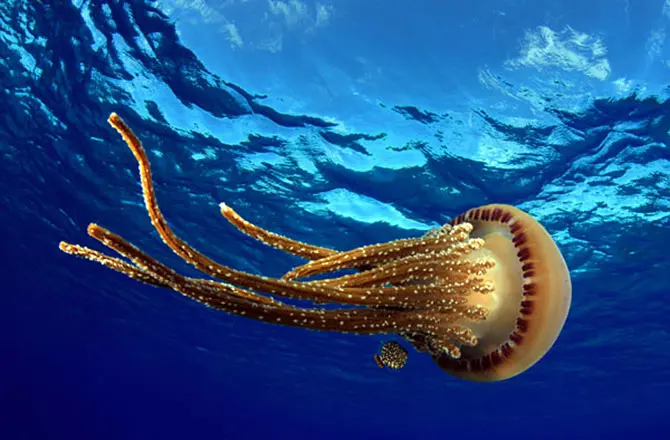
Most jellyfish species have relatively short lifespans that are dictated by their environmental conditions and reproductive cycles. For many common medusae, such as the moon jelly, the adult stage typically lasts between two to six months. During this period, they focus entirely on feeding to build energy reserves and reproducing before they eventually succumb to predation, starvation, or changing water temperatures.
While the adult medusa phase is fleeting, the overall life cycle of a jellyfish is more complex. Many species begin as polyps attached to the seafloor, which can remain in a dormant state for years. Once conditions become favorable, these polyps undergo strobilation, releasing free-swimming ephyrae that mature into adult jellyfish. Because of this, the "true" age of a jellyfish colony is often much longer than the lifespan of an individual swimming medusa.
Why can some jellyfish live forever?
The Turritopsis dohrnii, commonly known as the immortal jellyfish, defies the standard biological rules of aging. When this species faces physical damage, environmental stress, or starvation, it can undergo a process called transdifferentiation. During this transformation, the adult medusa cells revert back to their earliest polyp stage, effectively resetting the organism's biological clock to begin its life cycle anew.
This process is not a simple regeneration but a complete cellular restructuring. By recycling its own tissues, the jellyfish avoids the natural senescence that leads to death in other animals. While they are theoretically immortal, they are still subject to the same external threats as other marine life. They can be consumed by predators, killed by disease, or destroyed by extreme changes in ocean chemistry, meaning few individuals actually achieve true biological immortality in the wild.
How do environmental factors affect lifespan?
A jellyfish's lifespan is heavily influenced by the stability of its marine habitat. Factors such as water temperature, salinity, and the availability of prey play a critical role in how quickly a jellyfish matures and how long it survives. In warmer waters, metabolic rates increase, which often leads to a faster life cycle and an earlier death compared to those in cooler, deeper environments.
Human activity also significantly impacts the survival rates of these creatures. Pollution, overfishing of natural predators, and climate-driven shifts in ocean currents can either shorten or extend the presence of jellyfish blooms. When ecosystems are disrupted, jellyfish often thrive due to their high adaptability and lack of complex requirements. To understand the population dynamics of these organisms, scientists monitor several key environmental indicators:
- Water temperature fluctuations that trigger reproductive cycles.
- Nutrient availability, which dictates the frequency of polyp budding.
- Predator density, including sea turtles and sunfish that control medusa populations.
- Coastal development, which increases the surface area for polyps to attach.
Common mistakes when identifying jellyfish age
Many observers mistakenly assume that the size of a jellyfish is a direct indicator of its age. In reality, size is often a reflection of food availability and water quality rather than time passed. A small jellyfish may be an adult that has struggled to find nutrients, while a large specimen could be a young individual that has enjoyed an abundant food supply.
Another common error is failing to distinguish between the polyp and medusa stages. People often see a swarm of jellyfish and assume the entire population is the same age, ignoring the fact that these individuals likely emerged from a sessile polyp colony at different times. To accurately assess the health and stage of a jellyfish population, researchers must follow these steps:
- Observe the bell shape and presence of reproductive organs to determine sexual maturity.
- Examine the surrounding substrate for the presence of dormant polyps.
- Track local water temperature data to estimate the timing of the most recent strobilation event.
- Document the presence of parasites or tissue damage, which are better indicators of health than physical size.
Best ways to observe jellyfish lifespans
If you are interested in tracking jellyfish development, the most effective method is to maintain a controlled environment, such as a specialized kreisel tank. These tanks use circular water flow to keep the delicate creatures suspended, preventing them from becoming trapped in corners or damaged by filtration systems. This controlled setting allows for precise observation of the transition from ephyra to mature adult.
When keeping jellyfish, it is essential to prioritize water quality and feeding consistency. Because jellyfish are composed of roughly 95 percent water, they are extremely sensitive to shifts in ammonia and nitrate levels. Maintaining a consistent diet of enriched brine shrimp or specialized jell-food will ensure the specimens reach their full natural lifespan. By keeping detailed logs of feeding schedules and water parameters, you can gain a deeper understanding of how these fascinating creatures progress through their unique life stages.
Key facts
- Most jellyfish species live for only a few months, typically completing their life cycle within a single season.
- The Turritopsis dohrnii is biologically immortal, capable of reverting its cells to an earlier developmental stage when stressed or aging.
- Large species like the Lion’s Mane jellyfish can live for up to one year in cold, nutrient-rich waters.
- Environmental factors, such as water temperature and food availability, dictate the lifespan of most jellyfish populations.
- Predation by sea turtles, fish, and other jellyfish is the most common cause of death for these creatures.
- Captive jellyfish often live significantly longer than wild counterparts due to the absence of predators and consistent food supply.
The bottom line
The lifespan of a jellyfish varies dramatically depending on the species and environmental conditions. While most common jellyfish survive for only a few months in the wild, the unique Turritopsis dohrnii can theoretically live forever. Understanding these life cycles helps scientists track ocean health, as jellyfish are highly sensitive indicators of shifts in marine ecosystems, water pollution, and the impact of climate change on biodiversity.
People also ask
Do jellyfish have brains?
Jellyfish do not have brains or a central nervous system. Instead, they possess a decentralized nerve net that allows them to detect light, odor, and other stimuli in their environment.
Are all jellyfish dangerous to humans?
Not all jellyfish are dangerous, but many possess stinging cells called nematocysts that can cause pain or allergic reactions. It is best to avoid contact with any jellyfish, as their toxicity levels are often difficult to identify in the water.
What do jellyfish eat?
Jellyfish are carnivores that consume plankton, small fish, crustaceans, and other jellyfish. They use their tentacles to capture prey and pull it into their mouth, which is located in the center of their bell.
Read the full answer →How do jellyfish reproduce?
Most jellyfish reproduce by releasing eggs and sperm into the water to create larvae. These larvae eventually attach to a hard surface and transform into polyps, which later bud off to become free-swimming medusae.
Can jellyfish survive outside of water?
Jellyfish cannot survive outside of water because they are composed of approximately 95 percent water. When removed from their aquatic environment, their structure collapses and they quickly dehydrate and die.
Why do jellyfish blooms occur?
Blooms often occur due to rising ocean temperatures, overfishing of natural predators, and increased nutrient runoff from farms. These conditions create an ideal environment for jellyfish populations to multiply rapidly in a short period.
This answer was created with the help of AI research tools and reference sources. Spotted an error? Let us know — we correct mistakes quickly. See our editorial policy.