How do you draw tears?
Short answer
Drawing tears requires capturing the physical shape of the eye and the way light interacts with liquid. Focus on the reflective highlight, the dark pupil, and the wet lower eyelid rim. By layering subtle gray values and leaving stark white spots, you create the illusion of moisture and depth in drawings.
On this page
How to draw realistic tears step by step
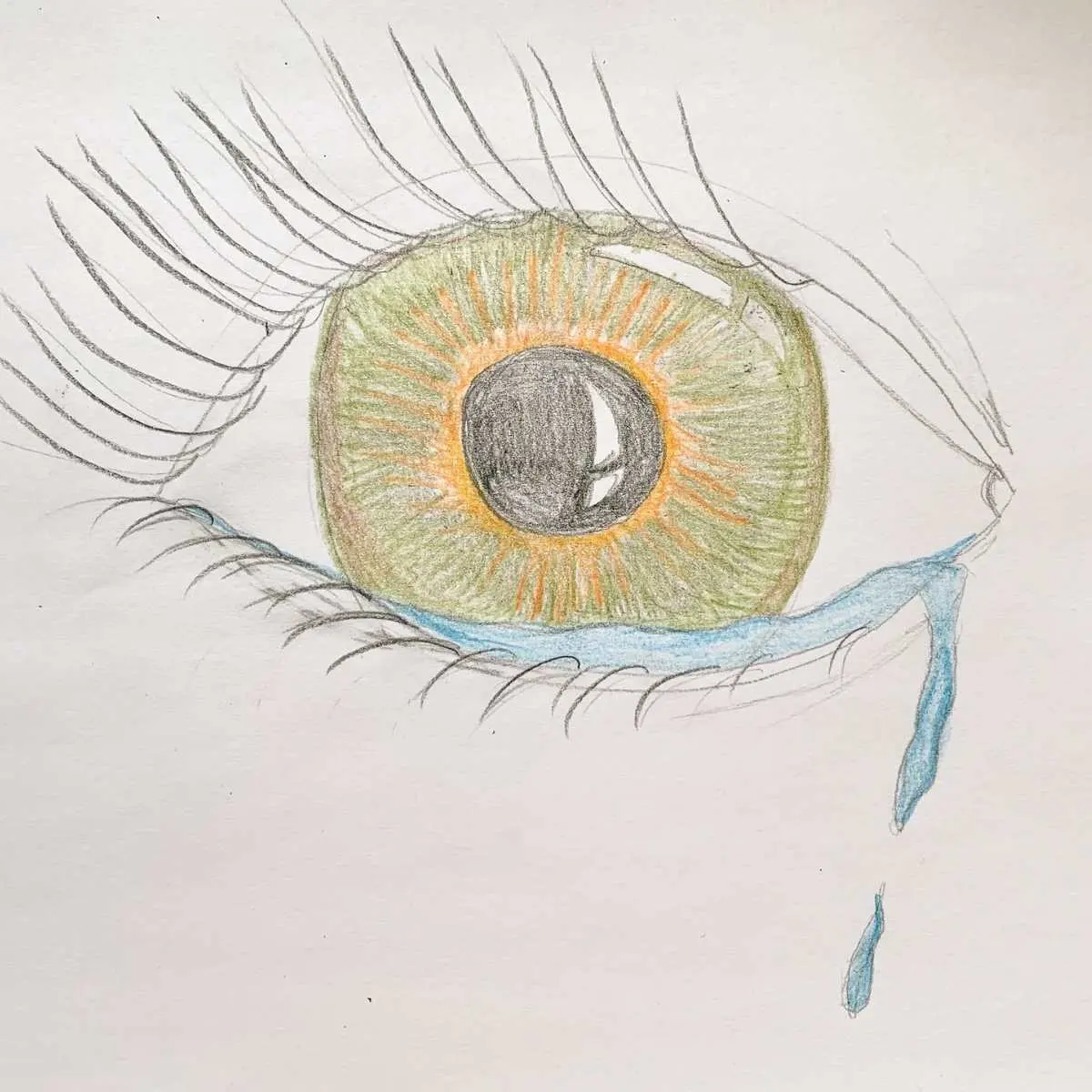
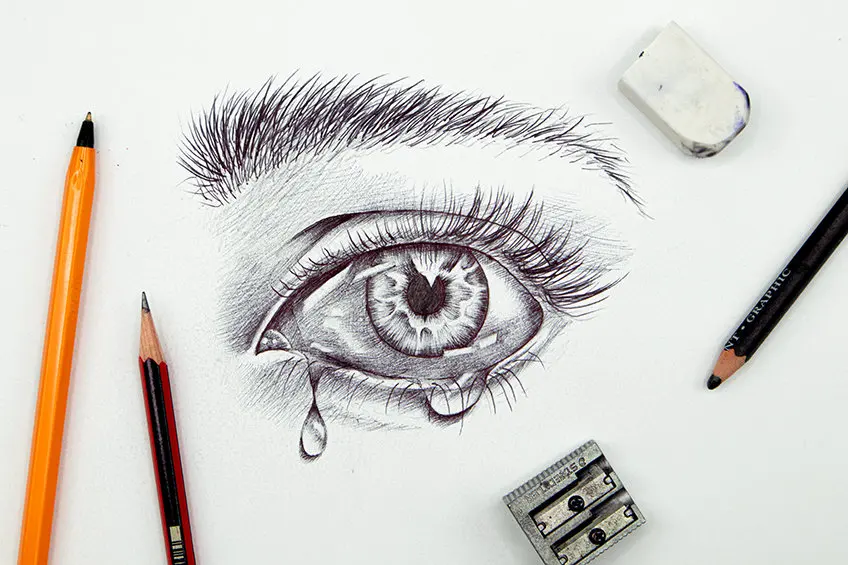
To draw a convincing tear, you must first understand that a tear is essentially a lens that refracts light. Begin by sketching the eye, paying close attention to the lower eyelid, which acts as a shelf for the liquid. Use a sharp graphite pencil to define the lower waterline, as this area is naturally moist and glossy.
- Draw the shape of the tear drop, keeping the edges soft and slightly irregular.
- Place a bright, sharp white highlight near the top of the drop to indicate light reflection.
- Add a soft shadow on the cheek just beneath the tear to show its volume.
- Use a blending stump to smooth out the transitions between the skin and the liquid.
- Apply a final layer of dark graphite around the edges of the drop to increase contrast.
By following these steps, you create a three-dimensional effect that makes the tear appear to cling to the skin rather than sitting flat on the paper.
Why tears look different on skin
The appearance of a tear changes based on the texture of the skin it rests upon. Skin is porous and slightly matte, whereas a tear is perfectly smooth and reflective. To mimic this contrast, you must ensure the surrounding skin is shaded with a textured, grainy pencil stroke, while the tear itself remains clean and polished.
When a tear tracks down a face, it follows the contours of the cheekbone and jawline. Gravity pulls the liquid downward, causing it to widen at the bottom and taper at the top. If you are drawing a tear that has not yet fallen, it will appear as a small, rounded bead. If the tear is streaming, it will look like a thin, translucent ribbon. Always observe how light hits the bulge of the tear, as this is the most critical factor in making it look wet.
Best tools for drawing tears
Achieving high-quality results requires specific drawing materials that allow for both precision and soft blending. A mechanical pencil with 0.5mm lead is essential for drawing the sharp, crisp edges of a highlight. For the darker shadows that give the tear its depth, use a softer 4B or 6B graphite pencil to create a deep, rich tone that contrasts with the white of the paper.
- Kneaded erasers: These are vital for lifting graphite to create the tiny, perfect highlights that define liquid.
- Blending stumps: Use these to soften the edges of the tear so it integrates naturally with the skin.
- White gel pens: These are excellent for adding final, intense highlights that graphite cannot achieve.
- Bristol board: A smooth paper surface is preferred, as heavy tooth paper can make the tear look bumpy and unrealistic.
Investing in these tools helps you maintain control over the fine details that distinguish a professional drawing from a novice attempt.
Common mistakes when drawing tears
One of the most frequent errors is making the tear look too dark or muddy. If you shade the entire tear with a uniform gray, it will look like a solid object rather than a transparent liquid. Remember that a tear is mostly clear; it should be composed of reflected light and the color of the skin beneath it. Another mistake is forgetting the shadow that the tear casts on the face. Without this shadow, the tear will appear to float above the skin rather than resting on it.
Avoid drawing perfect circles, as natural tears are irregular and organic in shape. If your tear looks like a perfect sphere, it will appear artificial. Additionally, do not outline the entire tear with a heavy black line. A thick outline flattens the image and destroys the illusion of transparency. Instead, define the edges through subtle shading and contrast against the surrounding skin tones.
How to add emotions to tear drawings
Tears are rarely just physical objects; they are expressions of human emotion. The way a tear sits on the eye can communicate sadness, joy, or relief. To convey sadness, draw the tear pooling in the corner of the eye, suggesting it is about to overflow. To suggest a tear that has already fallen, draw a long, slightly wavy line trailing down the cheek.
The position of the eyebrows and the tension in the lower eyelid also play a massive role in how the viewer perceives the tears. If the inner corners of the eyebrows are pulled upward, the eyes look pained, which makes the presence of a tear more impactful. By combining precise technical rendering with these subtle anatomical cues, you can create a portrait that feels deeply human. Practice observing real-life references or high-resolution photographs to understand how facial muscles shift when someone is crying, as this will inform your shading and help you create truly emotive artwork.
Key facts
- Tears are produced by the lacrimal glands located above the outer corner of each eye.
- Basal tears constantly coat the eye to keep it moist, while reflex tears flush out irritants like smoke or onion vapors.
- Emotional tears contain higher levels of stress hormones and natural painkillers like leucine enkephalin.
- To draw realistic tears in art, focus on adding a bright white highlight at the top of the droplet to indicate light reflection.
- Use a sharp, dark line to define the bottom edge of the tear to create the illusion of volume and weight.
- A common mistake is drawing tears as perfectly round circles; real tears cling to the lower eyelid and follow gravity's path.
The bottom line
Drawing tears requires capturing the interplay between light and gravity. By placing a stark white highlight on the upper curve and a dark, defined shadow along the lower edge, you create a convincing three-dimensional effect. Remember that tears are not perfectly spherical; they are fluid shapes that cling to the lower lash line. Observing how light refracts through liquid is essential for achieving a realistic, emotive result.
People also ask
Why do onions make people cry?
Onions release a chemical called syn-propanethial-S-oxide when sliced, which turns into sulfuric acid upon contact with eye moisture. The brain triggers reflex tears to wash this irritant away from the surface of the eye.
What is the difference between crying and weeping?
Crying is a broad term for shedding tears, often due to physical pain or irritation. Weeping typically refers to a more intense, prolonged period of shedding emotional tears associated with deep sadness or grief.
Do animals cry like humans do?
While many animals produce basal tears to keep their eyes lubricated, humans are the only species known to shed emotional tears. Other animals may vocalize distress, but they do not use tear production as a social signal for sadness.
Can you run out of tears?
It is physically impossible to run out of tears because the lacrimal glands are constantly producing fluid. However, dehydration or certain medical conditions like Sjögren's syndrome can reduce tear production, leading to chronic dry eyes.
Why do eyes get red when you cry?
Emotional crying causes the blood vessels in the eyes and the surrounding tissues to dilate. This increased blood flow, combined with the irritation of salt in the tears, results in the characteristic redness.
How do contact lenses affect tear production?
Contact lenses can disrupt the tear film, sometimes causing the eyes to produce extra reflex tears to compensate for the foreign object. If the lens is poorly fitted, it may also block the natural flow of basal tears.
This answer was created with the help of AI research tools and reference sources. Spotted an error? Let us know — we correct mistakes quickly. See our editorial policy.