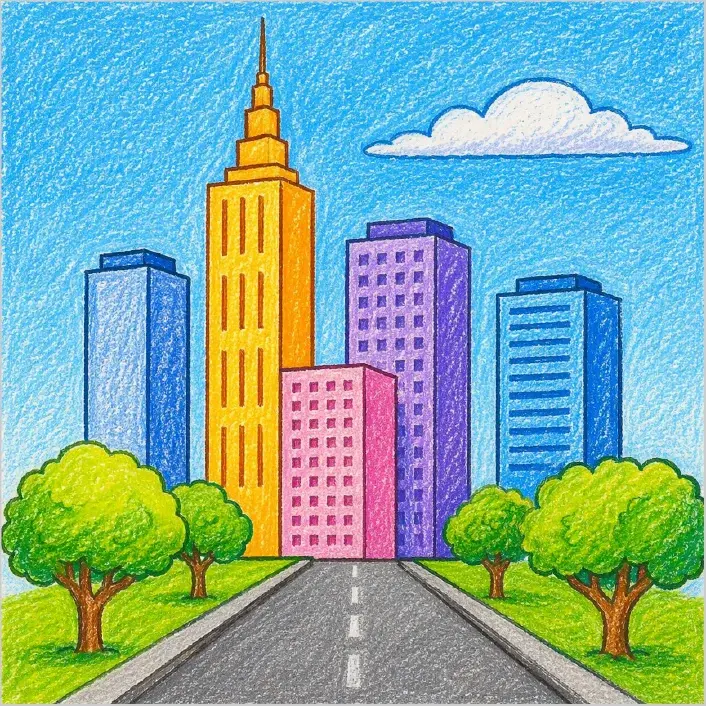
How do you draw a street in perspective step by step?
Short answer
Drawing a street in perspective requires establishing a horizon line and a vanishing point on your paper. By drawing receding diagonal lines from the vanishing point toward the edges, you create the illusion of depth. Adding vertical lines for buildings and horizontal lines for sidewalks completes the fundamental structure of a realistic street scene.
On this page
How to set up one-point perspective
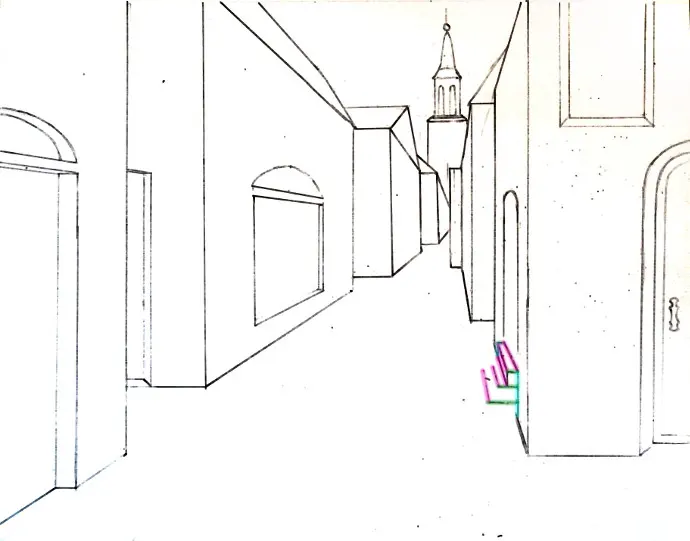
The foundation of any street scene is the horizon line, which represents the viewer's eye level. To begin, draw a horizontal line across the center of your page using a ruler. Place a single point, known as the vanishing point, somewhere along this line. This point acts as the destination for all lines that appear to move away from the viewer toward the distance.
Once the vanishing point is set, you must establish the ground plane. Draw two diagonal lines originating from the vanishing point and extending toward the bottom corners of your paper. These lines define the edges of the street or sidewalk. Everything within these boundaries will appear to shrink as it approaches the vanishing point, creating the necessary spatial depth for a realistic composition.
How to draw buildings in perspective
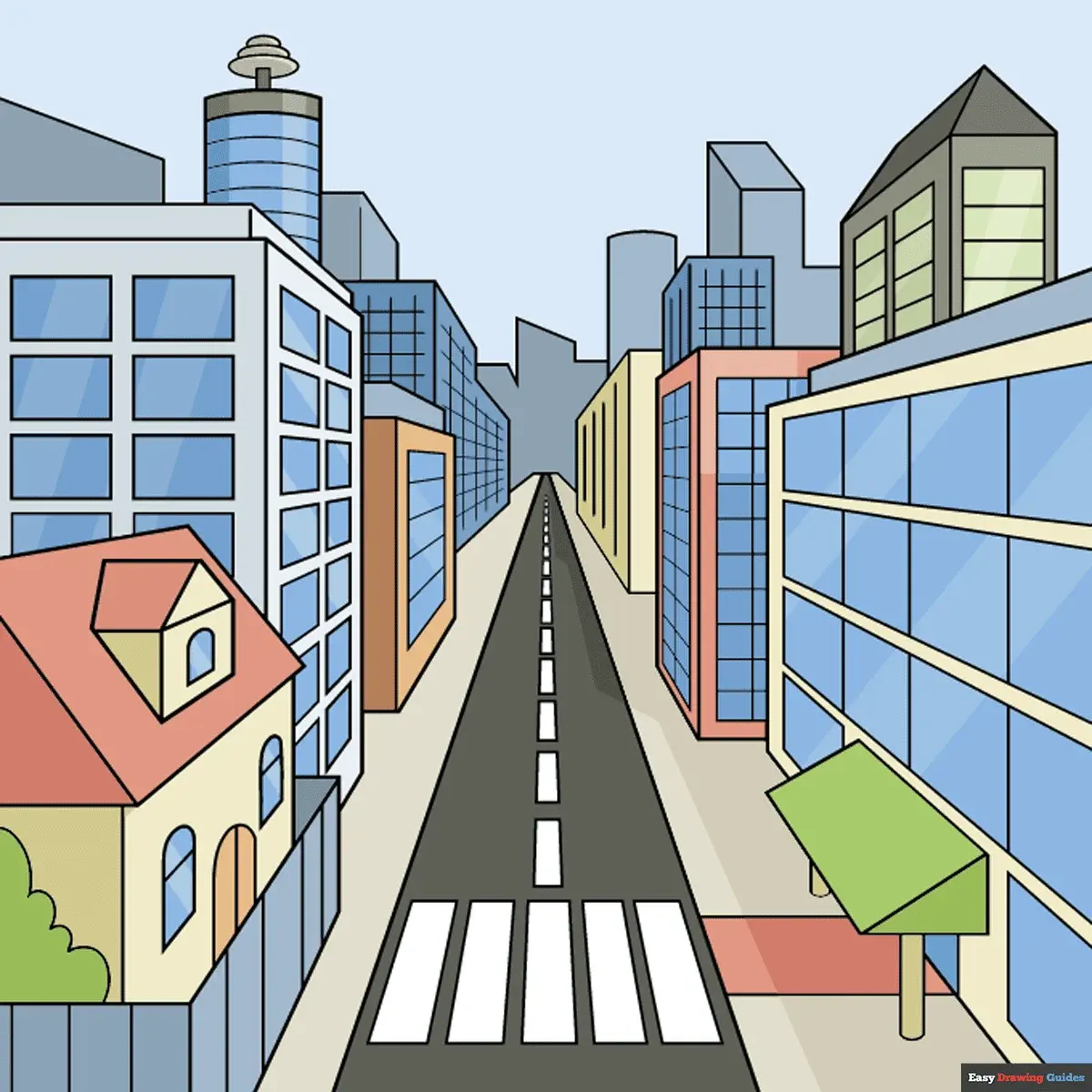
Buildings are the primary elements that define the character of a street. To draw them, start by sketching vertical lines that rise from your ground plane lines. The height of these lines determines the scale of the structures. Because the buildings are parallel to the viewer, their vertical edges remain perfectly perpendicular to the bottom of the page, while their tops and bottoms must connect to the vanishing point.
Follow these steps to construct your buildings accurately:
- Draw a vertical line to represent the corner of a building closest to the viewer.
- Use your ruler to draw light guidelines from the top and bottom of that vertical line to the vanishing point.
- Place another vertical line between those two guidelines to define the back edge of the building.
- Erase the excess guidelines to reveal the solid shape of the structure.
How to add details like windows and doors
Details provide the visual cues that tell the viewer how large a space is. When drawing windows or doors on a building, the vertical sides must remain parallel to the building's main corner. However, the top and bottom edges of these features must align with the vanishing point. This ensures that the windows appear to recede into the distance at the same rate as the building itself.
Consistency is vital when adding these elements. If you are drawing a row of windows, the spacing between them should decrease as they get closer to the vanishing point. Think of this as the "foreshortening" effect, where objects appear compressed in space. By keeping the horizontal lines of your windows tethered to the vanishing point, you maintain the geometric integrity of the entire street scene.
Best tools for perspective drawing
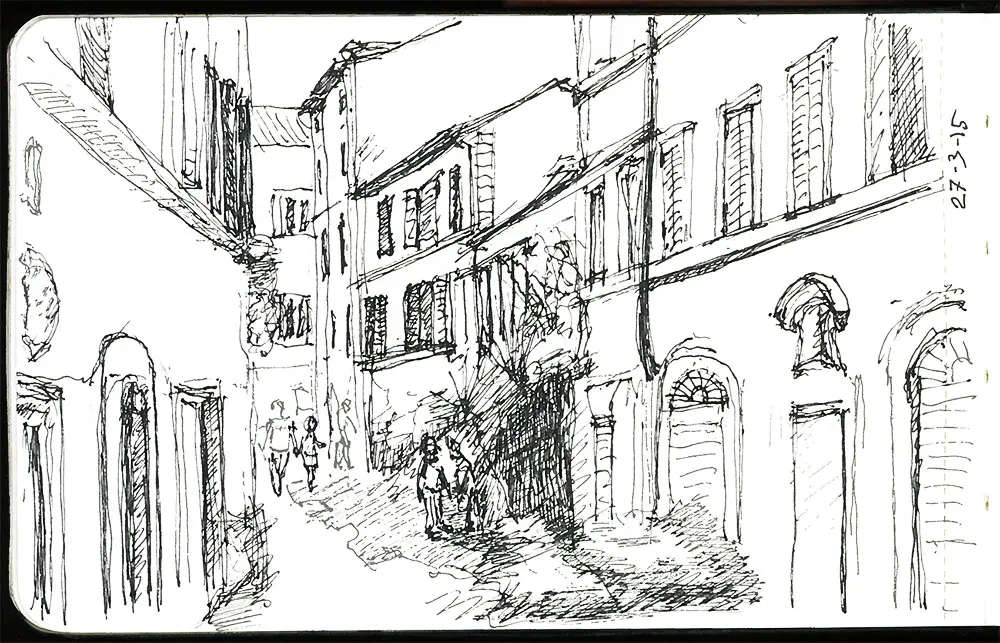
Precision is essential when working with perspective, making a few basic tools indispensable for beginners. A transparent plastic ruler is the most important item, as it allows you to see your previous lines while aligning new ones with the vanishing point. Use a hard lead pencil, such as an H or 2H, for your initial construction lines, as these can be drawn lightly and erased easily without smudging the paper.
In addition to a ruler and pencil, consider using a fine-liner pen for the final outlines. Once your perspective structure is finalized in graphite, tracing over the permanent lines with ink gives the drawing a professional, clean look. A kneaded eraser is also highly recommended because it lifts graphite off the page gently without damaging the paper surface, allowing you to refine your work throughout the drawing process.
Common mistakes when drawing perspective
One of the most frequent errors is failing to keep vertical lines perfectly upright. If a vertical line tilts even slightly, the entire building will look as though it is collapsing, which destroys the illusion of stability. Always ensure your vertical lines are 90 degrees relative to the horizon line. Another mistake is drawing objects that are too large in the distance; remember that every object must adhere to the scale dictated by the vanishing point.
Avoid these common pitfalls to improve your accuracy:
- Drawing lines that do not converge exactly at the vanishing point, resulting in a distorted view.
- Over-detailing buildings in the far distance, which draws too much attention to areas that should be subtle.
- Neglecting the horizon line, which causes the street to look like it is sloping uphill or downhill unintentionally.
- Using heavy pressure for construction lines, making them impossible to remove once the drawing is complete.
By remaining mindful of these rules, you will create a street that feels grounded and structurally sound.
Key facts
- One-point perspective uses a single vanishing point on the horizon line to create the illusion of depth.
- The horizon line should always be placed at the viewer's eye level within the composition.
- All lines representing the sides of buildings or curbs must converge precisely at the vanishing point.
- Vertical lines representing the height of buildings must remain perfectly perpendicular to the bottom edge of the paper.
- Varying the width of the street as it approaches the vanishing point creates a realistic sense of distance.
- Use a straightedge or ruler to ensure all converging lines meet at the exact same point to avoid distortion.
The bottom line
Drawing a street in perspective relies on the consistent use of a horizon line and a single vanishing point. By anchoring all receding lines to this point while keeping vertical lines perfectly upright, you create a convincing sense of depth. Practice using a ruler to ensure precision, as even slight deviations can break the illusion. Mastering these fundamental geometric principles allows you to construct complex urban environments with ease.
People also ask
What is the difference between one-point and two-point perspective?
One-point perspective uses one vanishing point for objects facing the viewer, while two-point perspective uses two points for objects viewed from a corner. One-point is ideal for looking directly down a street.
Where should I place the vanishing point on my paper?
You can place it anywhere on the horizon line, but centering it creates a symmetrical, balanced view. Placing it off-center can make the scene feel more dynamic and natural.
How do I draw objects that are not part of the street?
Any object, such as a lamp post or a person, must follow the same perspective rules. The base of the object should sit on the ground plane, and its height should diminish as it nears the vanishing point.
Why do my buildings look like they are leaning?
This usually happens because the vertical lines are not perfectly parallel to the sides of the paper. Always keep your vertical lines straight up and down, regardless of the angle of the street.
Should I use a grid to help with perspective?
A perspective grid is a helpful tool for beginners to maintain consistent proportions. You can draw light guidelines first and erase them once the main structures are defined.
How do I create the illusion of a curved street?
To draw a curve, you must plot multiple vanishing points along a path or use a series of short, straight segments. Each segment must align with its own specific vanishing point to maintain the perspective.
This answer was created with the help of AI research tools and reference sources. Spotted an error? Let us know — we correct mistakes quickly. See our editorial policy.