How do you draw a ukulele?
Short answer
Drawing a ukulele involves sketching a figure-eight body, a long neck, and a headstock with four tuning pegs. By focusing on the instrument’s hourglass proportions and placing the circular sound hole in the center of the body, you can create an accurate representation of this iconic four-stringed musical instrument.
On this page
How to sketch the basic ukulele shape
The ukulele, a member of the lute family, is defined by its distinct hourglass silhouette. To begin your drawing, lightly sketch two overlapping circles: a larger one for the base and a slightly smaller one for the upper bout. Connect these shapes with smooth, inward-curving lines to form the waist of the instrument. Aim for a balanced look where the bottom section is roughly one-third larger than the top section.
Once the body outline is set, draw a long, rectangular neck extending from the center of the upper bout. The neck should be about two-thirds the length of the body. Add a rectangular headstock at the very top, which is typically wider than the neck itself. Keep your initial lines faint so you can easily erase or adjust the proportions before finalizing the details of the instrument’s structure.
How to add strings and hardware
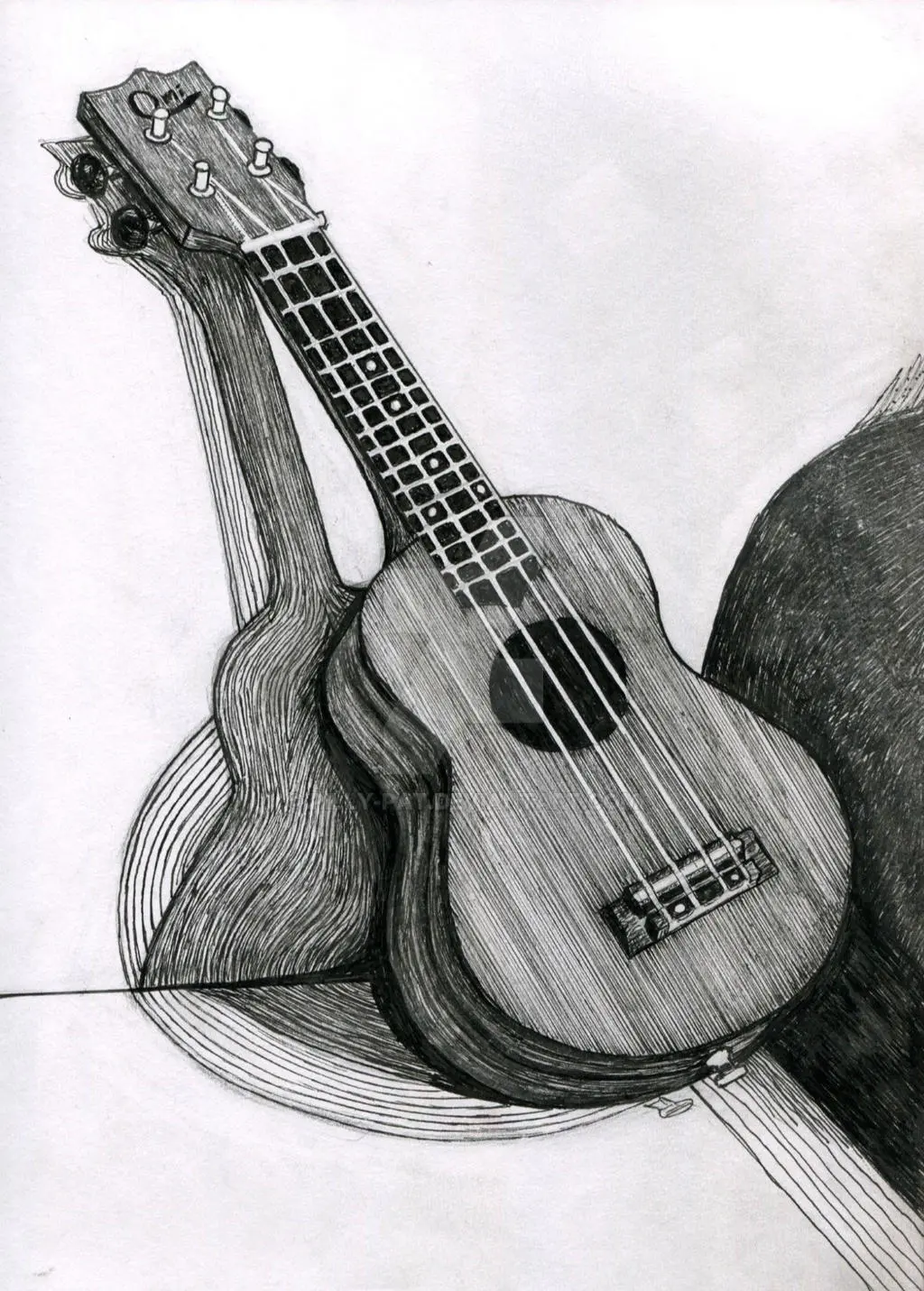
The defining features that transform a simple shape into a recognizable ukulele are the strings and the tuning hardware. A standard soprano, concert, or tenor ukulele features four strings that run from the bridge near the bottom of the body to the tuning pegs on the headstock. Use a ruler to draw these lines straight to ensure they look taut and functional.
- Place the bridge as a small rectangle near the bottom of the body.
- Draw four parallel lines running from the bridge, across the sound hole, and up the neck.
- Add four small circles on the headstock to represent the tuning pegs.
- Connect each string to a peg to show how the instrument is tensioned.
Focus on the symmetry of these elements. If the strings are not aligned with the center of the neck, the ukulele will appear distorted or impossible to play.
Which ukulele parts to detail
Adding specific anatomical details makes your drawing look professional and realistic. The sound hole, located in the center of the body, is a crucial focal point. Draw a circle slightly smaller than the width of the upper bout, and consider adding a thinner ring around it to represent the rosette, which is a decorative inlay found on most quality instruments.
The fretboard is another essential component that requires precision. Draw thin, horizontal lines across the neck to represent the frets, which are usually spaced closer together as they approach the body. You can also add small dots on the fretboard at the 5th, 7th, and 10th positions, as these are standard markers for players to navigate the instrument. These small additions provide the necessary context that differentiates a ukulele from a standard acoustic guitar.

Common mistakes when drawing ukuleles
A frequent error is miscalculating the scale of the headstock. Many beginners draw the headstock too small, which makes the ukulele look unbalanced and top-heavy. Remember that the headstock must be wide enough to accommodate four tuning pegs comfortably. If the pegs are crowded or overlapping, the drawing will lack the technical accuracy required for a realistic depiction of the instrument.
Another common mistake involves the placement of the bridge. If the bridge is drawn too high up on the body, it interferes with the sound hole and ruins the instrument's proportions. Always ensure the bridge is positioned securely on the lower half of the body. Furthermore, avoid drawing the neck too wide; a ukulele neck is significantly narrower than that of a guitar, reflecting its four-string configuration rather than the six strings found on larger instruments.
How to shade for a realistic finish
Shading brings depth to your drawing and helps the ukulele look like a three-dimensional object rather than a flat sketch. Start by identifying a light source, such as the upper left corner. Apply darker shading to the right side of the body and the underside of the neck to create a sense of volume. Use a blending stump or a soft tissue to smooth out the pencil strokes for a polished, wood-like appearance.
- Use cross-hatching techniques to darken the sound hole, as it is a hollow cavity.
- Apply subtle highlights to the strings to make them appear metallic or nylon.
- Add a slight shadow beneath the bridge to show that it is raised above the surface of the body.
- Use vertical strokes on the neck to suggest the texture of the wood grain.
By carefully layering your graphite, you can emphasize the curves of the body and the tension of the strings, resulting in a drawing that captures the authentic spirit of the ukulele.
Key facts
- A ukulele body is shaped like a figure-eight, resembling a miniature acoustic guitar.
- The instrument features four strings, which are typically made of nylon to produce a soft tone.
- The neck is relatively short, usually containing between 12 and 15 frets depending on the size.
- A circular sound hole is positioned in the center of the body, just below the bridge.
- The headstock holds four tuning pegs, two on each side, which control the tension of the strings.
- Draw the bridge as a small rectangle near the bottom of the body to anchor the strings.
The bottom line
Drawing a ukulele is a straightforward process that relies on mastering the classic figure-eight silhouette. By focusing on the proportions of the small body, the four parallel strings, and the distinct headstock with its four tuning pegs, you can create an accurate representation. Remember to include the circular sound hole and the bridge to ensure the instrument is instantly recognizable as a ukulele rather than a guitar.
People also ask
What is the most common ukulele size to draw?
The soprano ukulele is the most iconic and frequently drawn size due to its classic, compact figure-eight proportions.
Should I draw the strings parallel to each other?
Yes, the four strings should run in straight, parallel lines from the bridge up the neck to the headstock.
How do I make the ukulele look three-dimensional?
You can add depth by drawing a slight curve on the side of the body to represent the thickness of the wood.
Are there specific types of ukuleles I should consider?
You might choose between the standard figure-eight shape or the pineapple shape, which features a rounded, oval-like body.
Where do the tuning pegs go on the headstock?
Standard ukuleles feature two tuning pegs on the left side and two on the right side of the headstock.
What is the purpose of the frets on the neck?
Frets are thin metal wires placed horizontally across the fingerboard that allow the player to change the pitch of the strings.
This answer was created with the help of AI research tools and reference sources. Spotted an error? Let us know — we correct mistakes quickly. See our editorial policy.