How do you draw a soccer ball?
Short answer
Drawing a soccer ball requires creating a spherical shape and filling it with a pattern of hexagons and pentagons. Use a compass to ensure perfect symmetry, then sketch a central pentagon surrounded by six hexagons. This geometric arrangement, known as a truncated icosahedron, creates the classic look of a professional match ball.
On this page
How to draw a soccer ball step-by-step
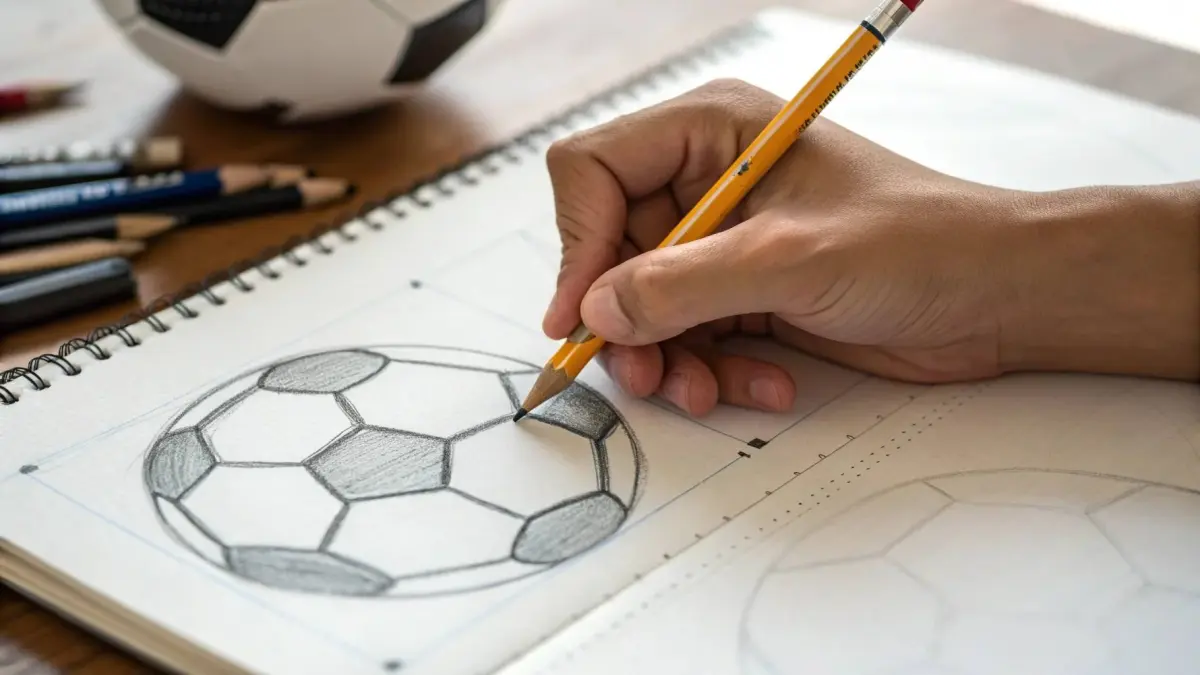
To begin your drawing, start by sketching a large, perfect circle to represent the overall volume of the ball. Use a compass to ensure the circle is symmetrical, as an uneven shape will make the subsequent geometric pattern look distorted. Once the circle is established, lightly mark the center point where your primary pentagon will be placed. This central shape acts as the anchor for the entire design.
Follow these steps to construct the pattern accurately:
- Draw a small pentagon in the exact center of your circle.
- Extend five lines from the corners of this pentagon to form the inner edges of five surrounding hexagons.
- Complete these hexagons by drawing the outer edges to touch the circular perimeter.
- Continue adding smaller pentagons and hexagons as you move toward the edges of the circle, curving the lines slightly to suggest a three-dimensional sphere.
Why the soccer ball pattern is geometric
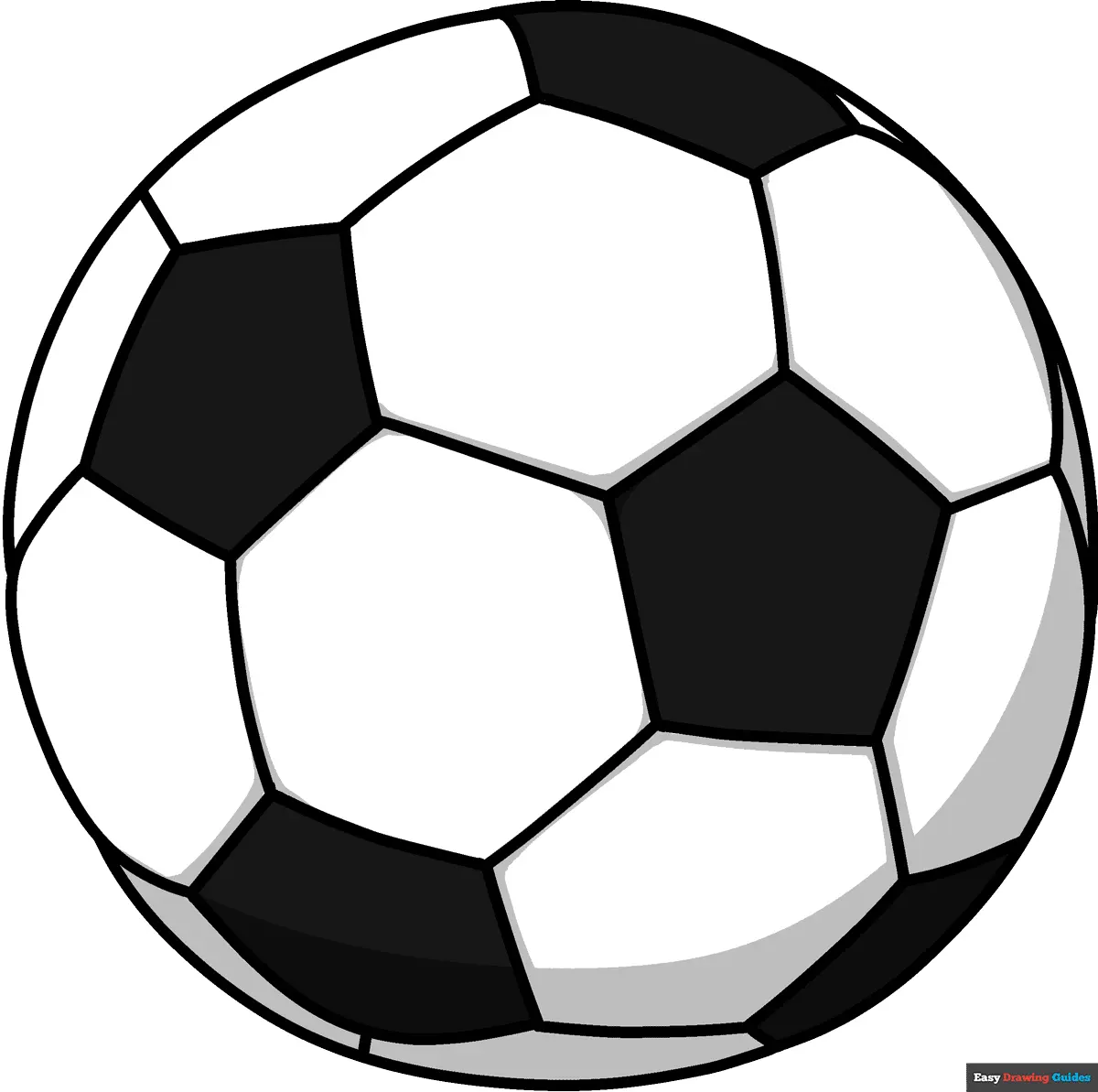
The classic soccer ball design is based on a mathematical shape called a truncated icosahedron. This structure consists of 12 regular pentagons and 20 regular hexagons, totaling 32 panels. While it may look like a simple collection of shapes, this specific configuration is essential for creating a sphere that is as close to perfectly round as possible. The geometry was popularized by the Adidas Telstar, introduced for the 1970 FIFA World Cup, which used black and white panels to make the ball more visible on black-and-white television broadcasts.
When drawing these shapes, remember that the panels must appear to wrap around the curvature of the ball. The shapes near the center should look flat, while those near the edges should appear foreshortened or compressed. This perspective technique provides the illusion of depth and volume, transforming a flat circle into a realistic, rotating object.
Best tools for drawing soccer balls
For the best results, use a set of high-quality drawing pencils, specifically an HB for the initial outline and a 2B or 4B for shading. A mechanical pencil is particularly useful for the geometric lines, as it allows for consistent line thickness throughout the drawing. Avoid using heavy pressure during the initial layout, as you will need to erase the construction lines later to achieve a clean, professional finish.
Consider using the following tools to enhance your work:
- A metal compass for creating a perfectly round base circle.
- A transparent ruler to ensure the sides of your pentagons and hexagons are straight.
- A kneaded eraser to lift away graphite without damaging the paper surface.
- A blending stump or soft tissue to smooth out the shading on the curved surfaces of the panels.
Common mistakes when drawing soccer balls
One of the most frequent errors is neglecting the curvature of the sphere. Beginners often draw the hexagons as flat, uniform shapes across the entire surface, which makes the ball look like a two-dimensional tile pattern rather than a round object. To correct this, ensure that the lines near the edges of the circle are slightly bowed or squashed. This subtle distortion is what convinces the human eye that the object is three-dimensional and solid.
Another common mistake is failing to maintain the correct ratio of pentagons to hexagons. If you add too many pentagons, the ball will look lumpy or incorrectly shaped. Always remember that each pentagon must be completely surrounded by hexagons; they should never touch each other directly. Keeping this rule in mind will ensure your drawing remains mathematically accurate and visually pleasing. If your lines look messy, do not hesitate to restart; precision is the hallmark of a realistic technical drawing.
How to shade a soccer ball for realism
Shading is the final step that brings your soccer ball to life. Identify a single light source, such as a lamp to the top-left, and ensure your shadows consistently fall on the opposite side of each panel. The panels closest to the light source should remain bright, while those on the opposite side should be darkened using cross-hatching or smooth graphite strokes. This contrast creates the necessary depth to make the ball pop off the page.
Pay close attention to the cast shadow beneath the ball, which anchors it to the ground. A soft, elliptical shadow directly under the ball, fading as it moves away, adds weight and realism. Use a lighter touch for the reflected light on the shaded side of the ball to show that the surface is slightly glossy. By combining precise geometric lines with thoughtful, consistent shading, you can create a drawing that captures the authentic spirit and structure of a professional soccer ball.
Key facts
- A standard modern soccer ball, known as a Telstar design, consists of 20 hexagonal panels and 12 pentagonal panels.
- The 12 pentagons are traditionally colored black, while the 20 hexagons are white to increase visibility.
- To draw the pattern, start by sketching a central pentagon and surround it with five hexagons.
- Use a compass or a circular stencil to ensure the overall shape of the ball remains perfectly spherical.
- A common mistake is drawing flat edges; remember to curve your lines slightly to create a three-dimensional volume.
- Shading the edges of the panels toward the center of the ball helps simulate the curvature of a sphere.
The bottom line
Drawing a soccer ball requires balancing geometric precision with an understanding of spherical perspective. By starting with a central pentagon and building outward with hexagons, you create the classic structure. Remember that shading is the key to transforming a flat circle into a realistic, three-dimensional object. With practice, you can master the curvature and panel placement necessary to depict this iconic piece of sports equipment accurately.
People also ask
Why are soccer balls made of hexagons and pentagons?
This geometric pattern, called a truncated icosahedron, allows flat panels to form a shape that is as close to a perfect sphere as possible. It provides structural integrity and consistent aerodynamics during flight.
How do I draw a soccer ball without a compass?
You can trace the bottom of a circular object like a bowl or a roll of tape to create the outer boundary. Use a ruler to ensure your internal panels maintain consistent proportions across the curved surface.
Should I draw the black panels first or the white ones?
It is easiest to draw the pentagons first as anchor points. Once the 12 pentagons are placed, you can simply connect them with the hexagonal shapes to complete the pattern.
What is the best tool for shading a soccer ball?
A soft graphite pencil works best for creating smooth gradients. Use a blending stump or a tissue to soften the transitions between light and shadow on the rounded panels.
Is it necessary to draw all 32 panels for a realistic look?
You do not need to draw every panel if the ball is viewed from a distance or at an angle. Focus on the panels facing the viewer to establish the pattern, then allow the detail to fade toward the edges.
Why does my soccer ball look flat when I draw it?
The most common cause is ignoring the horizon line or failing to shade the panels. Adding a drop shadow beneath the ball and darkening the panels furthest from the light source will give it depth.
This answer was created with the help of AI research tools and reference sources. Spotted an error? Let us know — we correct mistakes quickly. See our editorial policy.