Why is The Birth of Venus so famous?
Short answer
Sandro Botticelli’s The Birth of Venus, painted around 1485, is iconic for its revolutionary blend of classical mythology and Renaissance humanism. It broke artistic conventions by featuring a large-scale female nude in a secular context. Its ethereal aesthetic, technical mastery, and status as a symbol of Florence’s cultural golden age ensure its enduring fame.
On this page
Why is The Birth of Venus so famous?
The painting gained historical prominence because it was one of the first large-scale works in the Italian Renaissance to depict a mythological subject rather than a religious one. Commissioned by the wealthy Medici family, the piece reflects the intellectual climate of 15th-century Florence, where scholars were rediscovering ancient Greek and Roman philosophy. By placing Venus, the goddess of love, at the center of the composition, Botticelli elevated pagan themes to a level of importance previously reserved for Christian iconography.
This work is also famous for its departure from the rigid realism favored by many of Botticelli’s contemporaries. Instead of focusing on anatomical precision, the artist prioritized grace, elongated proportions, and a sense of dreamlike movement. This stylistic choice created a poetic atmosphere that resonated with the Neoplatonic ideals of the time, which sought to connect physical beauty with divine truth. Today, the painting serves as the quintessential visual representation of the Renaissance spirit.
What is the history of The Birth of Venus?
Sandro Botticelli created this tempera-on-canvas masterpiece in the mid-1480s, likely for a member of the Medici family. Unlike many works of the era that used wood panels, Botticelli chose canvas, which was then a relatively new and experimental medium for such a significant commission. The painting remained in the Medici collection for centuries before eventually being moved to the Uffizi Gallery in Florence, where it has resided since 1815.
The painting’s survival through the centuries is a testament to its cultural value. It has weathered political upheavals, wars, and the changing tastes of art history to remain a centerpiece of Western civilization. Its journey from a private villa to a public museum has allowed millions of people to view it, cementing its status as a global icon. Key historical milestones include:
- 1485: Estimated completion date of the work.
- 1815: The painting is officially transferred to the Uffizi Gallery.
- 1987: A major restoration project is completed to stabilize the pigments and remove centuries of grime.
How to analyze the symbolism in the painting?
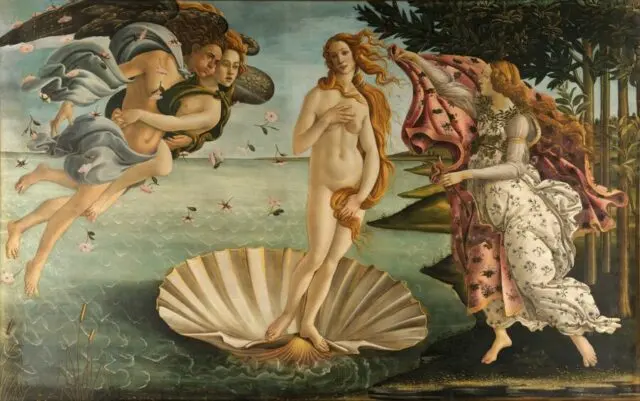
To understand the deeper meaning of the work, viewers must look at the specific figures and elements surrounding the central subject. Venus stands on a giant scallop shell, symbolizing the arrival of love and beauty into the world. To her left, the wind gods Zephyrus and Aura blow her toward the shore, representing the physical forces of nature. On the right, a figure known as the Hora of Spring waits to clothe the goddess in a floral-patterned mantle.
The painting is rich with allegorical layers that invite careful observation. The following elements are crucial for a proper interpretation:
- The Scallop Shell: Often associated with the birth of life from the sea.
- The Roses: Falling through the air, they represent the creation of love, which is said to have brought flowers into existence.
- The Pose: Venus adopts the Venus Pudica or "modest Venus" stance, a classical pose that emphasizes her vulnerability and divine grace.
- The Landscape: The stylized coastline and trees reflect a symbolic, rather than realistic, vision of the natural world.
Common mistakes when interpreting Botticelli's work
One common error is assuming that the painting is meant to be a realistic or anatomical study. Because Botticelli intentionally elongated the neck and shoulders of Venus, some critics might wrongly label the work as technically flawed. In reality, these distortions were deliberate artistic choices made to enhance the elegance and ethereal quality of the figure. Judging the painting against modern standards of photographic realism ignores the artist’s intent to capture an ideal, rather than a physical, form.
Another mistake is viewing the painting in isolation from its intellectual context. Many viewers fail to recognize the influence of Neoplatonism, a philosophy that merged ancient mythology with Christian thought. Without understanding that the Medici circle viewed Venus as both a pagan goddess and a symbol of spiritual beauty, the painting loses much of its intended depth. Avoiding these pitfalls requires looking past the surface beauty to consider the philosophical questions the artist was attempting to answer for his patrons.
Where to see The Birth of Venus today?
The painting is permanently housed in the Uffizi Gallery in Florence, Italy. As one of the most visited museums in the world, the Uffizi provides a professional environment for viewing the work within the context of other Renaissance masterpieces. Visitors can observe the delicate brushwork and the subtle use of gold highlights that make the painting appear to shimmer under the gallery lights. Seeing the original work allows for an appreciation of its scale, which is roughly six feet by nine feet.
If you are planning a visit to see this masterpiece, keep these practical tips in mind to ensure the best experience:
- Book tickets in advance: The Uffizi is extremely popular, and walk-up tickets often sell out hours in advance.
- Visit during off-peak hours: Arriving early in the morning or late in the afternoon can help you avoid the largest crowds.
- Study the layout: The painting is located in the Hall of Botticelli, which also contains his other famous work, Primavera.
- Respect the rules: Photography without flash is generally permitted, but always check current museum policies upon arrival to ensure you are following the latest guidelines for preservation.
Key facts
- Sandro Botticelli painted The Birth of Venus in the mid-1480s, likely commissioned by the Medici family.
- It is one of the first large-scale paintings on canvas in Tuscany, as most works of that era were painted on wood panels.
- The painting depicts the goddess Venus arriving at the shore after her birth, standing on a giant scallop shell.
- It was a radical departure from the period’s focus on Christian themes, marking a shift toward secular, mythological subjects.
- The work measures approximately 5 feet 8 inches by 9 feet 1 inch, making it a monumental piece of Renaissance art.
- To view the painting in person, visit the Uffizi Gallery in Florence, Italy, where it has been housed since the early 19th century.
The bottom line
The Birth of Venus remains famous because it perfectly captures the spirit of the Italian Renaissance. By blending classical mythology with innovative artistic techniques, Botticelli created an iconic image of beauty that broke from religious tradition. Its large scale, graceful composition, and historical significance as a Medici commission ensure its status as a masterpiece, continuously captivating viewers with its serene, dreamlike depiction of a divine arrival.
People also ask
Is the woman in the painting actually Venus?
Yes, she represents the Roman goddess of love and beauty. Botticelli modeled her after Simonetta Vespucci, a famous beauty of the Florentine Renaissance.
Why is Venus standing on a shell?
The shell is a classical symbol of fertility and the sea. It serves as a vessel to transport the goddess from the ocean to the island of Cyprus.
What are the figures on the left doing?
Those are the wind gods, Zephyrus and Aura, who are blowing Venus toward the shore. They are surrounded by roses, which were said to have been created at the same time as Venus.
Who is the woman on the right side of the painting?
She is one of the Horae, the goddesses of the seasons. She is reaching out to cover Venus with a floral-patterned cloak to protect her modesty.
What techniques did Botticelli use to make the painting look unique?
He used egg tempera on canvas, which gives the colors a matte, ethereal quality. He also utilized long, flowing lines to emphasize the grace and movement of the figures.
Are there any common mistakes when interpreting this painting?
A common error is assuming the painting is anatomically perfect, as Botticelli prioritized elegance over realism. Venus’s neck is unusually long and her shoulders are sloped, which were intentional stylistic choices to enhance her divine beauty.
This answer was created with the help of AI research tools and reference sources. Spotted an error? Let us know — we correct mistakes quickly. See our editorial policy.