How do you draw a gas station?
Short answer
Drawing a gas station requires establishing a strong perspective, typically using a two-point approach to capture the corners of the canopy and building. Focus on the geometry of the fuel pumps, the structural pillars, and the signage. By organizing these elements into simple geometric shapes, you create a realistic, functional scene.
On this page
How to draw a gas station structure
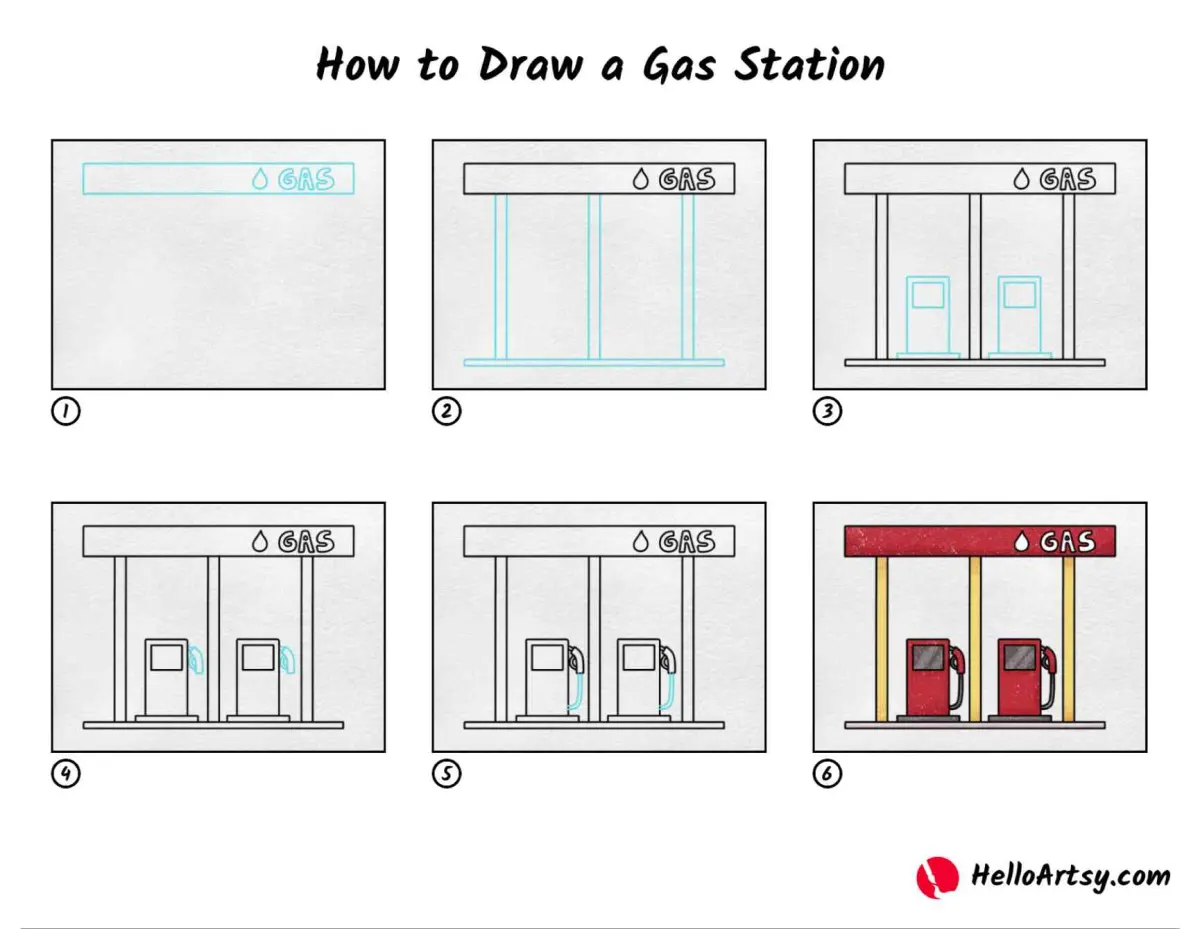
The foundation of a gas station drawing is the canopy, which is the large, flat roof covering the fuel pumps. Start by sketching two vanishing points on your horizon line to create a two-point perspective. Draw the rectangular outline of the canopy as a thin, horizontal prism. This provides the scale for the rest of your composition.
Once the canopy is set, place the vertical pillars that support it. These should align with the corners of your canopy prism. Beneath the canopy, draw the fuel pumps as smaller, vertical rectangular blocks. Keep these shapes simple at first to ensure they sit correctly on the ground plane. Using a ruler for these initial lines helps maintain the architectural precision required for a believable structure.
- Draw a horizon line across your paper.
- Place two vanishing points at the far ends of the line.
- Sketch the canopy as a long, thin box angled toward both points.
- Add vertical lines for the support pillars.
- Place rectangular fuel pumps on the ground, aligned with the perspective.
Best tools for drawing buildings
For beginners, a mechanical pencil with 0.5mm or 0.7mm lead is ideal for creating crisp, clean lines. Because gas stations are defined by sharp angles and straight edges, a high-quality metal or plastic ruler is essential. Avoid using freehand lines for the main structural elements, as even slight wobbles can make the entire building look distorted or unstable.
Use a kneaded eraser to lift away graphite without damaging the paper surface. This is particularly useful when you need to clean up the construction lines that define your perspective grid. For finishing, fine-liner pens with varying tip sizes allow you to add weight to the foreground elements while keeping background details light. This contrast helps create depth, making the station appear three-dimensional rather than flat.
- Mechanical pencil (HB or 2B lead)
- Metal ruler or T-square
- Kneaded eraser
- Fine-liner pens (0.1mm to 0.5mm)
- Smooth-surface drawing paper
Why perspective is important in architecture
Perspective is the mathematical system that mimics how human eyes perceive depth. If the lines of the gas station canopy do not converge toward the vanishing points, the drawing will look "broken" or illogical. Many artists struggle because they draw the building from a flat, frontal view, which removes the sense of space and distance that makes a drawing look professional.
When drawing a gas station, consider the eye level of the viewer. If you place the horizon line low, the station will look imposing and grand. If you place it high, it feels like you are looking down upon the site from a drone or a second-story window. Consistency in your vanishing points is the single most important factor in ensuring the station looks like a real-world object rather than a cartoon sketch.
Common mistakes when drawing gas stations
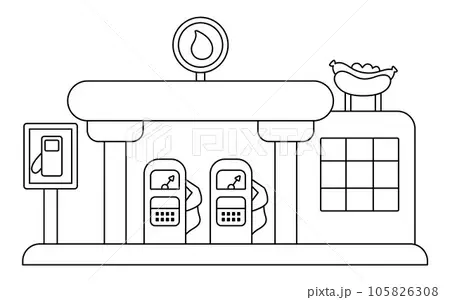
A frequent error is failing to account for the thickness of the canopy roof. Beginners often draw the canopy as a single line, which ignores the structural reality of the building. Add a second, parallel line a short distance below the first to show the depth of the roof fascia. This small detail adds significant realism and provides a place to eventually draw the company logo or signage.
Another common mistake is neglecting the ground plane. Gas stations are usually surrounded by concrete pads, drainage grates, and curb lines. If you draw the pumps floating on a blank white page, the drawing will lack context. Always include a few lines to indicate the pavement surface, as this anchors the pumps to the ground and completes the architectural scene. Ensure your shadows are consistent, as light hitting the canopy should cast a shadow on the ground in the same direction for all objects.
How to add details and texture
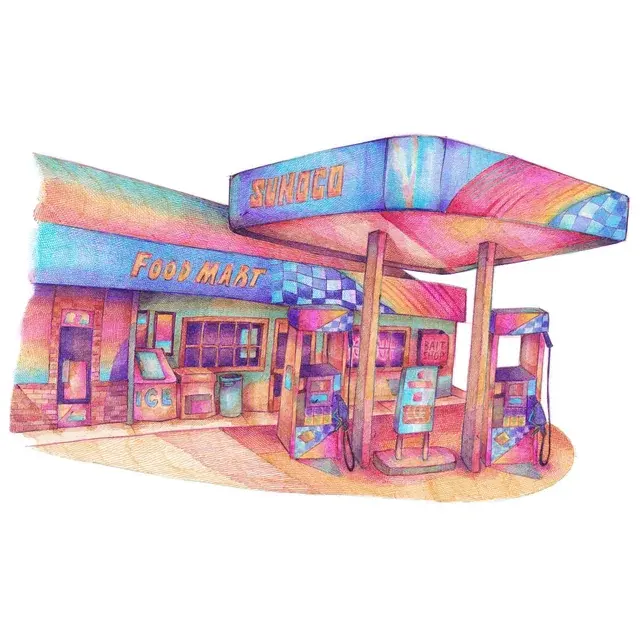
Once the structure is firm, focus on the functional details that identify the building as a gas station. Add the hose reels on the side of the pumps and small squares for the payment card readers. These details do not need to be complex; simple marks and small rectangles are enough to suggest the machinery. Adding a few cars parked near the pumps also provides a sense of scale.
Finally, consider the lighting and shading to give the station a polished look. Use cross-hatching or stippling to darken the underside of the canopy, as this area is typically shielded from direct sunlight. Highlighting the edges of the pumps with a white gel pen can make them look metallic and reflective. By layering these details, you transform a basic geometric frame into a convincing, recognizable environment that captures the busy energy of a roadside stop.
Key facts
- Gas stations are defined by a large, flat canopy supported by columns that protects the pump area from weather.
- Use two-point perspective to create depth, placing the vanishing points on the horizon line outside the drawing area.
- Sketch the main building as a simple rectangular prism, typically housing a convenience store with large glass windows.
- Fuel pumps are rectangular blocks located beneath the canopy, usually arranged in parallel rows for vehicle access.
- Incorporate a tall, thin pylon sign near the street to display fuel prices, which serves as a visual landmark.
- Add horizontal lines or pavement markings on the ground to indicate traffic flow and parking spaces for cars.
The bottom line
Drawing a gas station effectively relies on mastering perspective and scale. By establishing a strong horizon line and using simple geometric shapes for the canopy, pumps, and store building, you create a believable structure. Focus on the relationship between the vehicle size and the pump height to ensure proportions remain accurate. Adding small, functional details like signage and pavement markings will complete the realistic look of your composition.
People also ask
What is the most important feature to include for realism?
The canopy is the most recognizable element of a gas station. Ensure it is drawn with a slight thickness to show it is a structural roof rather than just a flat line.
How do I draw the fuel pumps correctly?
Draw them as simple vertical boxes with thin rectangles on the sides representing the nozzle hoses. Keep them proportional to the height of a standard car.
Should I include cars in the drawing?
Adding cars helps establish the scale of the station. Draw them parked at the pumps to show how the space is intended to be used.
How do I handle the windows on the convenience store?
Use a grid pattern to represent the glass panes. Adding a slight blue or grey tint with white highlights can suggest reflection and transparency.
What is a common mistake when drawing the canopy?
Beginners often forget to draw the support columns. Always include at least two visible pillars to make the structure appear physically stable.
How do I make the station look busy?
Add details like trash cans, air pumps, and signage on the building exterior. These small objects break up the empty space and add visual interest.
This answer was created with the help of AI research tools and reference sources. Spotted an error? Let us know — we correct mistakes quickly. See our editorial policy.