How do you draw an airport?
Short answer
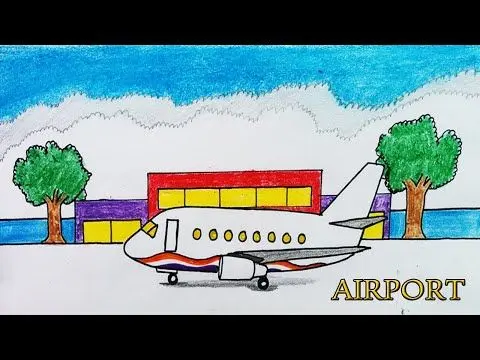
Drawing an airport requires balancing architectural precision with functional layout. Start by sketching the central terminal building, then extend runways and taxiways as straight, intersecting lines. Incorporate essential zones like parking lots, hangars, and control towers. Use a bird’s-eye perspective to maintain scale and clarity across the entire airfield complex.
On this page
How to structure an airport layout
A functional airport drawing begins with the terminal, which serves as the visual anchor. Place this structure near the center or along one side of your paper, ensuring it has enough space for surrounding gates and boarding bridges. Connect the terminal to the tarmac using a series of parallel lines that represent taxiways. Keep these paths wide enough to accommodate the scale of your aircraft.
Runways are the most important geometric elements in your drawing. They should be long, straight, and clearly marked with numbers corresponding to their magnetic compass headings, such as 09 or 27. When drawing multiple runways, ensure they intersect at logical angles to allow for different wind conditions. Use a ruler to maintain sharp edges, as airport infrastructure relies on precise, linear geometry to ensure safe ground operations.
Best drawing techniques for beginners
Start your sketch using light pencil strokes to establish the primary zones before committing to ink. Begin by outlining the main terminal building as a large rectangle or a series of connected polygons. Once the footprint is established, add the runway system as long, thin strips extending toward the edges of the page. This approach prevents the common error of running out of space for critical infrastructure.
- Draw the terminal building first to establish the central hub.
- Sketch the primary runway as a long, straight line intersecting the site.
- Add taxiways connecting the runway to the terminal gates.
- Include secondary structures like hangars and the control tower.
- Use a fine-liner pen to finalize the lines and add runway markings.
By following these steps, you maintain a logical flow that mimics real-world civil engineering. Focus on the relationship between the terminal and the apron, where planes park and load passengers.
Why scale and perspective matter
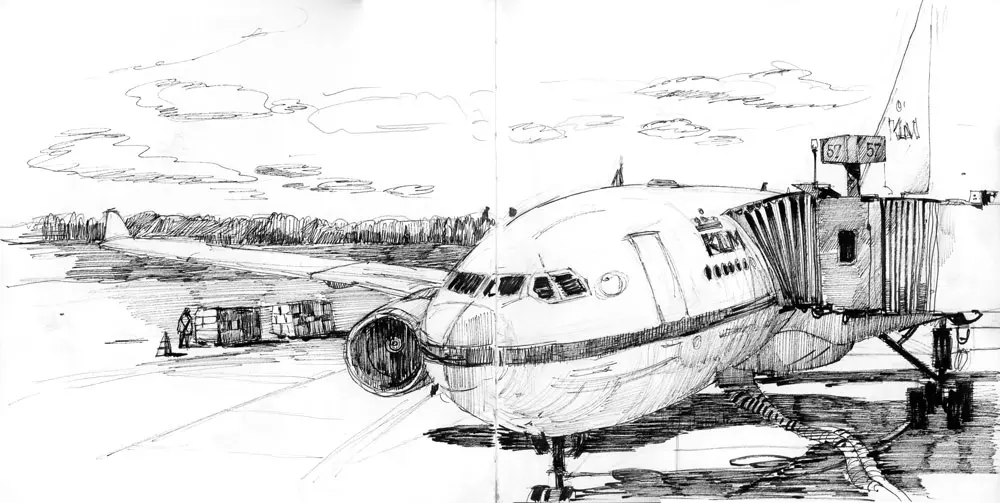
Airport design is defined by its massive scale, which can be difficult to translate onto paper. To achieve a professional look, maintain a consistent bird’s-eye view, also known as an orthographic projection. If you draw the terminal from a side angle but the runways from above, the drawing will lack spatial coherence. Keep all elements on a flat, two-dimensional plane to emphasize the organized grid of the airfield.
Proportion is equally vital when detailing the support buildings. A control tower should appear significantly taller than the terminal but much smaller than the total length of a runway. If you struggle with proportions, look at satellite imagery of major hubs like London Heathrow or Hartsfield-Jackson Atlanta. Notice how the runways dominate the landscape, while the terminal buildings are clustered in a dense, interconnected web. This contrast between vast open space and concentrated building clusters is what makes an airport drawing recognizable.
Common mistakes when drawing airports
One of the most frequent errors is neglecting the "airside" versus "landside" divide. The landside includes parking lots, access roads, and drop-off zones, while the airside is restricted to aircraft operations. Beginners often draw runways that lead directly into a parking lot, which is functionally impossible. Always separate these zones with a clear boundary, such as a perimeter fence or a security line, to reflect how actual airports operate.
- Drawing runways without clear arrival and departure paths.
- Forgetting to include the control tower, which is the visual focal point.
- Neglecting to add aircraft silhouettes for scale reference.
- Making taxiways too narrow for the planes to realistically turn.
- Omitting the complex network of roads that lead to the terminal.
Avoiding these oversights ensures that your drawing reflects the reality of aviation infrastructure. Remember that airports are designed for efficiency, so every line on your page should serve a specific purpose in the movement of vehicles or aircraft.
Essential details for a realistic finish
To bring your drawing to life, focus on the small details that define an active airport. Add runway markings, such as white threshold stripes at the ends of the pavement, and yellow centerlines on the taxiways. These markings provide visual interest and demonstrate an understanding of aviation safety standards. You can also sketch small, simplified airplane shapes near the gates to show the scale of the aircraft relative to the terminal buildings.
Finally, consider the environment surrounding the airport. Adding a few trees, service vehicles, or cargo containers near the hangars adds depth and context to the scene. Use shading to differentiate between the concrete of the runways and the surrounding terrain. By layering these small, deliberate details over your primary structural lines, you transform a basic diagram into a sophisticated architectural illustration. Consistency in your line weight and attention to these minor features will result in a professional and accurate representation of an airport.
Key facts
- Start by drawing a long, horizontal rectangle for the runway, as it is the most defining feature of any airport.
- Position the terminal building as a complex shape connected to the runway by narrow taxiways.
- Use a vanishing point perspective to give the flat tarmac depth and a sense of scale.
- Include small circles or rectangles to represent parked aircraft near the gates to add life to the drawing.
- Add ground markings like white stripes on the runway and yellow lines for taxiway centerlines to increase realism.
- Avoid drawing too many small details at once; focus on the massive geometry of the hangars and runways first.
The bottom line
Drawing an airport requires balancing large, geometric shapes with precise, linear markings. By establishing a clear horizon line and using perspective to guide your runway placement, you create a realistic foundation. Focus on the relationship between the terminal, taxiways, and runways to ensure the scale remains accurate. With simple shapes for aircraft and careful attention to ground markings, you can effectively capture the complex scale of aviation infrastructure.
People also ask
How do I make the runway look realistic?
Draw the runway as a trapezoid that narrows toward the horizon line to create depth. Add parallel white lines along the edges and a dashed centerline to mimic standard aviation markings.
What is the best way to draw airplanes on the ground?
Sketch the planes as simple cylinders with triangular wings and a small tail section. Keep them significantly smaller than the terminal building to maintain proper scale.
Should I draw the airport from a bird's-eye view?
An aerial perspective is the easiest way to show the layout of runways, terminals, and parking lots simultaneously. It allows you to map out the entire airport infrastructure clearly.
How do I draw the control tower?
Place the control tower near the center of the terminal area as a tall, thin pillar with a wider, glass-enclosed cabin at the top. This provides a clear focal point for your drawing.
What common mistakes should I avoid?
Avoid drawing the runways too close to the terminal, as airports require significant buffer zones for safety. Also, ensure your lines are straight by using a ruler to prevent the infrastructure from looking unstable.
How do I add detail to the terminal building?
Use a grid pattern to represent rows of windows and glass walls. Adding subtle shadows underneath the roof overhangs will give the structure a three-dimensional appearance.
This answer was created with the help of AI research tools and reference sources. Spotted an error? Let us know — we correct mistakes quickly. See our editorial policy.