How do you draw a crocodile for beginners?
Short answer
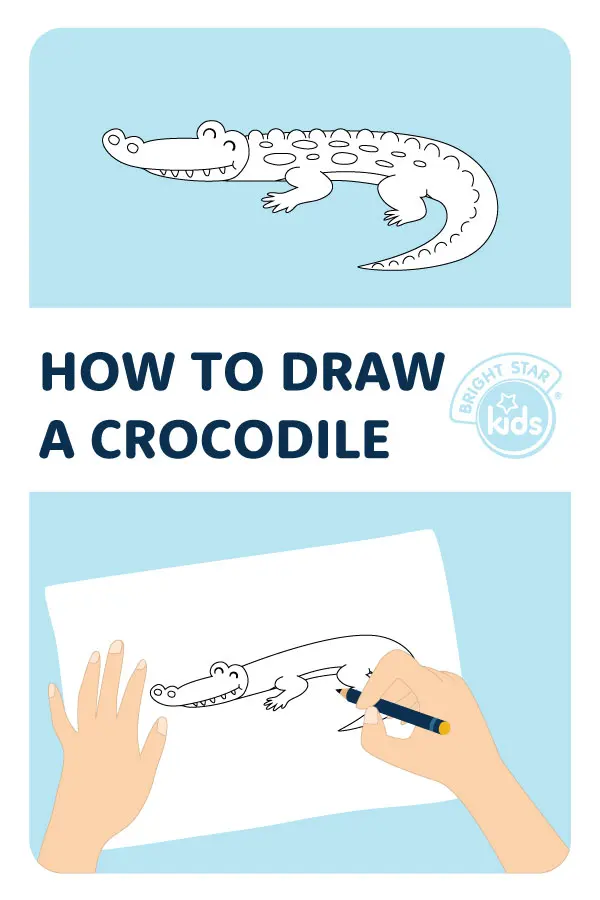
Drawing a crocodile involves breaking its complex form into simple geometric shapes. Start by sketching an elongated oval for the body and a long, triangular snout. Connect these with a curved neck, then add sturdy legs and a powerful tail. Refine the outlines with jagged scales and teeth to achieve realism.
On this page
How to draw a crocodile step by step
To begin your drawing, focus on the basic skeletal structure rather than the details. Start by sketching a long, horizontal oval to represent the main body mass. Position a smaller, elongated rectangle or triangle at the front to serve as the snout, ensuring it connects smoothly to the head area. Keep your pencil strokes light so you can easily erase or adjust the proportions as you refine the sketch.
Once the primary shapes are in place, add the limbs and tail to give the creature movement. Crocodiles have short, thick legs that splay outward from the body, so draw them as sturdy, bent cylinders. The tail should be long and muscular, tapering to a point at the end. Use these steps to build your foundation:
- Draw a large, flattened oval for the torso.
- Add a long, narrow triangle for the snout and jaw.
- Sketch four short, thick legs with clawed feet.
- Extend a long, thick tail from the back of the oval.
Best tools for crocodile drawing
For beginners, using a standard HB graphite pencil is ideal because it allows for both light sketching and darker shading. A set of drawing pencils ranging from 2B to 6B can help you achieve deeper contrast when you begin adding the texture of the crocodile’s hide. Keep a high-quality white vinyl eraser nearby, as you will likely need to clean up your initial construction lines once the final form is established.
The type of paper you choose also influences the quality of your drawing. Smooth, medium-weight drawing paper or a dedicated sketchbook is preferable to printer paper, as it handles erasing better and holds graphite particles more effectively. If you want to add color, colored pencils or markers are excellent choices for beginners. They allow you to layer greens, browns, and grays to mimic the natural camouflage of the reptile’s skin.
How to add texture to a crocodile
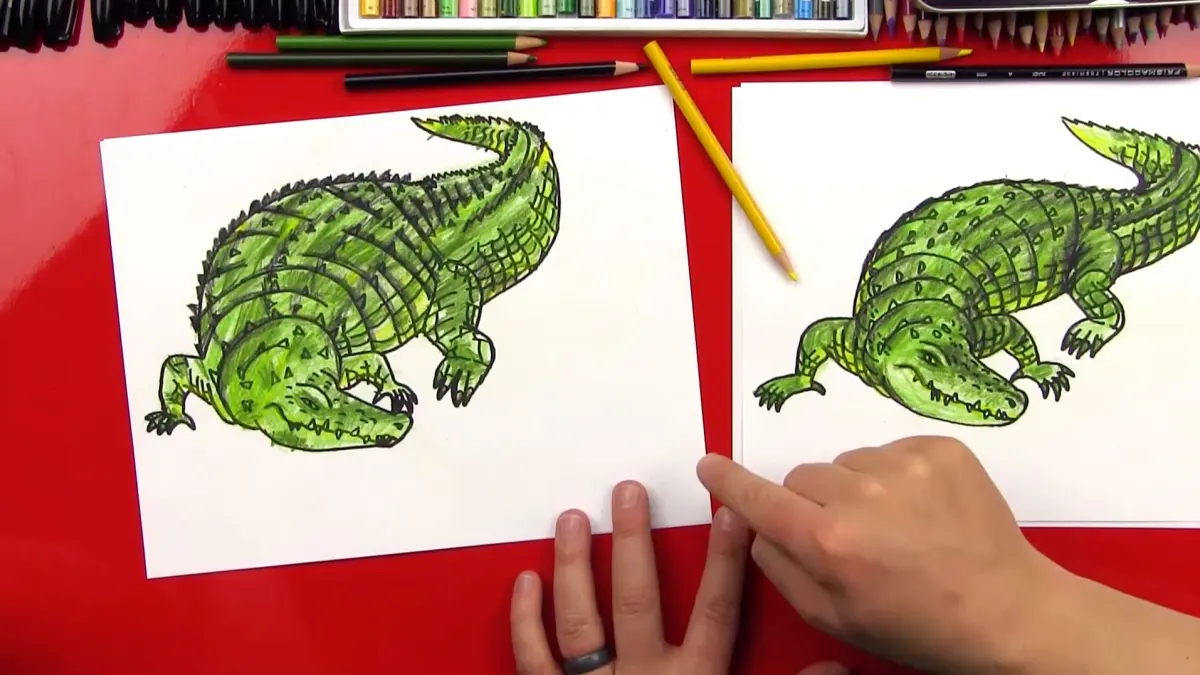
The defining feature of a crocodile is its rough, armored skin. To represent this, avoid drawing every single scale individually, as this can make the drawing look cluttered or unnatural. Instead, focus on creating a pattern of small, irregular shapes across the back and sides of the body. Use a cross-hatching technique or small, overlapping "U" shapes to suggest the texture of scutes, which are the bony plates found on the animal's back.
Focus the most detail around the eyes and along the ridge of the back and tail. These areas are naturally more prominent and textured. You can use these techniques to enhance your drawing:
- Vary the pressure of your pencil to create depth between the scales.
- Leave small highlights on the raised parts of the scales to suggest sunlight hitting the skin.
- Use darker, denser marks in the crevices between scales to create shadows.
- Simplify the pattern on the belly, where the scales are flatter and more uniform.
Common mistakes when drawing crocodiles
One of the most frequent errors is making the snout too narrow or pointed. Crocodiles, particularly the Nile and saltwater species, have broad, powerful snouts that look more like a rounded shovel than a spear. If your snout looks too much like a lizard’s, widen the base where it meets the head. Additionally, beginners often make the legs too thin; remember that a crocodile is a heavy, muscular animal that needs thick limbs to support its weight on land.
Another common mistake is neglecting the placement of the eyes and nostrils. These features sit on the very top of the head, allowing the crocodile to breathe and see while mostly submerged in water. If you draw the eyes on the side of the head like a human or a typical mammal, the animal will lose its reptilian appearance. Always ensure the eyes, ears, and nostrils are aligned along the upper ridge of the skull.
Why crocodile anatomy looks unique
The unique silhouette of a crocodile is a result of millions of years of evolutionary adaptation for an aquatic lifestyle. Their bodies are streamlined to minimize drag while swimming, while their powerful tails act as rudders for steering. When drawing, emphasize the curve of the spine; a crocodile’s back is not perfectly flat but has a slight, natural arch. This subtle curvature adds a sense of life and potential energy to your drawing.
Understanding the jaw structure is also essential for a realistic depiction. The upper jaw is fixed, while the lower jaw is hinged to open wide, revealing rows of sharp, interlocking teeth. When drawing the mouth open, ensure the teeth are not perfectly straight; they should be slightly irregular in size and spacing. By observing these anatomical details, you move beyond simple shapes and create a drawing that accurately captures the formidable nature of this ancient predator.
Key facts
- Crocodiles have a long, V-shaped snout, which distinguishes them from the U-shaped snout of an alligator.
- Always start your drawing with basic geometric shapes like circles for the head and a long rectangle for the body.
- The eyes of a crocodile are positioned on top of the head, allowing them to remain above water while submerged.
- Use a jagged, zigzag line to represent the scaly texture along the back and tail.
- A crocodile’s tail is roughly equal in length to its head and body combined.
- Keep the legs short and sturdy, as crocodiles typically hold their bodies close to the ground when walking.
The bottom line
Drawing a crocodile is a manageable task when you break the animal down into simple geometric forms. By focusing on the V-shaped snout, the placement of the eyes, and the length of the tail, you can capture the essence of this reptile. Avoid over-detailing the scales initially, as clean lines and accurate proportions provide a much stronger foundation for a realistic and professional-looking finished sketch.
People also ask
How do I make the crocodile look realistic?
Focus on the texture of the skin by adding small, irregular bumps and scales. Varying the line weight can help define the shadows under the jaw and belly.
Should I draw the mouth open or closed?
Drawing a closed mouth is easier for beginners because it avoids complex tooth placement. If you draw it open, remember that the lower teeth fit into notches in the upper jaw.
What is the best way to draw the scales?
Do not draw every single scale, as this makes the drawing look cluttered. Instead, draw a few clusters of scales near the spine and leave the rest of the skin smooth.
How do I draw the feet correctly?
Crocodiles have five toes on their front feet and four on their back feet. Use simple claw shapes at the end of each toe to provide a predatory look.
Why does my crocodile look like a lizard?
This usually happens because the snout is too short. Ensure the snout is long and tapered to maintain the correct proportions of a crocodilian.
What tools are best for beginners?
Start with a graphite pencil and a soft eraser to sketch your initial shapes. Once the outline is set, use a fine-liner pen to add permanent details and textures.
This answer was created with the help of AI research tools and reference sources. Spotted an error? Let us know — we correct mistakes quickly. See our editorial policy.