How do rainbows form?
Short answer
Rainbows form when sunlight enters raindrops, undergoes refraction, reflects off the back of the droplet, and refracts again upon exiting. This process separates white light into its component colors—red, orange, yellow, green, blue, indigo, and violet—creating a circular arc of light visible to an observer positioned between the sun and rain.
On this page
Why do rainbows happen?
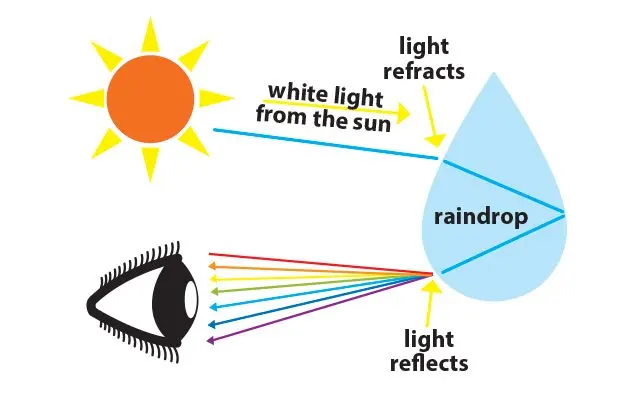
Rainbows are optical phenomena caused by the interaction of light with water droplets suspended in the atmosphere. When sunlight hits a raindrop, the light slows down and bends as it enters the denser water, a process known as refraction. Because different wavelengths of light bend at slightly different angles, the white light begins to disperse into its individual spectral colors.
Once inside the droplet, the light strikes the back surface and reflects, similar to how a mirror works. As the light exits the droplet, it refracts a second time, further spreading the colors. Each droplet acts like a tiny prism, scattering light at specific angles. While millions of droplets are involved, an observer only sees the light from droplets positioned at a specific angle relative to their eye and the sun.
How to see a rainbow
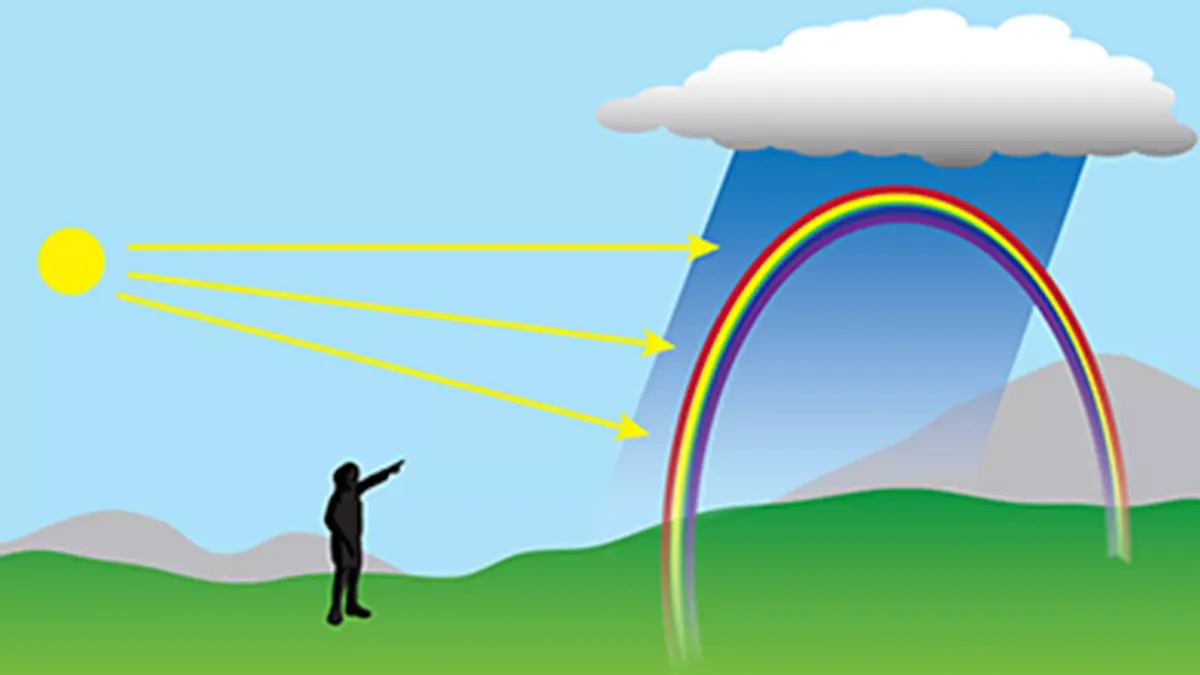
To increase your chances of spotting a rainbow, you must position yourself correctly relative to the weather and the sun. The sun must be behind you, and the rain must be falling in front of you. Because the light reflects at a specific angle, you will only see the arc if the sun is relatively low in the sky, typically during the early morning or late afternoon.
Follow these steps to find a rainbow:
- Locate the position of the sun in the sky.
- Turn your back directly toward the sun.
- Look toward the area where rain is falling or mist is present.
- Scan the horizon for the characteristic arc of colors.
If the sun is higher than 42 degrees above the horizon, the rainbow will likely be below your line of sight, making it invisible from the ground.
What are the colors of a rainbow?
The visible spectrum of a rainbow is traditionally described by seven distinct colors: red, orange, yellow, green, blue, indigo, and violet. This sequence is often remembered by the acronym ROYGBIV. Isaac Newton originally defined these seven colors in the 17th century, though the transition between them is actually a continuous gradient rather than a series of distinct bands.
The order of colors is determined by their wavelengths. Red light has the longest wavelength and bends the least, appearing at the outermost edge of the arc. Violet light has the shortest wavelength and bends the most, appearing at the innermost edge. This consistent arrangement occurs because the physics of refraction remains uniform regardless of the size of the individual raindrops or the intensity of the light source.
Why are rainbows circular?
While we typically see rainbows as semi-circles on the ground, they are actually full circles. The ground usually blocks the bottom half of the arc from our perspective. If you were viewing a rainbow from a high-altitude location, such as an airplane or a mountain peak, you might be able to see the entire circular shape. The center of this circle is always located at the antisolar point, which is directly opposite the sun from your vantage point.
The circular shape is a direct result of the geometry of the light refraction. The angle of 42 degrees is constant in every direction around the antisolar point. Therefore, the rainbow forms a cone of light with your eye at the apex. Any droplet located at that specific 42-degree angle relative to your line of sight will contribute to the color you perceive, forming a perfect ring of light.
Common mistakes when looking for rainbows
Many observers fail to see rainbows because they overlook the necessary environmental conditions or their own positioning. One frequent error is searching for a rainbow while facing the sun; this is physically impossible because the light must reflect back toward your eyes. Another common mistake is ignoring the altitude of the sun, as a high midday sun prevents the light from reaching your eyes at the required 42-degree angle.
Avoid these common pitfalls to improve your success rate:
- Do not look for rainbows in direct sunlight without accompanying precipitation.
- Avoid obstacles like buildings or dense trees that might block your view of the horizon.
- Do not expect to see a rainbow if the clouds are too thick, as direct sunlight is required to interact with the droplets.
- Remember that rainbows are not physical objects, so they will move as you move and cannot be approached or touched.
By understanding these principles, you can effectively predict when and where these beautiful atmospheric displays will appear, ensuring you never miss a chance to witness one in nature.
Key facts
- Rainbows require sunlight behind you and water droplets in front of you to be visible.
- Light enters a raindrop, slows down, and bends, a process known as refraction.
- Inside the drop, light reflects off the back surface, causing it to change direction.
- As the light exits the drop, it refracts again and separates into the visible spectrum of colors.
- The primary colors of a rainbow are red, orange, yellow, green, blue, indigo, and violet.
- To see a rainbow, the sun must be at an angle of less than 42 degrees above the horizon.
The bottom line
Rainbows are beautiful manifestations of physics occurring when sunlight interacts with suspended water droplets. By refracting, reflecting, and dispersing light, nature creates a vibrant spectrum perfectly positioned at a 42-degree angle from your line of sight. Remember that you must always stand with your back to the sun to witness this phenomenon, as it is a personal optical experience that shifts as you move through the landscape.
People also ask
Why are rainbows shaped like an arc?
A rainbow is actually a full circle, but the ground usually obscures the bottom half from our perspective. You can only see the full circular shape if you are viewing it from a high altitude, such as an airplane.
Can you ever reach the end of a rainbow?
No, a rainbow is an optical phenomenon rather than a physical object located at a specific spot. Because it depends on your specific position relative to the sun and the rain, it moves whenever you move.
Why do some rainbows have a second, fainter arch?
A double rainbow occurs when light reflects twice inside the raindrops instead of once. This second reflection causes the colors of the outer bow to appear in reverse order compared to the primary one.
Can you see a rainbow at night?
Yes, a "moonbow" can occur when moonlight is bright enough to be refracted by water droplets. These are rare and often appear white to the human eye because moonlight is dimmer than sunlight.
Why do rainbows disappear when I get closer to them?
Rainbows are light effects that require a specific viewing angle to be visible. As you move toward the location of the rain, the geometry of the light reflection changes, causing the bow to fade or shift.
Are there rainbows in mist or fog?
Yes, these are called fogbows and they appear mostly white. Because the water droplets in fog are much smaller than raindrops, they scatter the light more uniformly, washing out the distinct colors.
This answer was created with the help of AI research tools and reference sources. Spotted an error? Let us know — we correct mistakes quickly. See our editorial policy.