Why should you flip your drawing?
Short answer
Flipping your drawing reveals structural errors, perspective distortions, and asymmetrical flaws that your brain ignores after staring at a piece for too long. By reversing the image, you reset your visual perception, forcing your eyes to see the work as a fresh composition rather than a familiar, habituated mental map.
On this page
Why does our brain ignore drawing mistakes?
When you spend hours working on a drawing, your brain enters a state of familiarity. You stop seeing the actual lines on the page and start seeing your intentions instead. This phenomenon is known as "perceptual habituation," where the brain filters out constant sensory input to save energy. Because you know exactly what you intended to draw, your mind automatically "corrects" errors in your perception, making lopsided eyes or tilted noses look perfectly straight.
This psychological bias makes it nearly impossible to objectively critique your own work while you are in the middle of the creative process. By the time you step back, your brain has already committed to the incorrect proportions. Flipping the canvas is a mechanical intervention that disrupts this cycle. It forces the brain to process the image as a new, unfamiliar object, stripping away the mental overlay of your intentions and revealing the objective reality of the marks you have made.
How to flip your drawing effectively
The method you use to flip your drawing depends on whether you are working with traditional media or digital software. Digital artists have the advantage of a "flip horizontal" command, which can be toggled instantly. For traditional artists, the process is slightly more manual but equally effective. You must physically move the drawing to view it from a different perspective to achieve the same corrective benefits.
- Hold your drawing up to a mirror and look at the reflection to see the reversed image.
- If using translucent paper, flip the page over and hold it up to a light source to see the reverse side.
- Take a photograph of your work with your phone and use a photo editing app to mirror the image horizontally.
- Use a piece of tracing paper to sketch the reversed orientation if you need to work directly on the corrected lines.
When is the best time to flip a drawing?
Timing is critical when using this technique. If you flip your drawing too early, you may become discouraged by the rough, unfinished state of your work. If you wait until the very end, correcting major structural issues might require erasing hours of detailed shading or ink work. The most efficient approach involves flipping your canvas at specific milestones throughout the drafting process.
- During the initial gesture sketch to ensure the pose is balanced.
- After establishing the primary proportions but before adding fine details.
- Once the anatomy is blocked in to check for symmetry.
- Periodically throughout the rendering phase to maintain overall cohesion.
- Before final cleanup to ensure no lingering distortions exist.
By integrating these checks into your routine, you avoid the frustration of discovering a major flaw only after you have invested significant time in the final rendering.
Common mistakes when flipping drawings
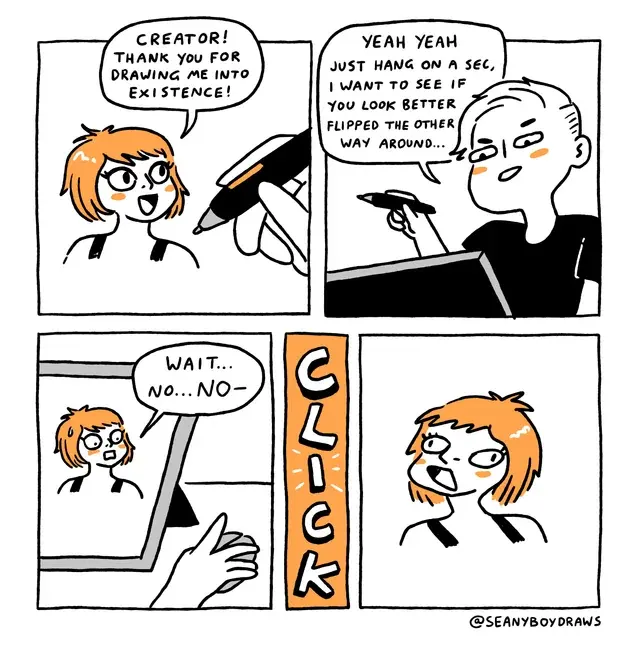
One frequent error is relying on the flip to fix issues that are actually rooted in poor foundational construction. If you find yourself flipping the image constantly, you might be using it as a crutch rather than a diagnostic tool. Another mistake is becoming obsessed with perfection. Not every drawing needs to be perfectly symmetrical, and sometimes the "flaws" you see are actually stylistic choices that give your work personality. Do not let the mirror image dictate your artistic voice.
Another common trap is failing to flip the drawing back to its original orientation before continuing your work. If you accidentally draw on the reversed version, you may end up with a composition that is mirrored from your original intent. Always ensure you are working on the correct side of the paper or the correct layer in your software. If you find that the drawing looks "wrong" in both orientations, it is usually a sign that your underlying structure is fundamentally flawed and needs a complete redraw.
How to interpret what you see after flipping
Once you have flipped your drawing, look for specific red flags that indicate a loss of structural integrity. Pay close attention to the weight of the composition; often, a drawing that looks stable in one direction will feel like it is falling over when flipped. Check the alignment of features like eyes, ears, and shoulders. If one side of a face appears to be drooping or shifting toward the center, the flip will make this immediately obvious.
Focus on the negative space surrounding your subject. When the image is reversed, the shapes between your subject and the edge of the paper change, making it easier to spot awkward gaps or crowded areas. If you notice that your lines look shaky or hesitant in the flipped version, it is a sign that your confidence in the form is lacking. Use this information to guide your corrections, focusing on the structural bones of the image rather than the surface details. By systematically addressing these visual discrepancies, you will significantly improve your accuracy and develop a more professional approach to your artistic practice.
Key facts
- Flipping a drawing horizontally reveals anatomical errors and perspective distortions that the brain naturally ignores during the creation process.
- The "fresh eyes" effect occurs because reversing the image disrupts the brain's habit of filling in gaps or correcting mistakes automatically.
- Digital artists use the "Flip Canvas" shortcut (often set to 'H' or 'F') to check proportions constantly while sketching.
- Traditional artists can use a mirror or take a photograph of their work and flip it on a phone screen to achieve the same result.
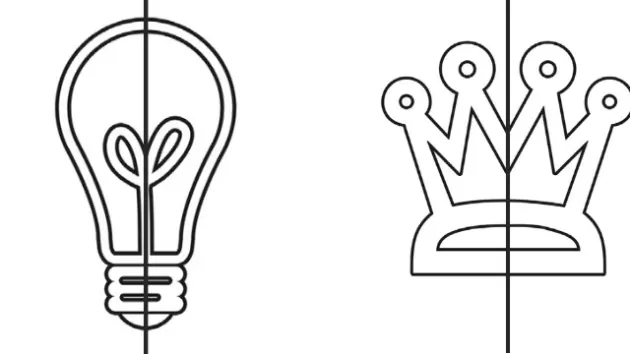
- Asymmetry in facial features, such as eyes placed at different heights, becomes immediately obvious when the drawing is mirrored.
- Flipping helps identify "tangents," which are instances where lines accidentally touch or align in a way that flattens the composition.
The bottom line
Flipping your drawing is a fundamental practice for artists seeking to improve their accuracy and composition. By reversing the image, you bypass the brain’s tendency to normalize errors, allowing you to identify anatomical mistakes, perspective issues, and poor balance. Incorporating this simple habit into your workflow ensures that your final work is polished, professional, and structurally sound, ultimately saving you time on complex, late-stage corrections.
People also ask
Does flipping a drawing change its quality?
Flipping does not change the quality of the art itself, but it highlights errors that reduce the professional appeal of the piece. It acts as a diagnostic tool rather than an editing effect.
Should I flip my drawing at the beginning or the end?
You should flip your drawing frequently throughout the entire process. Checking early prevents you from building a detailed final piece on top of a fundamentally flawed foundation.
Why do my drawings look wrong only when I flip them?
Your brain becomes accustomed to the specific mistakes in your drawing after staring at it for a long time. Flipping forces your brain to treat the image as a new, unfamiliar object, making errors visible.
Can I flip a physical canvas using a mirror?
Yes, holding a mirror up to a traditional drawing or painting provides an instant reversed view. This is a classic technique used by portrait painters for centuries to ensure likeness accuracy.
Is it bad to draw while the image is flipped?
It is generally discouraged to draw while the image is flipped because it can confuse your muscle memory. Use the flip function only to check your work, then flip it back to continue drawing.
Does flipping help with color balance?
Flipping can help you spot imbalances in color or value distribution across the composition. It allows you to see if one side of the image feels too heavy or cluttered compared to the other.
This answer was created with the help of AI research tools and reference sources. Spotted an error? Let us know — we correct mistakes quickly. See our editorial policy.