Why is The Fighting Temeraire so famous?
Short answer
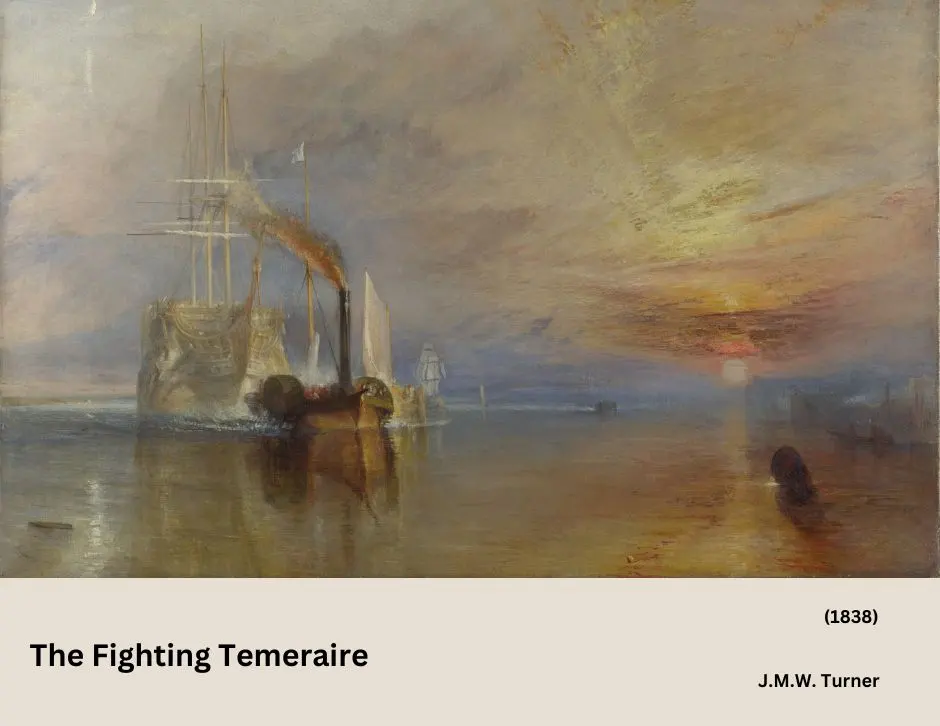
The Fighting Temeraire is famous for its poignant depiction of the transition from the age of sail to the industrial era. Painted by J.M.W. Turner in 1839, it captures the majestic HMS Temeraire being towed to its final scrap yard, symbolizing the end of Britain’s naval supremacy and the relentless march of technological progress.
On this page
Why is The Fighting Temeraire so famous?
The painting resonates deeply because it functions as a visual elegy for the British Royal Navy. The HMS Temeraire was a celebrated veteran of the Battle of Trafalgar in 1805, where it played a decisive role in securing victory against the French and Spanish fleets. By showing this once-mighty vessel being pulled by a small, dark, fire-breathing steam tug, Turner created a powerful contrast between the grace of wind-powered history and the harsh efficiency of the Industrial Revolution.
This work is widely considered Turner’s masterpiece because it captures a specific moment of national transition. The painting does not merely document a ship; it evokes a sense of melancholy and nostalgia that transcends its historical subject. It remains a fixture in the National Gallery in London, frequently cited by the public as Britain’s favorite painting due to its emotional depth, technical brilliance, and the universal theme of inevitable change.
How to analyze the symbolism in the painting
To understand the painting's impact, one must look at the specific visual cues Turner employed to tell his story. The composition is split into two distinct halves: the fading, ethereal past and the harsh, mechanical present. The sunset acts as a metaphor for the closing of an era, casting a golden, ghostly light over the aging warship.
Consider these key elements when observing the work:
- The ghostly white hull of the Temeraire represents the fading memory of naval glory.
- The dark, soot-belching tugboat represents the intrusion of industrialization into the natural world.
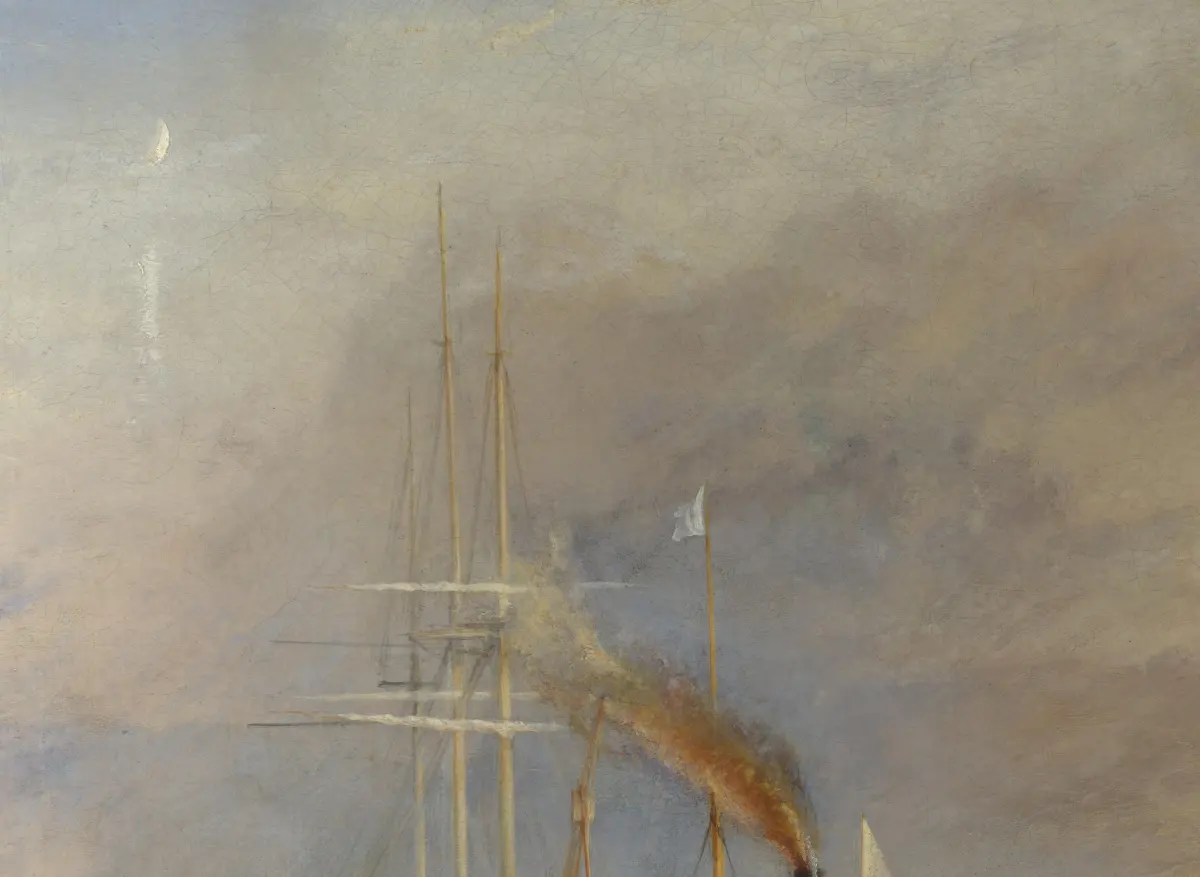
- The moon, rising in the upper left, signifies the passage of time and the dawning of a new, colder age.
- The absence of a crew on the Temeraire suggests it is a vessel of the past, effectively a ghost ship being led to its final rest.
What historical context is necessary to understand it
The HMS Temeraire was a 98-gun second-rate ship of the line, launched in 1798. It gained fame for its bravery at Trafalgar, where it famously locked masts with two French ships, effectively saving Admiral Nelson’s flagship from destruction. By 1838, the ship was obsolete, and the Admiralty ordered it to be sold for scrap. Turner witnessed the ship being towed up the River Thames toward the breaker’s yard in Rotherhithe.
While Turner took artistic liberties—the Temeraire was actually towed by two tugs rather than one, and the event occurred during the day rather than at sunset—the painting remains historically significant. It captures the exact moment when the wooden walls of England, which had protected the island nation for centuries, were rendered redundant by the advent of steam power and iron hulls. This shift fundamentally altered the geopolitical landscape and the nature of maritime warfare forever.
How to appreciate Turner’s painting technique
Turner was a master of light and atmosphere, and The Fighting Temeraire showcases his ability to manipulate oil paint to create a dreamlike quality. He used a technique known as glazing, applying thin, transparent layers of paint over a lighter base to achieve a luminous, glowing effect. This makes the water and sky appear as if they are radiating light from within the canvas.
If you are attempting to study the painting’s technique, follow these steps:
- Examine the brushwork on the tugboat; notice how the paint is applied more thickly and with darker, more aggressive strokes compared to the ship.
- Focus on the horizon line where the sky and the Thames meet, noting how Turner blurs the edges to create a sense of infinite distance.
- Observe how the ship’s masts are rendered with delicate, skeletal precision, emphasizing their fragility against the encroaching darkness of the industrial tug.
- Compare the warm, golden hues of the sunset to the cool, blue tones of the water to understand how he creates spatial depth.
Common mistakes when interpreting the work
A frequent error is viewing the painting purely as a literal historical document. Because Turner was a Romantic painter, his primary goal was to evoke an emotional response rather than provide a photographic record of the event. Viewers often mistakenly focus on the technical inaccuracy of the tugboat’s position or the lighting, missing the allegorical message about the loss of tradition and the inevitability of progress.
Another common mistake is ignoring the role of the tugboat as a character. Some viewers see it only as a machine, but Turner paints it with a sense of purpose and dominance that suggests it is the protagonist of a new, less romantic world. To truly appreciate the work, one must recognize that it is a commentary on the human condition. It reminds us that all great powers eventually succumb to the passage of time, a lesson that remains as relevant today as it was in the nineteenth century.
Key facts
- The Fighting Temeraire was painted by J.M.W. Turner in 1839 and depicts the final voyage of the HMS Temeraire.
- The painting shows a majestic, ghostly white warship being towed to its final scrap yard by a small, dark, soot-belching steam tug.
- It serves as a visual metaphor for the end of the age of sail and the rise of the industrial era in Britain.
- Turner exhibited the work at the Royal Academy in 1839 with the title The Fighting Temeraire, tugged to her last berth to be broken up, 1838.
- The painting is currently housed in the National Gallery in London and was voted the "greatest painting in Britain" in a 2005 BBC poll.
- To appreciate the work in person, stand back at least six feet to see how the contrasting colors of the sunset emphasize the ship's spectral appearance.
The bottom line
The Fighting Temeraire remains famous because it perfectly captures a poignant moment of historical transition. By juxtaposing the fading glory of a legendary warship against the relentless progress of steam power, Turner created a universal symbol of obsolescence and change. Its emotional resonance, combined with masterful light effects, continues to define British identity, securing its place as an enduring masterpiece of Western art history.
People also ask
Did the HMS Temeraire actually fight in a famous battle?
Yes, the HMS Temeraire played a crucial role in the Battle of Trafalgar in 1805. It famously saved Admiral Nelson’s flagship, HMS Victory, by engaging two French ships simultaneously.
Is the steam tug in the painting historically accurate?
While the tug existed, Turner took significant artistic liberties with its size and position. He exaggerated the contrast between the tug and the warship to heighten the emotional impact of the scene.
Why are the colors in the painting so vibrant?
Turner was a master of light and atmospheric effects, often using thin glazes of oil paint to create a glowing, ethereal quality. The dramatic sunset reflects his romantic style rather than a strictly realistic depiction of the Thames.
What does the painting represent in terms of history?
It symbolizes the transition from the romantic, heroic past of wooden naval warfare to the mechanical, soot-filled future of the Industrial Revolution. It captures a sense of national nostalgia for a vanishing era.
Can I see the original painting today?
Yes, the painting is part of the permanent collection at the National Gallery in London. It is frequently displayed in the main galleries, though it occasionally travels for special exhibitions.
What is the most common mistake when viewing this painting?
Many viewers focus only on the ships and miss the subtle, complex play of light on the water. Taking time to look at the reflection of the sunset on the river surface reveals Turner’s technical genius.
This answer was created with the help of AI research tools and reference sources. Spotted an error? Let us know — we correct mistakes quickly. See our editorial policy.