Why is The Raft of the Medusa so famous?
Short answer
Théodore Géricault’s The Raft of the Medusa is famous for its monumental scale, visceral depiction of human suffering, and bold critique of political corruption. Completed in 1819, this Romantic masterpiece transformed historical painting by focusing on a contemporary tragedy rather than heroic myths, forever changing how art engages with real-world social injustice.
On this page
Why is The Raft of the Medusa so famous?
The painting depicts the aftermath of the 1816 wreck of the French frigate Méduse. When the ship ran aground off the coast of Mauritania, the captain and senior officers took the lifeboats, leaving 147 passengers and crew to drift on a makeshift raft. After 13 days of starvation, dehydration, madness, and cannibalism, only 15 men survived.
Géricault chose this subject to challenge the French government, which had appointed an incompetent, aristocratic captain due to political patronage rather than merit. By elevating a scandalous news event to the scale of a traditional history painting, the artist forced the public to confront the consequences of institutional failure. The work remains a symbol of human endurance and the dangers of political negligence.
How was the painting created?
Géricault conducted extensive, morbid research to ensure the painting’s accuracy and emotional impact. He interviewed survivors, commissioned a scale model of the raft, and even visited morgues to study the color and texture of decaying flesh. This obsessive dedication to realism helped him capture the grim reality of the ordeal.
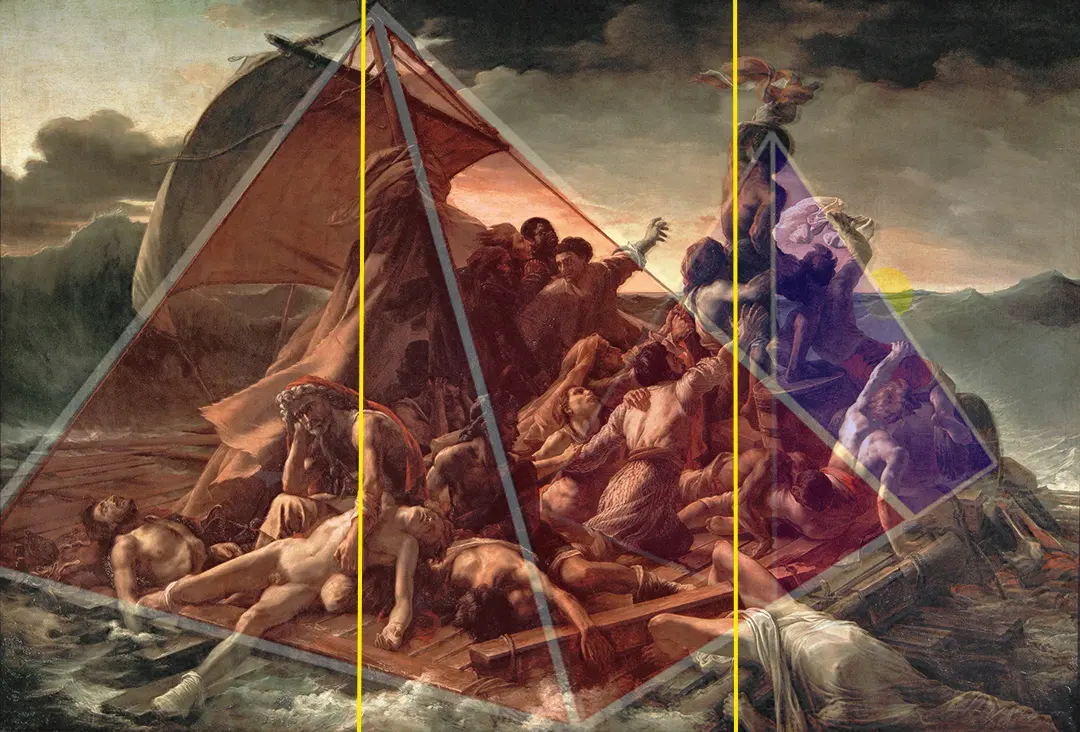
The composition is structured around two distinct pyramidal shapes that guide the viewer’s eye. The first pyramid, formed by the mast and the ropes, represents the despair of the victims, while the second, culminating in the figure waving a cloth, symbolizes the desperate hope for rescue. This technical mastery balances the chaotic subject matter with a rigorous, classical sense of order.
- Study the anatomy of the figures to understand the influence of Michelangelo.
- Observe the use of chiaroscuro, or the dramatic contrast between light and dark, to heighten the tension.
- Analyze the diagonal lines that pull the viewer toward the distant rescue ship.
What is the historical context of the work?
The painting was unveiled at the 1819 Paris Salon, where it sparked immediate controversy. At the time, the Bourbon Restoration government was sensitive to any criticism regarding the incompetence of its officials. By portraying the victims of a state-sanctioned disaster, Géricault turned his canvas into a political manifesto that resonated with the liberal opposition.
The sheer size of the canvas, measuring approximately 16 by 23 feet, was intended to overwhelm the viewer. By placing the audience at the same eye level as the raft, Géricault effectively invited them to join the survivors on their journey. This immersive approach transformed the act of viewing art from a passive experience into an active, emotional confrontation with the truth.
- The painting serves as a bridge between Neoclassicism and Romanticism.
- It highlights the shift toward depicting contemporary social issues in fine art.
- It emphasizes the raw, unidealized human body as a vehicle for storytelling.
How to analyze the artwork for beginners
When viewing the painting, start by observing the physical state of the figures. Notice how Géricault moves from the dead and dying at the bottom left to the animated, hopeful survivors at the top right. This progression represents the transition from total despair to the flicker of survival.
Avoid the common mistake of looking only at the central figures. Instead, scan the edges of the canvas to see how the artist uses shadow and texture to suggest the vast, uncaring ocean. Pay attention to the color palette, which consists largely of murky browns, blacks, and sickly yellows, reinforcing the sense of rot and hopelessness.
- Focus on the facial expressions to identify individual stories of grief.
- Look for the placement of the horizon line to gauge the distance of the rescue ship.
- Consider the influence of the "sublime," a concept describing the terrifying beauty of nature.
Common mistakes when interpreting the painting
A frequent error is assuming the painting is a purely heroic depiction of survival. In reality, Géricault focused heavily on the grotesque aspects of the event, including the presence of corpses and the psychological breakdown of the men. The painting is a study in human fragility rather than a celebration of triumph over adversity.
Another mistake is ignoring the role of the "Argus," the ship that eventually rescued the survivors. The ship is barely visible as a tiny speck on the horizon, emphasizing that the rescue was a matter of pure chance rather than divine intervention. By understanding these nuances, you can better appreciate why this work continues to influence modern artists who use visual media to document human rights abuses and state failures across the globe today.
Key facts
- Théodore Géricault painted The Raft of the Medusa between 1818 and 1819, measuring a massive 16 by 23.5 feet.
- The work depicts the aftermath of the 1816 wreck of the French frigate Méduse, where 147 people were set adrift on a makeshift raft.
- Only 15 survivors remained after 13 days of starvation, dehydration, madness, and cannibalism.
- Géricault conducted meticulous research, including interviewing survivors and studying severed limbs and cadavers in his studio to capture realistic decay.
- The painting served as a scathing political indictment of the French Bourbon Restoration, which appointed an incompetent captain based on nepotism.
- It is considered a landmark of French Romanticism, shifting art away from idealized Neoclassical subjects toward raw, contemporary human tragedy.
The bottom line
The Raft of the Medusa remains famous because it transformed a contemporary political scandal into a timeless symbol of human suffering and endurance. By rejecting the rigid idealism of his era, Géricault forced viewers to confront the brutal consequences of incompetence and corruption. Its immense scale, dramatic composition, and unflinching realism continue to influence how artists depict historical trauma and the darker side of the human experience.
People also ask
Where is the painting currently located?
The painting is permanently housed in the Louvre Museum in Paris, France. It occupies a prominent position in the Denon Wing, where its massive scale dominates the gallery space.
Why did the captain of the Medusa abandon the passengers?
The captain, Viscount de Chaumareys, prioritized the safety of the wealthy officers and himself by using the ship's lifeboats. He ordered the tow ropes to the raft to be cut, effectively abandoning the lower-class passengers and soldiers to their fate.
Did Géricault include any real survivors in the painting?
Yes, Géricault interviewed the ship’s surgeon, Henri Savigny, and the engineer, Alexandre Corréard. He even invited survivors to his studio to pose as models for the figures on the raft.
What is the significance of the man waving a cloth at the horizon?
The figure at the apex of the human pyramid is waving to the Argus, the ship that eventually rescued the survivors. This detail represents the thin, desperate line between total despair and salvation.
How did the public react when the painting was first exhibited?
The 1819 Paris Salon debut was highly controversial because it challenged the government and depicted a horrific, non-heroic subject. While some critics praised its technical mastery, others were repulsed by the graphic portrayal of death.
Can I see the original raft in a museum?
No, the original wooden raft was destroyed shortly after the rescue in 1816. The painting is the only primary historical record that captures the visceral reality of the event.
This answer was created with the help of AI research tools and reference sources. Spotted an error? Let us know — we correct mistakes quickly. See our editorial policy.