Why is A Sunday Afternoon on the Island of La Grande Jatte so famous?
Short answer
Georges Seurat’s A Sunday Afternoon on the Island of La Grande Jatte is famous for pioneering Pointillism, a technique using tiny dots of pure color to create optical mixing. Completed in 1886, its massive scale, rigid composition, and scientific approach to light revolutionized Post-Impressionism, fundamentally altering the trajectory of modern Western art history.
On this page
Why is the painting so famous?
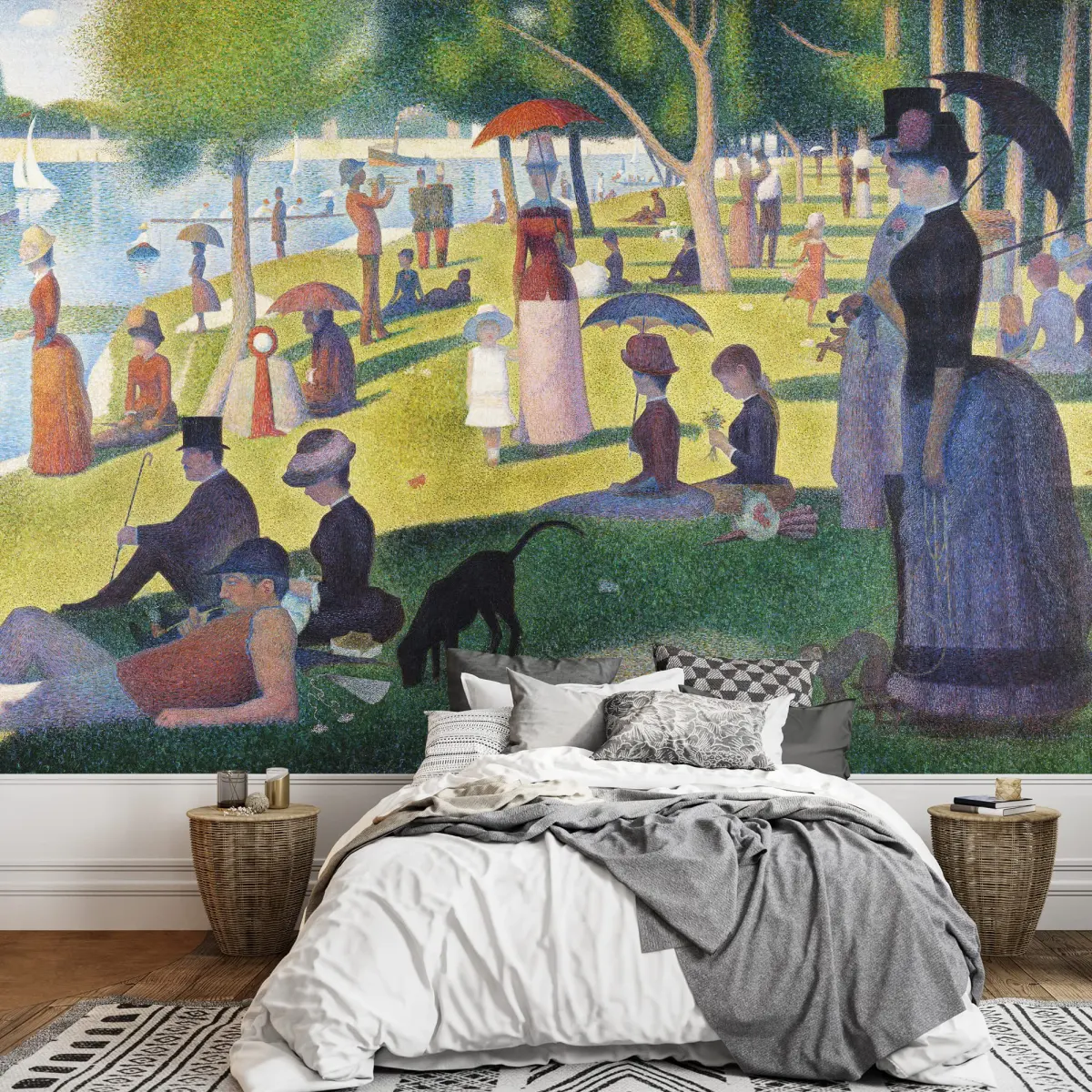
The fame of A Sunday Afternoon on the Island of La Grande Jatte rests primarily on its revolutionary technical execution. Georges Seurat spent two years, from 1884 to 1886, meticulously applying millions of individual dots of paint to the canvas. This method, known as Pointillism or Divisionism, was based on contemporary color theories by scientists like Michel Eugène Chevreul. By placing contrasting colors side-by-side rather than mixing them on a palette, Seurat forced the viewer’s eye to blend the hues optically at a distance.
Beyond its technique, the painting is celebrated for its monumental scale, measuring approximately 6.75 by 10 feet. It transformed the subject of a casual, middle-class leisure afternoon into a grand, static tableau reminiscent of classical friezes. This juxtaposition of a modern, mundane setting with the solemnity of ancient art challenged the Impressionist preference for spontaneous, fleeting moments. It remains an icon of the Art Institute of Chicago, representing the transition from the emotional intensity of Impressionism to the calculated, intellectual rigor of modernism.
How was the Pointillist technique developed?
Seurat’s approach was deeply rooted in the scientific study of optics and color perception. He sought to move beyond the intuitive color choices of the Impressionists, aiming for a more objective and luminous result. He observed that when two distinct colors are placed in close proximity, they appear to vibrate or intensify each other in the human eye. This phenomenon, called simultaneous contrast, allowed him to achieve a brilliance that traditional pigment mixing could not replicate.
To master this technique, artists generally follow these foundational steps:
- Select a limited palette of primary and secondary colors to ensure color harmony.
- Apply small, distinct dots of paint onto the canvas, keeping them separate to allow for optical mixing.
- Vary the density of dots to create gradients, shadows, and depth within the composition.
- Step back frequently to ensure the colors merge correctly from the intended viewing distance.
Common mistakes when attempting this style include using too many colors, which leads to a muddy appearance, or applying dots that are too large, which prevents the colors from blending properly.
What is the history of the painting?
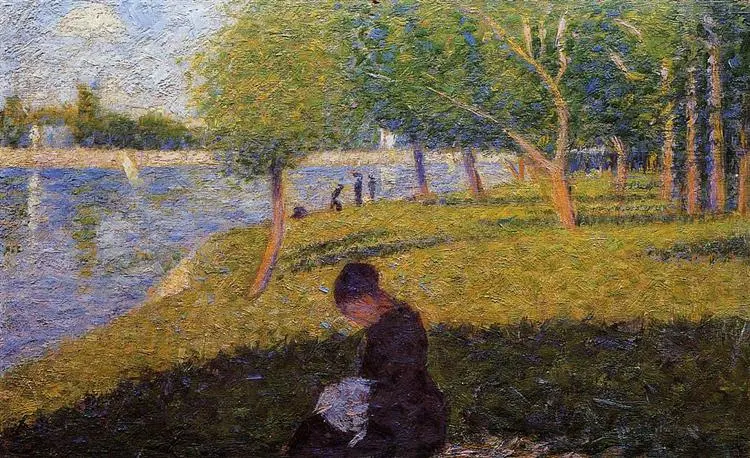
Seurat began sketching the island of La Grande Jatte, a popular park along the Seine River in Paris, in 1884. He produced dozens of preparatory oil sketches and drawings to refine the composition before committing to the final, massive canvas. When it debuted at the eighth and final Impressionist exhibition in 1886, the painting caused a sensation. Critics were divided; some mocked the stiff, doll-like figures, while others recognized it as a bold departure from the established artistic order.
The painting’s influence grew significantly after Seurat’s premature death in 1891. It became a cornerstone of the Neo-Impressionist movement, inspiring artists such as Paul Signac and Henri Matisse. Its journey through various private collections eventually led to its acquisition by the Art Institute of Chicago in 1926. Since then, it has been analyzed for its social commentary, reflecting the rigid class structures of 19th-century France, and its structural perfection. Its enduring presence in popular culture, including its iconic appearance in film, has cemented its status as one of the most recognizable images in existence.
How to interpret the composition?
The composition of the painting is defined by its extreme order and geometry. Unlike the chaotic, bustling scenes typical of his peers, Seurat arranged his figures in a series of horizontal and vertical lines. The park’s landscape is structured by the deep diagonal of the shoreline, which leads the eye toward the background. This deliberate arrangement suggests a sense of timelessness and stillness, as if the subjects are frozen in a vacuum rather than captured in a fleeting moment of time.
Key elements that define the composition include:
- The stark contrast between the sunlit grass and the deep shadows cast by the trees.
- The diverse social classes represented, ranging from working-class laborers to the bourgeoisie.
- The rigid, profile-oriented poses of the figures, which evoke the aesthetic of Egyptian or Greek relief carvings.
- The deliberate lack of interaction between the figures, emphasizing a sense of urban alienation despite the public setting.
These elements create a narrative tension between the relaxed nature of the scene and the highly controlled, almost mathematical precision of the artist’s hand.
Where can you see it today?
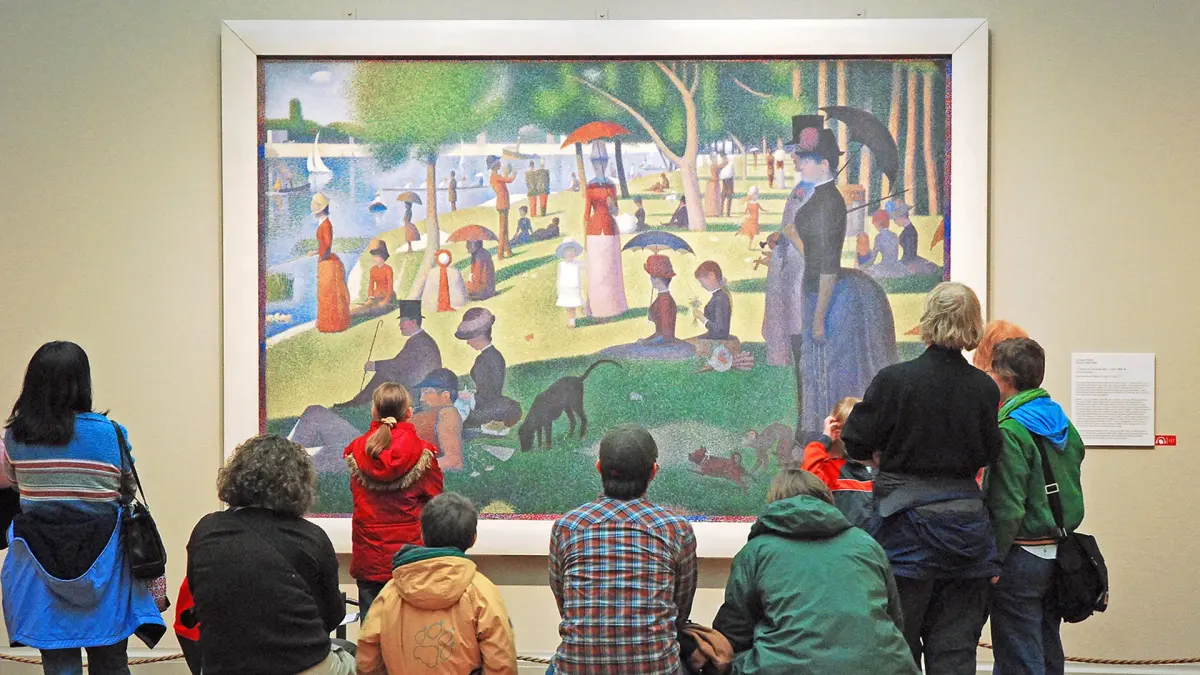
The painting has been housed at the Art Institute of Chicago since its purchase in 1926. It is displayed in a dedicated gallery that allows viewers to stand at a distance, which is essential for experiencing the optical blending of the dots. Because the work is fragile due to the specific pigments and binding agents Seurat used, the museum maintains strict environmental controls to preserve the integrity of the color. Visitors are encouraged to observe the painting from multiple distances to fully appreciate the transition from individual points of color to a cohesive, luminous scene.
When visiting the museum to view the work, it is helpful to note the following:
- Arrive early in the day to avoid large crowds that may obstruct the view.
- Spend time looking at the preparatory sketches often displayed nearby to understand the evolution of the composition.
- Move slowly from the far side of the room toward the canvas to witness the optical mixing effect firsthand.
- Avoid using flash photography, as the light can damage the pigments and disrupt the experience for other visitors.
By understanding the intentionality behind every dot, the viewer gains a deeper appreciation for the immense patience and intellectual ambition required to create this masterpiece.
Key facts
- Georges Seurat completed the painting between 1884 and 1886, measuring approximately 6 feet 10 inches by 10 feet 1 inch.
- The work is the definitive example of Pointillism, a technique where small, distinct dots of color are applied to form an image.
- Seurat used optical mixing, relying on the viewer's eye to blend dots of color rather than mixing pigments on a palette.
- The scene depicts a public park on the banks of the Seine River in Paris, a popular leisure spot for the middle and working classes.
- To appreciate the technique, stand at least six feet away from the canvas to allow the individual dots to merge into cohesive shapes and light.
- Avoid viewing the painting under poor lighting, as the intended color vibration relies on consistent, bright illumination to achieve its luminous effect.
The bottom line
Georges Seurat’s masterpiece remains iconic because it revolutionized how artists approach color and light. By replacing fluid brushstrokes with thousands of precise, scientific dots, Seurat transformed a simple afternoon in a Parisian park into a monumental study of optical perception. Its enduring fame stems from this bold departure from Impressionism, proving that rigorous mathematical structure could produce a deeply atmospheric and visually stunning work of art.
People also ask
Where is the painting located today?
The painting is part of the permanent collection at the Art Institute of Chicago, where it has been displayed since 1924.
How long did it take Seurat to finish the piece?
Seurat worked on the painting for two years, making numerous preliminary sketches and smaller oil studies to perfect the composition before committing to the final canvas.
What was the initial public reaction to the painting?
When first exhibited in 1886, many critics were confused or hostile toward the rigid, static figures and the unconventional, scientific approach to color application.
Why do the people in the painting look so stiff?
Seurat intentionally stylized the figures to create a sense of timelessness and order, rejecting the spontaneous, fleeting nature of traditional Impressionism.
What is the significance of the monkey on a leash?
Some art historians suggest the monkey was a symbol of illicit behavior or social satire, contrasting with the orderly, respectable figures surrounding it.
Did Seurat paint other works in this style?
Yes, Seurat applied his Pointillist theory to several other major works, such as Bathers at Asnières and The Circus, though none achieved the same level of fame.
This answer was created with the help of AI research tools and reference sources. Spotted an error? Let us know — we correct mistakes quickly. See our editorial policy.