How do you draw a cartoon hand?
Short answer
Drawing a cartoon hand requires simplifying complex anatomy into basic geometric shapes. Start by sketching a rounded trapezoid for the palm, then attach four cylinders for the fingers and a thumb. By maintaining consistent proportions and using rounded lines, you create a flexible, expressive hand that fits the stylized nature of cartoons.
On this page
How to simplify hand anatomy for cartoons
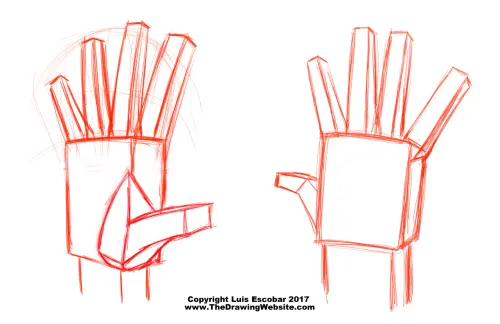
The human hand is notoriously difficult to draw because of its intricate bones and joints. In cartooning, you must ignore the anatomical precision of a medical illustration and focus on the "mitten" method. By viewing the hand as a single blocky shape, you establish a foundation that prevents the fingers from looking disjointed or unnatural.
Start by drawing a trapezoid to represent the palm. The side where the thumb attaches should be slightly slanted to allow for natural movement. Once the palm is established, you can add the fingers as rounded rectangles or cylinders. This simplification allows you to adjust the pose of the hand without worrying about the underlying skeletal structure, making the process much faster for illustrators.
- Sketch a flat, rounded trapezoid for the palm.
- Draw a curved line at the top to mark where the fingers begin.
- Add a small oval on the side of the palm for the thumb base.
- Extrude four cylinders from the top edge for the fingers.
Best proportions for cartoon hands
Cartoon hands often rely on exaggerated proportions to convey personality and action. While realistic hands have fingers that follow a specific curve, cartoon fingers are often uniform in length or slightly tapered. A common rule of thumb is that the middle finger should be roughly equal to the length of the palm. If you make the fingers too short, the hand looks like a stubby paw; if too long, it appears spindly and weak.
The thumb is the most critical component for making a drawing look functional. It should attach to the side of the palm rather than the top, and it should reach roughly to the midpoint of the index finger. When drawing the thumb, ensure it has a slight "S" curve to suggest the presence of a knuckle. Maintaining these relative sizes ensures that the character’s hand remains readable and believable within a stylized environment.
- The palm should be roughly square or slightly rectangular.
- The index, middle, ring, and pinky fingers should follow a slight arc.
- The thumb should always be thicker than the other fingers to denote strength.
- Keep the joints rounded to avoid a robotic or stiff appearance in the final line art.
How to draw expressive hand poses
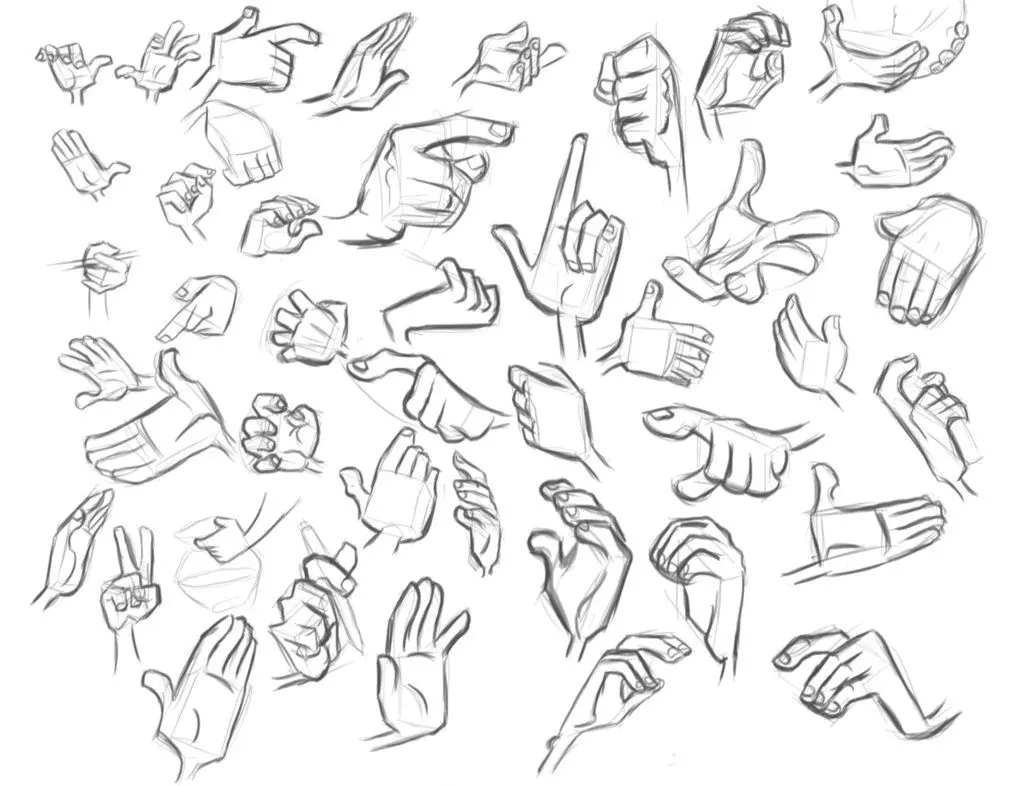
Hands are essential for body language, and a static hand often makes a character look lifeless. To draw expressive hands, focus on the "line of action" that flows from the wrist through the fingers. If a character is pointing, the index finger should be straight while the others curl toward the palm. If the character is making a fist, the fingers should overlap slightly to suggest tension and mass.
Think of the palm as a solid box and the fingers as flexible cables. When the hand bends, the palm remains rigid while the fingers fold inward. Practice drawing hands in different states of tension, such as a relaxed open palm, a tight grip, or a dramatic gesture. By varying the spacing between the fingers, you can communicate everything from nervousness to aggression, which adds significant depth to your character design.
Common mistakes when drawing cartoon hands
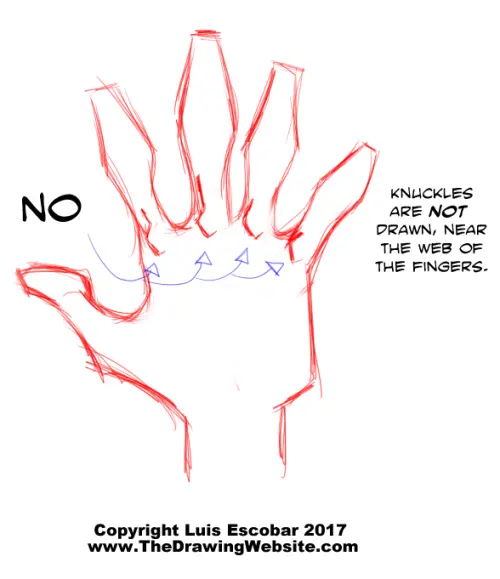
One of the most frequent errors is the "sausage finger" mistake, where fingers are drawn as identical, limp tubes without any indication of knuckles or tapering. This makes the hand look like a balloon animal rather than a functional appendage. Always add minor indentations at the knuckles to suggest where the fingers bend; even in a simple cartoon, these subtle details provide necessary structure.
Another common issue is the "floating thumb," where the thumb is placed too high or too low on the palm. This makes the hand look broken or alien. Always double-check that the thumb emerges from the base of the palm near the wrist. Additionally, avoid drawing perfectly parallel fingers. Nature rarely creates perfect symmetry, so varying the angles of the fingers slightly will make the hand look much more natural and dynamic on the page.
- Forgetting to account for the thickness of the palm.
- Drawing all fingers the same length without an arc.
- Placing the thumb on the same side as the pinky finger.
- Making the wrist too thin to support the weight of the hand.
How to practice drawing hands effectively
The most effective way to improve is to use your own hand as a reference. Place your hand on a table, observe the way the light hits the knuckles, and sketch the basic shapes you see. Do not try to draw every skin fold or fingernail; instead, focus on the silhouette. If the silhouette of the hand is recognizable without any internal details, you have successfully captured the pose.
Consistency is more important than perfection when you are starting out. Dedicate ten minutes each day to drawing hands in different positions, such as holding a cup, waving, or making a fist. Use a soft pencil to sketch the initial geometric shapes, then use a darker pen to finalize the outline. Over time, your brain will memorize these shapes, and you will be able to draw expressive cartoon hands from memory without needing constant reference material.
Key facts
- A cartoon hand typically features four fingers instead of five to simplify the design and emphasize expressiveness.
- The palm is generally constructed as a rounded square or a trapezoid shape to act as the base for the digits.
- Fingers are often drawn as "sausage" shapes, with the middle finger being the longest and the pinky being the shortest.
- The thumb should be positioned lower than the fingers, pointing inward toward the palm to maintain natural articulation.
- Use rounded, organic lines rather than sharp angles to give the hand a soft, flexible, and approachable appearance.
- Exaggerating the size of the hand relative to the head can help convey stronger emotions and dynamic gestures.
The bottom line
Drawing cartoon hands is an exercise in simplification and exaggeration. By replacing complex anatomical details with rounded, fluid shapes and reducing the finger count, you create a design that is both readable and expressive. Focus on the silhouette and the gesture of the hand rather than realistic precision. With consistent practice of these basic geometric foundations, you can master the art of conveying emotion through character movement.
People also ask
Why do cartoon characters often have only four fingers?
Animators historically reduced finger counts to save time and money during labor-intensive hand-drawn production. Four fingers remain a stylistic standard because it creates a cleaner silhouette that is easier to animate and recognize on screen.
How do I make cartoon hands look less stiff?
Avoid drawing fingers in a perfectly straight line. Add slight curves to the joints and vary the lengths of the fingers to mimic the natural, relaxed posture of a real human hand.
Should I draw fingernails on cartoon hands?
Fingernails are usually omitted in classic cartoon styles to maintain a simple, "mitten-like" aesthetic. If you do include them, use only a small, subtle curved line at the tip of the finger to avoid cluttering the design.
How do I draw a fist in a cartoon style?
Start with a rounded rectangle for the palm and draw overlapping circles to represent the curled fingers. The thumb should wrap over the index and middle fingers to create a solid, compact shape.
What is the best way to practice drawing hands?
Trace your own hand in various positions to understand the underlying geometry. Once you grasp the basic proportions, simplify those shapes into the rounded, exaggerated forms typical of cartooning.
How do I draw hands holding an object?
Focus on the negative space between the fingers and the object. Ensure the thumb acts as a counter-pressure point against the fingers to make the grip look believable and secure.
This answer was created with the help of AI research tools and reference sources. Spotted an error? Let us know — we correct mistakes quickly. See our editorial policy.