Why do we have different eye colors?
Short answer
Eye color is determined by the amount and quality of melanin pigment in the iris stroma. Genetic variations inherited from parents dictate how much pigment cells produce. While brown is the most common color globally due to high melanin, lower concentrations result in blue, green, or hazel hues through light scattering.
On this page
Why eye color variation happens
The primary driver of eye color is melanin, the same pigment that determines skin and hair tone. Specifically, the iris contains two layers: the posterior epithelium and the anterior stroma. The posterior layer is almost always dark brown in humans. However, the anterior stroma contains varying amounts of melanin. When there is a high concentration of melanin, the iris absorbs light, resulting in brown eyes. When there is very little melanin, light reflects and scatters off the fibers in the stroma, a phenomenon known as the Tyndall effect. This scattering of light makes the eyes appear blue, much like how the atmosphere makes the sky appear blue.
Genetics play the most complex role in this process. Scientists once believed that eye color was controlled by a single gene, but research has identified at least 16 different genes that influence the final outcome. The two most influential genes are OCA2 and HERC2, both located on chromosome 15. These genes regulate the production and processing of melanin. Because multiple genes are involved, parents with brown eyes can occasionally have children with blue eyes if both carry recessive alleles for lower melanin production.
How genetics determine eye color
Inherited traits from parents create a wide spectrum of possibilities for offspring. While simple Punnett squares were historically used to teach basic genetics, they often oversimplify the reality of polygenic inheritance. Because many genes contribute small amounts to the total pigment, eye color exists on a continuous scale rather than just a few distinct categories.
- Identify the parental phenotypes to understand the range of potential outcomes.
- Recognize that recessive genes can remain hidden for generations.
- Observe that environmental factors do not change eye color after birth.
- Consult a genetic counselor if you are interested in the specific likelihood of inherited traits in your family lineage.
Common misconceptions about eye color inheritance include the belief that two blue-eyed parents cannot have a brown-eyed child. While statistically rare, mutations or complex gene interactions can occasionally result in unexpected eye colors. It is important to remember that eye color is not a simple dominant-recessive trait, but rather a complex interaction of multiple genetic markers.
What influences eye color changes
Many infants are born with blue or gray eyes because their melanocytes have not yet begun producing significant amounts of pigment. As a child is exposed to light, the production of melanin often increases, causing the eyes to darken. This process typically stabilizes between six months and three years of age. While most people’s eye color remains permanent after early childhood, some adults experience minor shifts due to health conditions or age-related changes in the iris.
Certain medical conditions can also alter the appearance of the iris. For instance, Fuch’s heterochromic iridocyclitis or Horner’s syndrome can cause a loss of pigment or changes in the pupil size, which affects how light is perceived. Some medications, particularly those used for glaucoma, may also increase the amount of pigment in the iris over time. If you notice a sudden or significant change in your eye color as an adult, it is advisable to consult an ophthalmologist to rule out underlying ocular health issues.
How to categorize eye colors
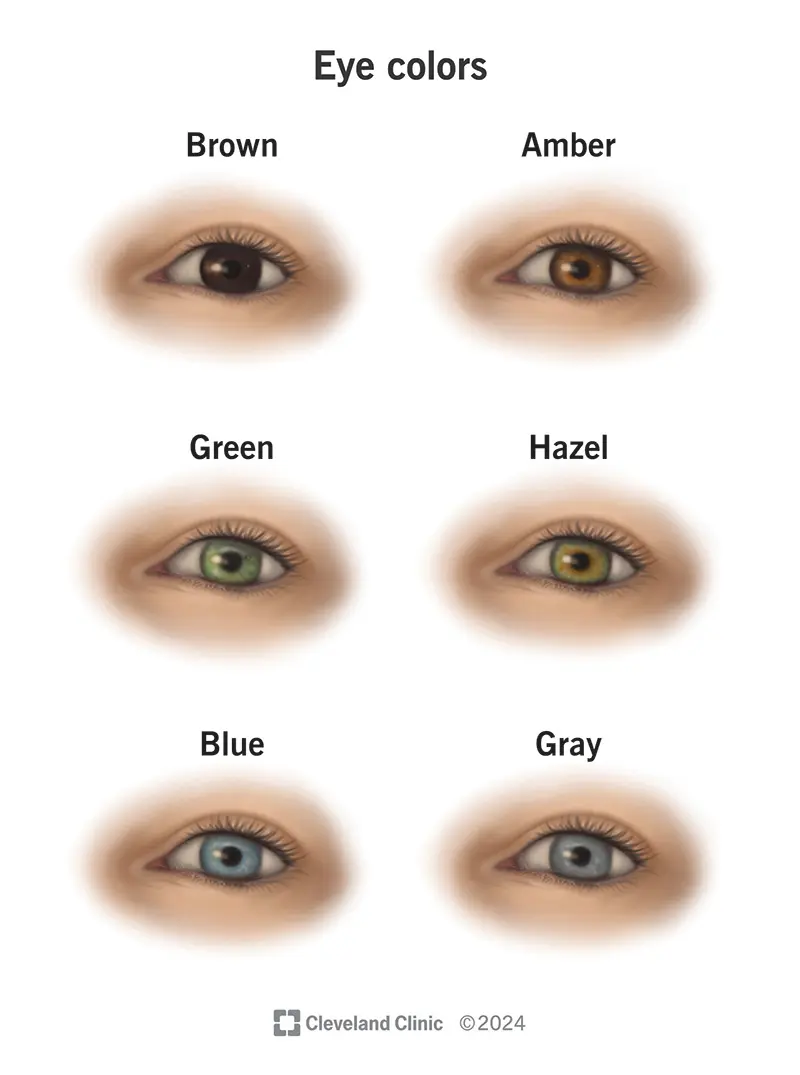
While there are infinite variations, scientists and clinicians generally group eye colors into a few primary categories based on pigment density. These categories help researchers track population trends and study the prevalence of different traits across various geographic regions.
- Brown: The most common color worldwide, characterized by high levels of melanin.
- Blue: Resulting from low melanin and light scattering; most common in Northern European populations.
- Green: Caused by a moderate amount of melanin combined with a yellowish pigment called lipochrome.
- Hazel: A combination of brown and green, often appearing to shift color depending on lighting conditions.
- Gray: Similar to blue but with a different structure in the stroma that scatters light more broadly.
These categories are helpful for general classification, but they do not capture the intricate patterns, such as rings or flecks, that make every person's iris unique. Even within the "brown" category, there is a massive difference between light amber and deep, near-black mahogany.
Common mistakes when analyzing eye color
One common mistake is assuming that eye color is a static, unchanging trait throughout a person's entire life. As noted, the eyes of infants are notoriously deceptive, often darkening significantly as they mature. Another error is relying on subjective descriptions like "bright blue" or "dark hazel," which can be influenced by ambient lighting, clothing colors, and even the observer's own perception. Because the iris is a reflective surface, the environment plays a massive role in how we perceive color.
To avoid these errors, researchers use standardized color scales during clinical examinations. If you are trying to determine your own eye color, try looking at your eyes in natural, indirect sunlight while holding a neutral background behind your head. Avoid using flash photography, as the reflection off the cornea and the pupil constriction can distort the true color of the iris stroma. By understanding that eye color is a complex, light-dependent, and genetically influenced trait, you can better appreciate the biological diversity found in the human population.
Key facts
- Eye color is determined by the amount and type of pigment called melanin in the iris.
- Brown is the most common eye color worldwide, appearing in approximately 70 to 80 percent of the human population.
- Blue eyes are not actually blue; they appear that way due to Rayleigh scattering, the same phenomenon that makes the sky look blue.
- Genetics are complex, as at least 16 different genes influence the final shade of an individual's eyes.
- People with albinism often have light blue or pinkish eyes because they lack melanin in the iris.
- Avoid assuming a child’s eye color at birth is permanent, as pigment levels often shift during the first three years of life.
The bottom line
Eye color is a complex biological trait primarily determined by the concentration of melanin in the iris. While genetics dictate the potential range of colors, physical phenomena like light scattering create the final appearance. Understanding that eye color is polygenic helps explain the diversity seen across populations. Ultimately, your eye color is a unique result of inherited traits interacting with the specific structural composition of your eyes.
People also ask
Can eye color change as you get older?
Yes, eye color can shift slightly due to changes in melanin production or density. While most changes occur in early childhood, some adults experience subtle darkening or lightening due to aging or health conditions.
Why do some people have two different colored eyes?
This condition is called heterochromia and occurs when there is an uneven distribution of melanin in the irises. It can be caused by genetic mutations, developmental issues, or injuries to the eye.
Is it possible for two blue-eyed parents to have a brown-eyed child?
While rare, it is biologically possible due to the polygenic nature of eye color inheritance. Because multiple genes contribute to pigment levels, recessive traits can occasionally combine in unexpected ways.
Do light-colored eyes have higher sensitivity to sunlight?
Yes, individuals with lighter eyes often experience more light sensitivity, or photophobia, than those with dark brown eyes. This is because lighter irises allow more light to pass through to the retina, necessitating the use of sunglasses.
Are green eyes the rarest eye color in the world?
Green is indeed one of the rarest eye colors, found in approximately two percent of the global population. It is often confused with hazel, which is a combination of brown and green pigments.
Does eye color affect vision quality?
There is no direct evidence that eye color determines visual acuity or the ability to see clearly. However, eye color may influence how the eyes react to glare and high-intensity lighting conditions.
This answer was created with the help of AI research tools and reference sources. Spotted an error? Let us know — we correct mistakes quickly. See our editorial policy.