Where did the English language come from?
Short answer
English originated from a collection of West Germanic dialects spoken by tribes migrating to Britain during the fifth century. It evolved through significant influences from Old Norse, Norman French, and Latin. Today, it stands as a global lingua franca, shaped by centuries of cultural contact, colonial expansion, and continuous linguistic borrowing.
On this page
Where did the English language begin?
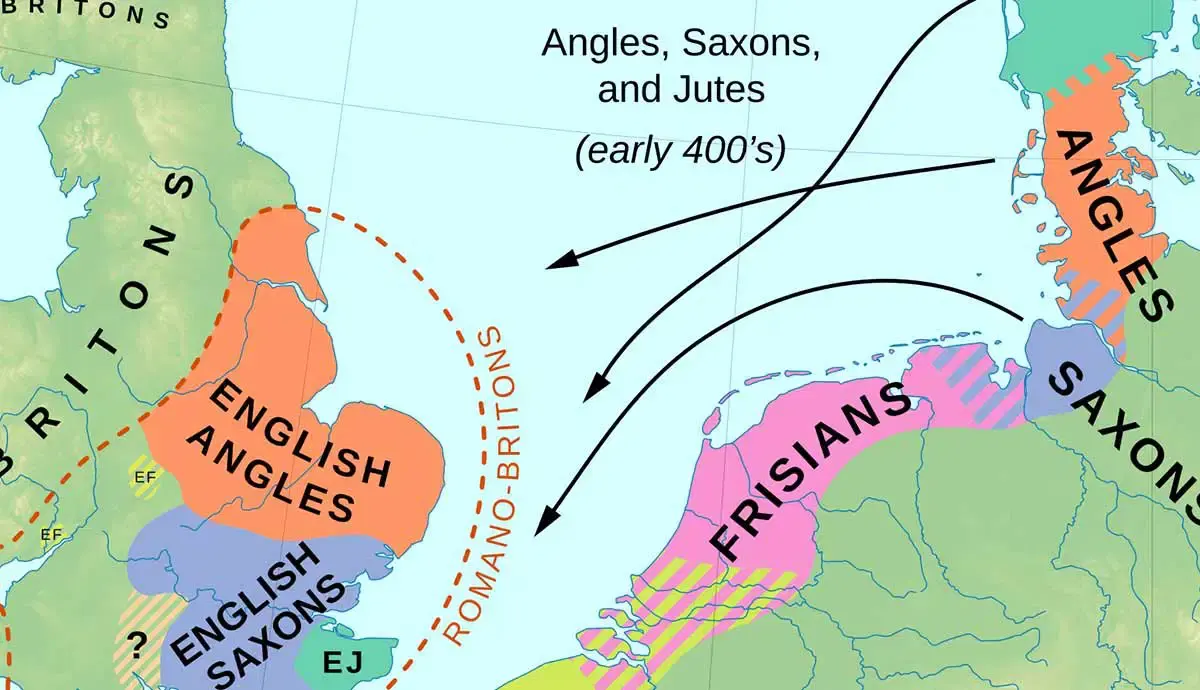
The roots of English are found in the migration of Germanic tribes—the Angles, Saxons, and Jutes—to the British Isles around 450 CE. These groups displaced the native Celtic speakers, establishing a collection of dialects known as Old English. This early stage of the language was heavily inflected and shared a common ancestor with modern German and Dutch.
Old English remained the primary language until the late 11th century, though it was not uniform across the region. It was characterized by complex grammar and a vocabulary that lacked many of the Latinate words common today. The period concluded after the Norman Conquest of 1066, which fundamentally altered the trajectory of the language by introducing a new ruling class that spoke Anglo-Norman.
How did French change the English language?
The Norman Conquest brought a massive influx of French vocabulary into the English lexicon, particularly in areas related to law, government, art, and cuisine. While the common people continued to speak English, the aristocracy and the legal system operated in French for centuries. This created a linguistic divide that eventually merged, leading to a hybrid vocabulary.
This fusion resulted in a unique phenomenon where English often has two words for the same concept: one of Germanic origin and one of French origin. This dual heritage provides the language with its characteristic synonymic richness, allowing for subtle distinctions in tone and register.
- Beef (French: boeuf) versus Cow (Germanic: cu)
- Justice (French) versus Law (Germanic)
- Mansion (French) versus House (Germanic)
- Potion (French) versus Drink (Germanic)
Why did English spelling become so inconsistent?
English spelling is notoriously difficult because it reflects a chaotic history of borrowing and pronunciation shifts. During the Middle English period, scribes often spelled words based on how they sounded in their local dialects rather than following a standardized system. When the printing press arrived in the 15th century, William Caxton chose the London dialect for his publications, effectively freezing many spellings in place.
The situation worsened during the Renaissance, when scholars attempted to "correct" English spelling by adding silent letters to words to reflect their Latin or Greek etymologies. For example, the "b" was added to "debt" to mirror the Latin debitum, even though the "b" is never pronounced. This process created a disconnect between the written form and the spoken reality of the language.
- Recognize that silent letters often indicate historical roots rather than modern pronunciation.
- Accept that English is not a phonetic language and requires memorization of specific patterns.
- Use etymological dictionaries to understand why certain words retain odd spellings.

When did Modern English emerge?
Modern English is generally considered to have begun around 1500, following the Great Vowel Shift. This was a massive change in pronunciation where the long vowels of Middle English began to be articulated higher in the mouth. This shift explains why English vowels often do not match the sounds found in other European languages that use the Latin alphabet.
The rise of the printing press and the publication of works by authors like William Shakespeare and the King James Bible helped standardize the grammar and vocabulary of the language. By the 18th century, grammarians began writing prescriptive rules, attempting to impose order on what had been a highly fluid and evolving system of communication.
- The Great Vowel Shift fundamentally altered the pronunciation of long vowels.
- Shakespeare expanded the vocabulary by inventing hundreds of new words.
- The King James Bible solidified the use of certain grammatical structures for centuries.
Common mistakes when studying English history
One common error is assuming that English is a "pure" language that has remained static since its inception. In reality, English is a "thief" language, having borrowed roughly 60% of its vocabulary from French, Latin, and Greek. Believing that English is strictly Germanic ignores the profound impact of the Viking invasions and the Norman Conquest on its structure.
Another mistake is ignoring the role of global interaction in shaping the language. English has continuously incorporated words from hundreds of other languages through trade, colonialism, and the internet. To understand English is to understand a history of constant movement and adaptation, rather than a fixed set of rules established in the past.
- Avoid assuming that all English words have Germanic roots.
- Do not treat the grammar of the 18th century as the only "correct" version of the language.
- Remember that dialects are valid variations, not incorrect versions of a standard.
Key facts
- English originated from West Germanic dialects brought to Britain by the Angles, Saxons, and Jutes around 450 CE.
- The language evolved through three distinct periods: Old English (450–1100), Middle English (1100–1500), and Modern English (1500–present).
- The Viking invasions in the 8th and 9th centuries introduced Old Norse words like "sky," "egg," and "give" into the English vocabulary.
- The Norman Conquest of 1066 introduced thousands of French words, significantly altering the English lexicon and legal terminology.
- William Shakespeare is credited with inventing or popularizing over 1,700 words, including "lonely," "dwindle," and "swagger."
- To understand English etymology, always check a dictionary for the language of origin rather than assuming a word is purely Germanic or Latinate.
The bottom line
English is a hybrid language born from Germanic roots and reshaped by centuries of migration, conquest, and cultural exchange. By blending its original Anglo-Saxon foundation with heavy influences from Norse, French, and Latin, it developed a vast and flexible vocabulary. Understanding this history reveals why English remains a complex, global language that continues to adapt, borrow, and grow to meet the needs of its diverse speakers.
People also ask
Why is English spelling so inconsistent?
English spelling often reflects older pronunciations or the original spelling of words borrowed from Latin, Greek, or French. Because the language adopted words from many sources without standardizing spelling until the 18th century, many irregularities remain.
How much of English is actually Germanic?
While the core grammar and most common words are Germanic, roughly 60% of the total vocabulary comes from French and Latin. You will find that most everyday verbs and pronouns are Germanic, while technical and academic terms are usually Latinate.
What is the difference between Old English and Middle English?
Old English, spoken until the 11th century, was highly inflected and resembled modern German in structure. Middle English emerged after the Norman Conquest, losing many complex grammatical endings and incorporating a massive influx of French vocabulary.
Did the printing press change the English language?
Yes, William Caxton’s introduction of the printing press in 1476 helped standardize English spelling and grammar. It encouraged a specific dialect, primarily the London dialect, to become the national standard for written communication.
Why do we have so many synonyms for the same thing?
English often has multiple words for one concept because it absorbed terms from different languages simultaneously. For example, "cow" (Germanic) refers to the animal, while "beef" (French) refers to the meat, reflecting the social hierarchy of medieval England.
Is English still evolving today?
Languages are living systems that change constantly through social media, technology, and global interaction. New words are added to the dictionary annually, and grammatical usage shifts to reflect the needs of contemporary speakers.
This answer was created with the help of AI research tools and reference sources. Spotted an error? Let us know — we correct mistakes quickly. See our editorial policy.