Why does Canada have two official languages?
Short answer
Canada maintains two official languages, English and French, to reflect its historical colonial roots and ensure national unity. This bilingual framework, solidified by the 1969 Official Languages Act, protects the rights of linguistic minorities, fosters cultural inclusivity, and acknowledges the foundational contributions of both British and French settlers to the nation’s development.
On this page
Why did Canada choose two official languages?
The roots of Canadian bilingualism lie in the 18th-century struggle between Britain and France for control over North America. Following the British conquest of New France in 1763, the British government passed the Quebec Act of 1774. This legislation was a pragmatic compromise that allowed French Canadians to retain their civil law, religious freedom, and language, effectively preventing a widespread revolt.
Over the following centuries, the demographic reality of Canada remained split between English-speaking and French-speaking populations. By the mid-20th century, the federal government sought a formal way to recognize this duality to keep the country together. The Royal Commission on Bilingualism and Biculturalism, established in 1963, recommended that Canada formally adopt both languages to ensure that French-speaking citizens felt like equal partners in the confederation.
How does the Official Languages Act work?
The Official Languages Act, passed in 1969, serves as the primary legal framework for Canada’s bilingual policy. It mandates that all federal institutions must provide services in both English and French. This ensures that any citizen, regardless of where they live in the country, can interact with the federal government in their preferred official language.
To implement this effectively, the government established several key requirements for public service delivery:
- Federal documents and publications must be available in both languages simultaneously.
- Courts of law under federal jurisdiction must allow proceedings in either English or French.
- Public service employees in designated bilingual regions must be proficient in both languages.
- Government websites and digital services must offer a seamless toggle between language versions.
What are the benefits of official bilingualism?
Bilingualism acts as a cornerstone of Canadian identity, promoting social cohesion and cross-cultural understanding. By providing services in both languages, the government signals that both English and French cultures are essential to the nation's fabric. This policy helps bridge the gap between different regions, particularly between Quebec and the rest of the country.
Beyond social benefits, there are significant practical advantages to this system:
- It encourages a more diverse and skilled workforce within the federal public service.
- It protects the linguistic rights of Francophone minorities living outside of Quebec.
- It facilitates international diplomacy, as Canada can engage more effectively with the global Francophonie.
- It provides educational opportunities for children to become functionally bilingual, enhancing their cognitive and professional prospects.
Common mistakes when discussing Canadian bilingualism
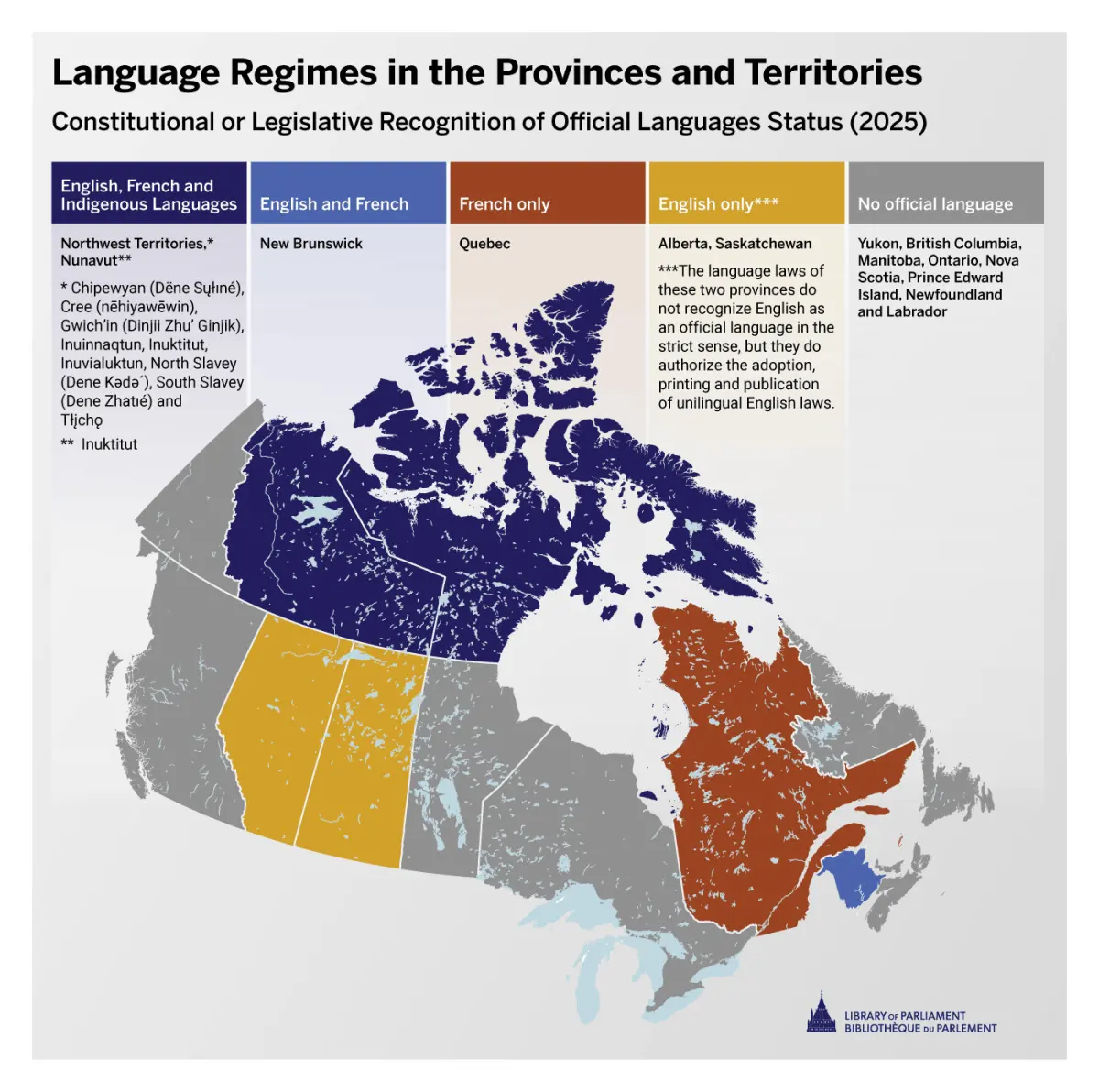
A frequent error is assuming that bilingualism means every individual citizen must speak both languages. In reality, the policy applies to federal institutions, not to private individuals or provincial governments, unless they choose to adopt similar policies themselves. For instance, while New Brunswick is the only province that is constitutionally bilingual, most other provinces operate primarily in English.
Another common misconception is that bilingualism is a recent political invention. Many people mistakenly believe it was introduced to appease specific political parties in the 1980s, rather than being a long-term evolution of colonial history. Understanding the distinction between federal requirements and provincial autonomy is crucial. Avoiding these generalizations helps clarify that the policy is a structural framework for government service rather than a mandate for every person living in the country to be fluent in two languages.
How to navigate services in both languages
If you are interacting with federal agencies, you have the right to request service in your preferred language. If you encounter a situation where service is not provided in both languages, you have the right to file a formal complaint with the Office of the Commissioner of Official Languages. This office acts as an ombudsman to ensure that the government upholds its legal obligations.
To ensure a smooth experience when dealing with federal services, follow these steps:
- Check the official website for a language toggle button, usually located in the top corner.
- If calling a government department, state your language preference immediately to be directed to a bilingual agent.
- Keep records of any correspondence, including the date and the name of the office, if you experience a service failure.
- Visit the official government portal to access resources designed to help citizens understand their language rights and responsibilities.
Key facts
- The Official Languages Act of 1969 established English and French as the two official languages of Canada at the federal level.
- Section 16 of the Canadian Charter of Rights and Freedoms constitutionally guarantees the equality of both languages in federal institutions.
- New Brunswick is the only province in Canada that is constitutionally bilingual under the Official Languages Act of New Brunswick.
- Approximately 22 percent of Canadians speak French as their first language, with the vast majority residing in Quebec.
- Federal government services, including tax forms, passports, and court proceedings, must be provided in both English and French upon request.
- When traveling in Canada, always check if a service is federal or provincial, as provincial language laws vary significantly outside of New Brunswick and Quebec.
The bottom line
Canada’s bilingualism reflects its complex colonial history, balancing the influence of British and French settlers. By enshrining both languages in law, the country ensures that federal institutions remain accessible to all citizens, regardless of their mother tongue. While provincial policies differ, this dual-language framework serves as a cornerstone of Canadian identity, promoting national unity and protecting the cultural rights of French-speaking communities across the country.
People also ask
Is every Canadian required to be bilingual?
No, there is no legal requirement for individual citizens to speak both English and French. Bilingualism is a requirement for federal government institutions and services, not for the private lives of individuals.
Can I receive healthcare in my preferred language anywhere in Canada?
Healthcare is a provincial responsibility, so language rights vary by province. While Quebec and New Brunswick have robust protections, other provinces may offer limited French-language health services depending on local population demographics.
Does Quebec have different language laws than the rest of Canada?
Yes, Quebec’s Charter of the French Language, or Bill 101, makes French the sole official language of the province. This law mandates the use of French in business, education, and public signage to protect the province's linguistic heritage.
What is the difference between federal and provincial language status?
Federal status means that government services, such as Canada Post or federal courts, must be accessible in both languages nationwide. Provincial status dictates the language of instruction in schools, municipal services, and local legislation within that specific province.
How do I request service in French if I am outside of Quebec?
You can request service in French at any federal government office, such as a Service Canada center or a passport office. If you are dealing with a provincial department, check the provincial government website to see if they offer French-language support in your specific region.
Are private businesses required to be bilingual?
Generally, private businesses are not required to be bilingual unless they operate in Quebec, where specific signage and labeling laws apply. Outside of Quebec, businesses choose to offer bilingual services based on their customer base and marketing strategy.
This answer was created with the help of AI research tools and reference sources. Spotted an error? Let us know — we correct mistakes quickly. See our editorial policy.