When did Canada become a country?
Short answer
Canada became a country on July 1, 1867, when the British North America Act came into effect. This legislation united the colonies of Canada, Nova Scotia, and New Brunswick into a single dominion within the British Empire. While this marked the birth of the modern nation, full legal independence evolved gradually over time.
On this page
When did Canada officially become a country?
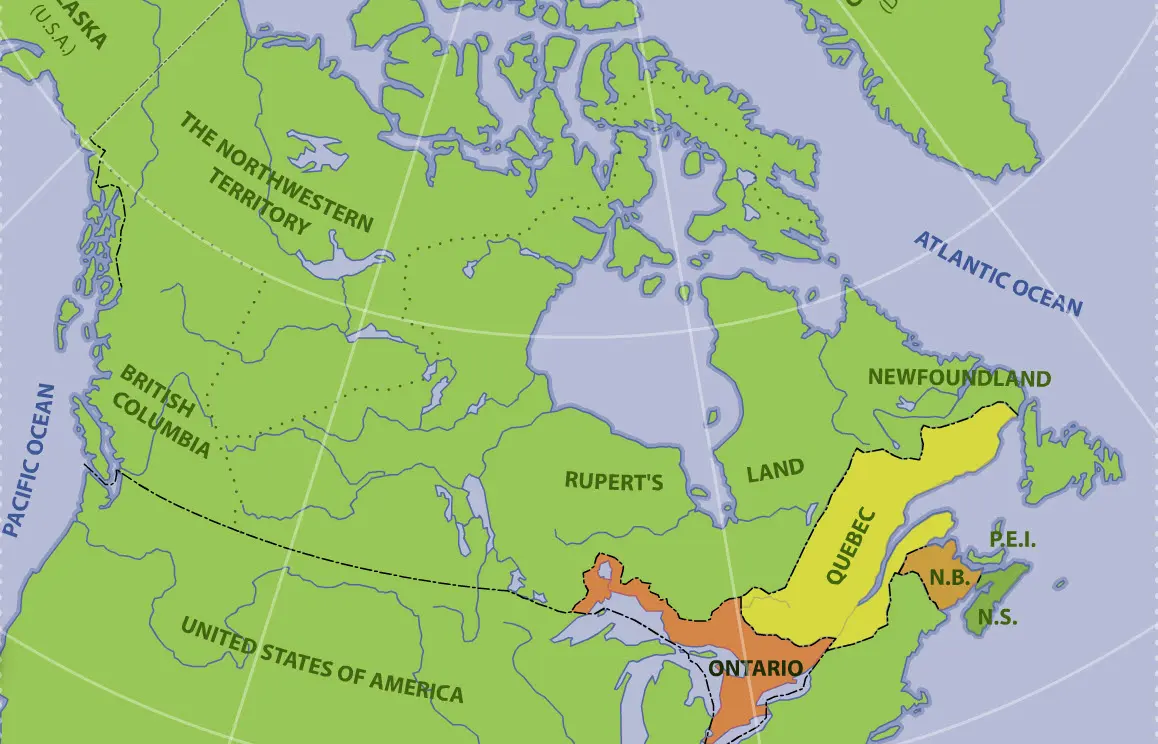
Canada officially became a self-governing dominion on July 1, 1867. This date is celebrated annually as Canada Day, marking the enactment of the British North America Act, which was passed by the British Parliament. The act united the Province of Canada, which was divided into Ontario and Quebec, with the colonies of Nova Scotia and New Brunswick. This new entity was named the Dominion of Canada and functioned under a federal structure that balanced local and national governance.
It is a common misconception that 1867 marked the moment Canada gained total independence from Great Britain. In reality, the 1867 act granted Canada control over its internal affairs, but the British government retained authority over foreign policy and constitutional amendments. The transition from a colonial territory to a sovereign nation was a slow process of legislative evolution rather than a single revolutionary event. Canada remained legally tied to the British Crown, maintaining a constitutional monarchy that continues to this day.
How did Canada gain full independence?
The path to complete sovereignty was defined by several key legislative milestones that gradually transferred power from London to Ottawa. The Statute of Westminster in 1931 was a pivotal moment, as it granted the Canadian Parliament the authority to pass laws without interference from the British government. This effectively ended the legislative supremacy of the United Kingdom over its dominions. However, Canada still lacked the power to amend its own constitution, which remained a British law.
The final step in achieving full legal independence occurred in 1982 with the patriation of the Canadian Constitution. This process involved the following developments:
- The Canada Act 1982 was passed by the British Parliament at the request of the Canadian government.
- The Constitution Act, 1982, was signed into law by Queen Elizabeth II in Ottawa.
- This act included the Canadian Charter of Rights and Freedoms, which solidified civil liberties.
- Canada gained the ability to amend its constitution independently, finally severing the last formal legislative link to the British Parliament.
Why is 1867 often confused with total independence?
Many people confuse the formation of the Dominion of Canada with the achievement of full sovereignty because of the significance of the 1867 confederation. The act created the structural framework for a national government, including the House of Commons and the Senate. Because this event established the political entity known as Canada, it is naturally viewed as the nation's "birthday." The complexity of the subsequent legal evolution is often overlooked in popular history, leading to the simplified belief that 1867 was the date of total separation.
Furthermore, the historical narrative of Canada’s development emphasizes a peaceful, evolutionary path rather than a violent break from colonial rule. Unlike countries that fought wars for independence, Canada negotiated its autonomy through treaties and constitutional conferences. This "quiet" evolution makes it difficult for casual observers to pinpoint a single day of independence. By focusing on the 1867 confederation, historians and educators provide a clear focal point for the beginning of the Canadian state, even if the legal reality was more nuanced.
Common mistakes when discussing Canadian history
A frequent error is assuming that Canada became a republic upon its formation. Canada has always been a constitutional monarchy, meaning the British monarch remains the formal head of state, represented by the Governor General. Another mistake is forgetting that the country grew in stages. Not all provinces joined in 1867; for instance, British Columbia joined in 1871, and Newfoundland and Labrador did not join until 1949. Treating the 1867 date as the final map of Canada ignores the decades of expansion that followed.
To accurately discuss the timeline of Canadian nationhood, keep these points in mind:
- Do not equate the 1867 confederation with the 1982 patriation of the constitution.
- Remember that "Dominion" status was a specific political category within the British Empire, not an independent state in the modern sense.
- Acknowledge that Indigenous peoples were already present and had their own governance systems long before the British North America Act was drafted.
- Distinguish between the political creation of the country and the legal acquisition of sovereignty.
How to research Canadian constitutional history
For those interested in the specifics of how Canada became a country, the best approach is to consult primary documents. The British North America Act, now known as the Constitution Act, 1867, is available online through the Department of Justice Canada. Reading the text of the act helps clarify the original division of powers between the federal government and the provinces. It is also helpful to review the 1982 Constitution Act to understand the final changes that granted Canada full control over its legal identity.
When conducting research, look for resources that distinguish between the political, legal, and symbolic aspects of Canadian history. Many educational websites provide timelines that clearly mark the difference between the 1867 confederation and the 1931 Statute of Westminster. By focusing on these distinct legislative milestones, you can develop a comprehensive understanding of how a collection of colonies transformed into a modern, sovereign nation. Avoiding oversimplified summaries will ensure that your research remains accurate and reflects the complex, multi-stage process that defined the modern Canadian state.
Key facts
- Canada became a country on July 1, 1867, through the British North America Act.
- The process of becoming a country is formally referred to as Confederation.
- The original four provinces were Ontario, Quebec, Nova Scotia, and New Brunswick.
- Canada did not gain full legal independence from Britain until the Statute of Westminster in 1931.
- The Canadian Constitution was fully patriated from Britain in 1982, ending the need for British parliamentary approval.
- A common mistake is assuming Canada gained total sovereignty in 1867; it remained a self-governing dominion under the British Empire.
The bottom line
Canada’s path to nationhood was an incremental evolution rather than a single event. While July 1, 1867, marks the formal creation of the Dominion of Canada, the country did not achieve full legal autonomy until the 20th century. By understanding this gradual transition, you can appreciate how Canada balanced its colonial roots with a steady movement toward complete sovereignty and its own unique national identity.
People also ask
Why is Canada Day celebrated on July 1?
It marks the anniversary of the 1867 enactment of the British North America Act, which united the three separate colonies into a single Dominion. This date serves as the symbolic birth of the modern Canadian state.
Was Canada a country before 1867?
No, the land was a collection of distinct British colonies and territories with separate administrations. Confederation was the political process that merged these entities into a single federal union.
Did Canada fight a war to become independent?
Unlike many other nations, Canada achieved its independence through peaceful political negotiation and legislative acts. This evolutionary process is often described as a gradual transition rather than a revolutionary break.
When did the last province join Canada?
Newfoundland and Labrador was the final province to join, officially becoming part of the confederation on March 31, 1949. Before this, it existed as a separate British dominion.
Is the Queen or King of England still the head of state?
Yes, Canada remains a constitutional monarchy. The British monarch serves as the official head of state, represented in Canada by the Governor General.
What is the difference between Confederation and Independence?
Confederation refers to the 1867 union of provinces, while independence refers to the long process of gaining full control over foreign policy and constitutional law. Canada achieved these milestones incrementally over the 20th century.
This answer was created with the help of AI research tools and reference sources. Spotted an error? Let us know — we correct mistakes quickly. See our editorial policy.