When did dinosaurs live?
Short answer
Dinosaurs lived during the Mesozoic Era, spanning approximately 186 million years. They first appeared during the Triassic Period about 230 million years ago and thrived throughout the Jurassic and Cretaceous periods. Their reign concluded abruptly 66 million years ago following a massive asteroid impact that triggered a global mass extinction event.
On this page
When did dinosaurs live on Earth?
Dinosaurs emerged during the Triassic Period, roughly 230 million years ago, evolving from small, bipedal archosaurs. At this time, all of Earth's landmasses were joined into a single supercontinent called Pangea. The climate was generally hot and dry, which favored the development of early dinosaur lineages like the Eoraptor.
As the Triassic gave way to the Jurassic Period about 201 million years ago, Pangea began to break apart. This tectonic shift increased humidity and created vast, lush forests, allowing dinosaurs to diversify rapidly. During this era, iconic giants such as the long-necked Brachiosaurus and the predatory Allosaurus became the dominant terrestrial vertebrates.
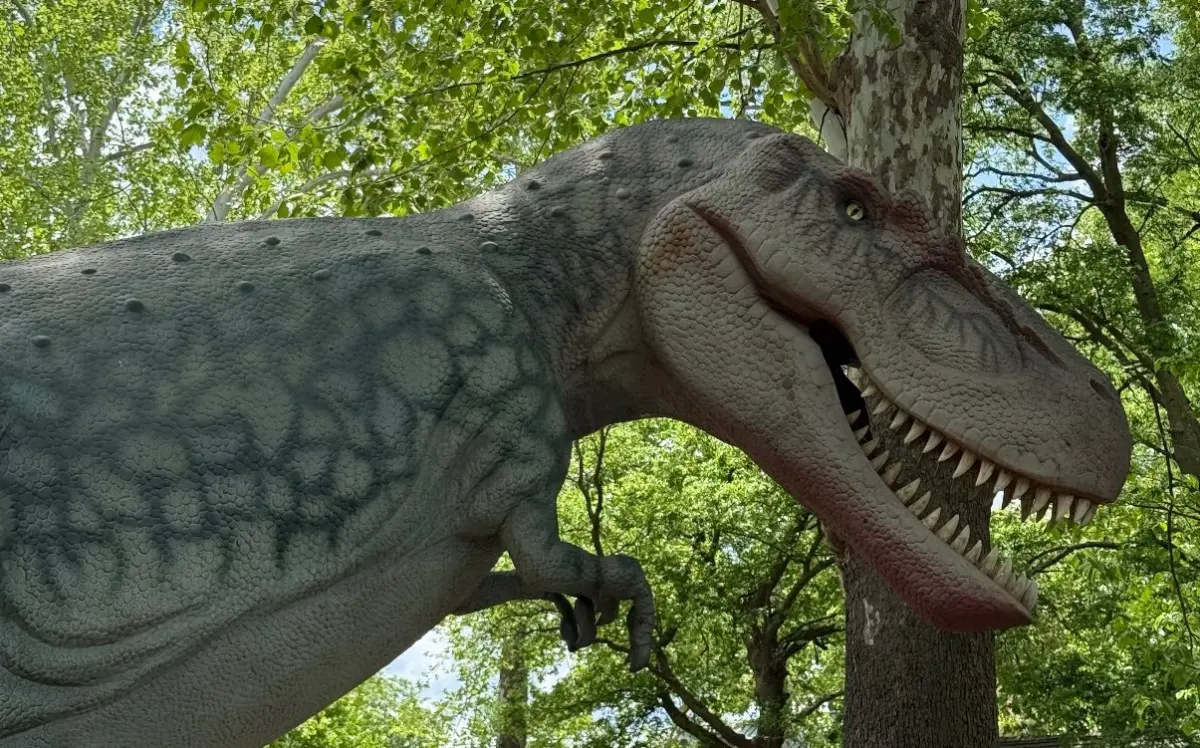
The final chapter for non-avian dinosaurs occurred during the Cretaceous Period, which lasted from 145 million to 66 million years ago. This era saw the rise of the most famous dinosaur species, including the Tyrannosaurus rex and Triceratops. By the end of this period, the continents had moved toward their modern positions, and flowering plants had begun to transform the global landscape.
How do scientists date dinosaur fossils?
Paleontologists use a combination of relative and absolute dating methods to determine when dinosaurs lived. Relative dating involves analyzing the position of fossils within layers of sedimentary rock, known as strata. Because deeper layers are generally older than those above them, scientists can establish a chronological sequence for different species.
Absolute dating, or radiometric dating, provides a more precise age by measuring the decay of radioactive isotopes in volcanic rock layers found near fossils. By calculating the ratio of parent isotopes to daughter products, researchers can pinpoint the age of the surrounding material with high accuracy. This process is essential for anchoring the geological time scale.
Common methods used in the field include:
- Potassium-Argon dating: Used for minerals in volcanic ash beds.
- Uranium-Lead dating: Highly accurate for dating igneous rocks.
- Biostratigraphy: Using index fossils to correlate rock layers across different regions.
- Magnetostratigraphy: Analyzing magnetic polarity reversals recorded in sedimentary rocks.
Why did the dinosaurs go extinct?
The extinction of non-avian dinosaurs 66 million years ago is primarily attributed to the Chicxulub asteroid impact. A massive space rock, estimated at 10 kilometers in diameter, struck the Yucatán Peninsula in present-day Mexico. The collision released energy equivalent to billions of atomic bombs, instantly vaporizing rock and sending a massive plume of debris into the atmosphere.
This impact caused immediate environmental devastation, including tsunamis, wildfires, and a global "impact winter." The dust and sulfur aerosols blocked sunlight for years, causing temperatures to plummet and halting photosynthesis. This collapse of the food chain led to the extinction of approximately 75 percent of all species on Earth, including all non-avian dinosaurs.
While the asteroid is the primary cause, some scientists argue that volcanic activity in the Deccan Traps of India also played a role. These massive eruptions released vast amounts of greenhouse gases, causing significant climate instability prior to the impact. The combination of these stressors likely made the ecosystem fragile and unable to recover from the asteroid's sudden blow.

Common mistakes when studying dinosaur timelines
One frequent error is the belief that all dinosaurs lived at the same time. In reality, the Stegosaurus lived during the Late Jurassic, about 150 million years ago, while the Tyrannosaurus rex lived during the Late Cretaceous, about 67 million years ago. There is a gap of over 80 million years between these two species, meaning a T. rex was closer in time to a human than to a Stegosaurus.
Another common misconception is that all prehistoric reptiles were dinosaurs. Pterosaurs, which were flying reptiles, and marine reptiles like the Mosasaurus are often incorrectly labeled as dinosaurs. To avoid this mistake, remember that dinosaurs are defined by specific skeletal features, such as an upright limb posture where the legs are positioned directly under the body rather than splayed to the sides.
- Verify the geological period of the species before assuming it lived alongside others.
- Check if the creature lived on land, as only terrestrial reptiles are classified as dinosaurs.
- Consult reputable geological charts to understand the vast time gaps between different Mesozoic eras.
- Distinguish between non-avian dinosaurs and their modern descendants, the birds.
How to explore dinosaur history for beginners
If you want to learn more about when dinosaurs lived, start by visiting natural history museums that feature chronologically organized exhibits. These displays are designed to guide visitors through the progression of the Mesozoic Era, showing how environments and species changed over millions of years. Pay attention to the labels, which usually provide the specific period and geological age of the fossils on display.
You can also engage with the subject through digital resources and reputable science websites. Many universities and museums offer virtual tours and databases where you can search for specific dinosaurs and see their temporal ranges. When reading about dinosaurs, prioritize sources that cite specific geological formations and radiometric dating results to ensure you are getting accurate, evidence-based information rather than speculative fiction.
Following these steps will help you build a solid understanding of deep time:
- Start with a general overview of the Mesozoic Era to understand the three main periods.
- Focus on one specific time period to learn about the unique flora and fauna of that age.
- Learn to identify the physical characteristics that define true dinosaurs.
- Use interactive geological timelines to visualize the immense duration of the dinosaur era.
Key facts
- Dinosaurs lived during the Mesozoic Era, which spanned from approximately 252 million to 66 million years ago.
- This era is divided into three distinct geological periods: the Triassic, the Jurassic, and the Cretaceous.
- The earliest known dinosaurs emerged during the Middle to Late Triassic period, roughly 230 to 240 million years ago.
- Non-avian dinosaurs went extinct at the end of the Cretaceous period following a massive asteroid impact.
- Avoid the common mistake of assuming humans lived alongside dinosaurs; humans did not appear until millions of years later.
- Remember that birds are the only surviving lineage of dinosaurs, meaning dinosaurs are technically still alive today.
The bottom line
Dinosaurs dominated terrestrial ecosystems for over 160 million years throughout the Mesozoic Era. Spanning the Triassic, Jurassic, and Cretaceous periods, these creatures evolved into an incredible array of forms before the catastrophic extinction event 66 million years ago. While non-avian species vanished, their legacy persists through modern birds. Understanding this vast timeline clarifies that dinosaurs were a remarkably successful group that shaped Earth’s prehistoric history.
People also ask
Did dinosaurs live at the same time as humans?
No, non-avian dinosaurs went extinct about 66 million years ago. Modern humans, Homo sapiens, did not evolve until roughly 300,000 years ago, creating a gap of over 65 million years.
Which period had the most famous dinosaurs?
The Jurassic and Cretaceous periods are the most iconic. The Jurassic featured giants like Brachiosaurus, while the Cretaceous hosted famous predators like Tyrannosaurus rex and Triceratops.
How do we know when dinosaurs lived?
Paleontologists use radiometric dating of volcanic ash layers found above and below fossil-bearing rock strata. This allows scientists to calculate the precise age of the fossils with high accuracy.
Were all dinosaurs massive?
While many were enormous, others were quite small. Some dinosaurs, such as Compsognathus or Microraptor, were roughly the size of a chicken or a small dog.
Did all dinosaurs go extinct at the same time?
The mass extinction event 66 million years ago wiped out all non-avian dinosaurs. However, small feathered theropods survived and evolved into the birds we see today.
Where were dinosaurs found?
Dinosaurs lived on every continent on Earth, including Antarctica. Their fossils have been discovered in diverse environments ranging from lush tropical forests to arid desert regions.
This answer was created with the help of AI research tools and reference sources. Spotted an error? Let us know — we correct mistakes quickly. See our editorial policy.