What is Madhubani painting?
Short answer
Madhubani painting, or Mithila art, is a traditional folk art style originating from the Mithila region of Bihar, India. Historically created by women on mud-plastered walls using natural dyes, these vibrant, geometric paintings depict mythological figures, flora, and fauna. Today, it is a globally recognized art form practiced on paper and canvas.
On this page
What are the characteristics of Madhubani painting?
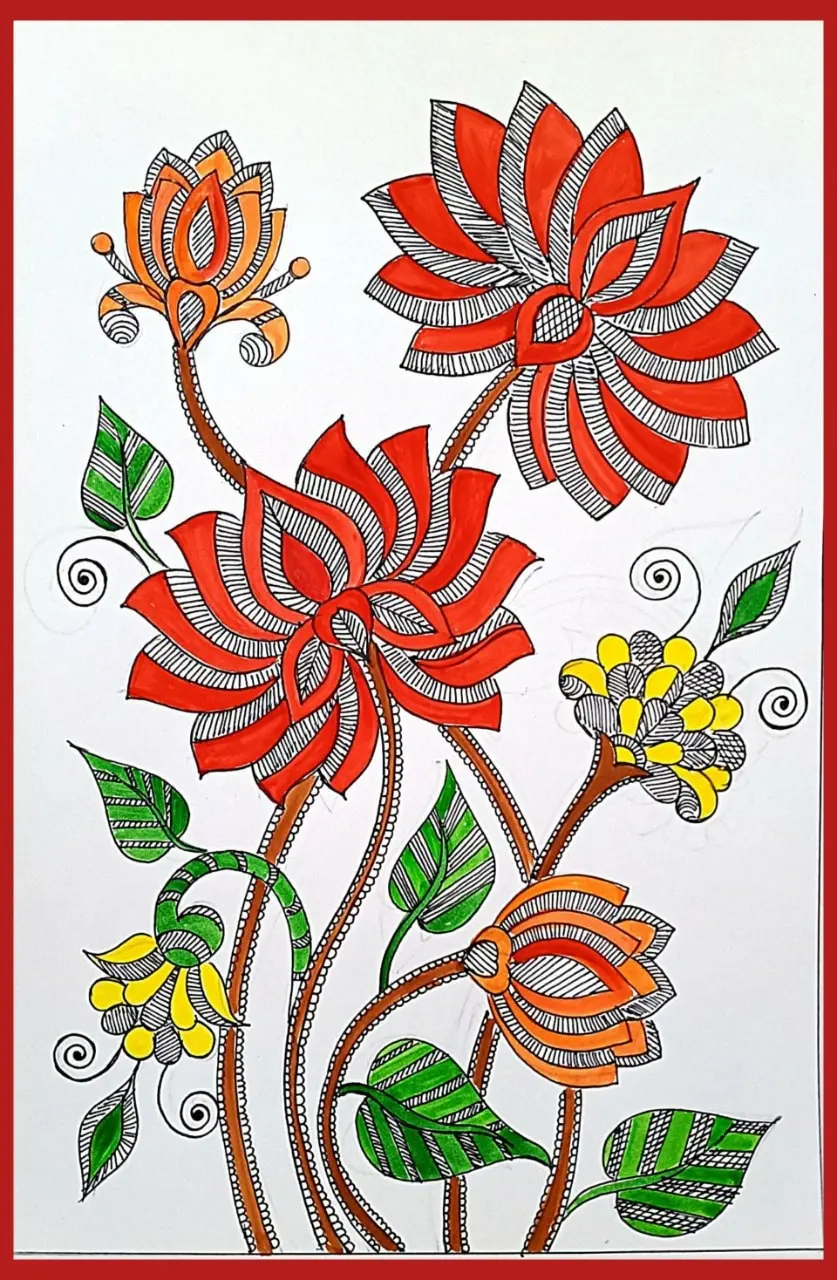
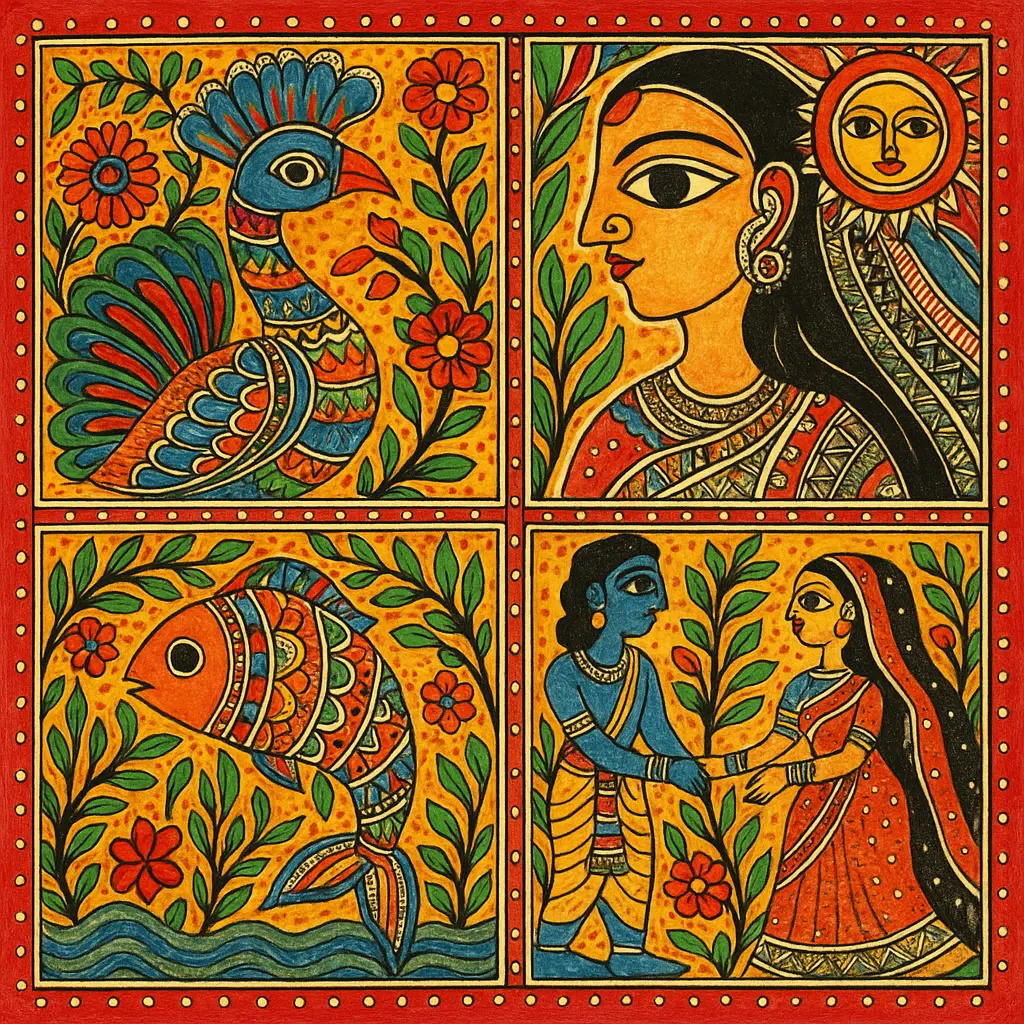
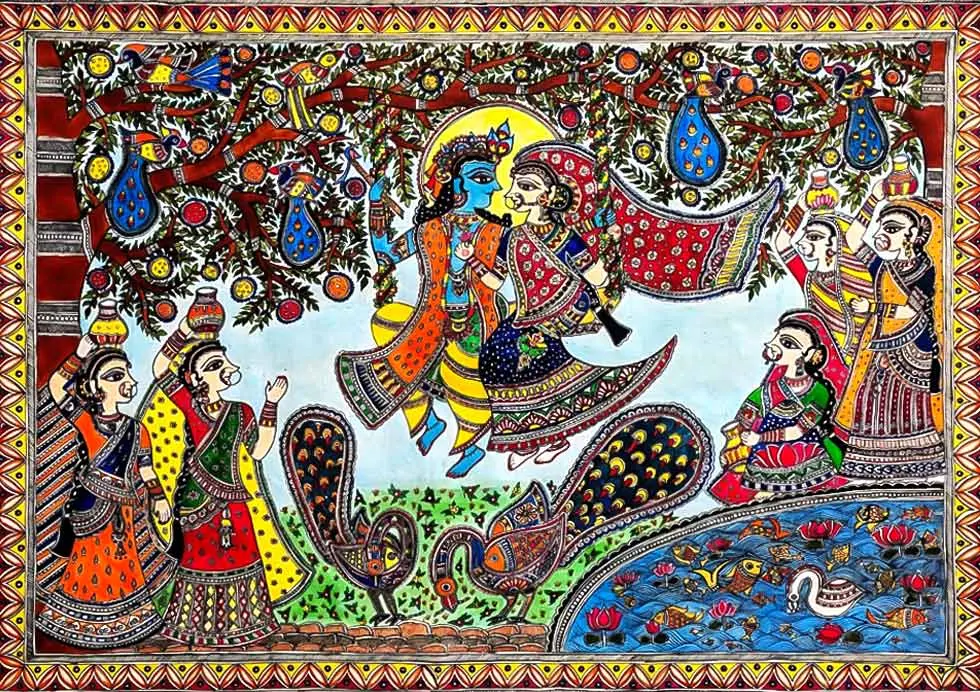
Madhubani art is instantly recognizable by its bold, vibrant colors and intricate geometric patterns. Artists typically fill every inch of the canvas with detailed motifs, leaving no empty space. Common subjects include Hindu deities like Krishna, Rama, and Durga, alongside celestial bodies such as the sun and moon. Nature also plays a central role, with frequent depictions of lotus flowers, fish, birds, and elephants, which symbolize fertility and prosperity.
The style is defined by a distinct lack of shading. Instead, artists use double lines for borders and fill the interiors with cross-hatching, stippling, or intricate line work. Traditionally, the paintings were monochromatic or used a limited palette of earth tones, but modern versions incorporate bright, synthetic colors. The result is a highly stylized, two-dimensional aesthetic that prioritizes symbolic representation over realistic perspective.
How is traditional Madhubani art made?
Historically, the process of creating a Madhubani painting was deeply connected to the daily life and environment of the Mithila people. Women would prepare the walls of their homes with a mixture of cow dung and mud to create a smooth, absorbent surface. They used bamboo twigs or cotton wrapped around a stick as brushes, rather than traditional artist brushes.
The pigments were extracted entirely from nature, showcasing a deep knowledge of local botany. These natural sources included:
- Turmeric for vibrant yellow tones.
- Sandalwood or rosewood for deep red hues.
- Indigo for rich blue shades.
- Rice flour paste for white outlines.
- Lampblack or charcoal for bold, dark borders.
Today, while natural pigments are still used by purists, most contemporary artists have transitioned to using high-quality acrylics or poster paints on handmade paper or cloth. This shift has allowed the art form to become more portable and durable for international exhibition and sale.
How to start Madhubani painting for beginners
If you are interested in learning this art form, start by mastering the basic line work. You do not need expensive materials to begin; a simple fine-liner pen or a thin brush with black ink is sufficient for practice. Focus on creating consistent, steady lines, as the precision of the outline is the foundation of every Mithila piece.
Follow these steps to create your first piece:
- Sketch a light pencil outline of a central figure, such as a fish or a bird.
- Trace the outline using a dark, permanent ink pen to define the shape.
- Fill the surrounding areas with repeating geometric patterns like triangles, waves, or small dots.
- Apply your chosen colors within the defined shapes, ensuring you maintain a flat, opaque finish.
Avoid the common mistake of overcrowding your canvas too early. Start with a single motif and gradually build your confidence by adding more complex background textures around the central figure.
Why is Madhubani painting culturally significant?
Madhubani painting serves as a visual language for the cultural history of the Mithila region. For centuries, these paintings were passed down from mother to daughter, serving as a way to preserve local folklore and religious narratives. They were traditionally created during auspicious occasions, such as weddings, births, and harvest festivals, to invoke blessings and good fortune for the household.
The art form also acts as a powerful tool for social expression. In recent decades, artists have moved beyond purely mythological themes to address contemporary issues, such as environmental conservation and women's literacy. By depicting these themes through traditional motifs, artists bridge the gap between ancient heritage and modern societal challenges. This evolution has helped Madhubani art gain international recognition, transforming it from a private domestic ritual into a celebrated professional career for thousands of rural women in India.
Common mistakes when painting Madhubani art
One of the most frequent errors beginners make is failing to maintain the integrity of the border. In traditional Madhubani, the double-line border is essential, as it frames the composition and acts as a container for the intricate patterns inside. If the border is shaky or inconsistent, the entire piece can lose its visual balance. Always use a ruler or a steady hand to ensure the frame is perfectly aligned before beginning the interior work.
Another mistake is neglecting the "no-empty-space" rule. A hallmark of this style is the "bharni" (filling) technique, where every gap is filled with secondary patterns like leaves, flowers, or geometric shapes. Beginners often leave large patches of background color, which makes the painting look incomplete. To avoid this, keep a small sketchbook of patterns handy to fill in any awkward gaps that appear during your creative process. Finally, ensure your paint consistency is smooth; if the paint is too thin, it will bleed into the paper, ruining the crisp, clean edges that define this beautiful folk art.
Key facts
- Madhubani, or Mithila art, originated in the Mithila region of Bihar, India, and Nepal.
- Traditionally, women created these paintings on freshly plastered mud walls and floors of huts during festivals.
- The style is characterized by geometric patterns, vibrant colors, and double-line borders with no empty space.
- Artists traditionally use natural dyes derived from plants, flowers, turmeric, and sandalwood.
- Common themes include Hindu deities like Krishna and Rama, nature motifs, and scenes from royal courts.
- To start a painting, use a fine-tipped bamboo twig or a modern nib pen for intricate outlines before filling in colors.
The bottom line
Madhubani painting is a historic Indian folk art form defined by its intricate geometric patterns, vibrant natural pigments, and profound connection to Hindu mythology. By filling every inch of the canvas with symbolic motifs, artists celebrate cultural identity and spiritual devotion. Whether practiced on traditional mud walls or modern paper, this enduring style remains a vital expression of creativity, precision, and the rich heritage of the Mithila region.
People also ask
What materials are used to paint Madhubani art today?
While traditional artists used natural pigments, modern practitioners often use acrylics, poster colors, or ink on handmade paper, canvas, or fabric. Cotton swabs and brushes have largely replaced bamboo twigs for more consistent line work.
Are there specific styles within Madhubani painting?
Yes, there are five primary styles: Bharni, Kachni, Tantric, Godna, and Kohbar. These vary based on the use of color, line density, and whether the subject matter is religious or folk-oriented.
How do I avoid common mistakes when creating this art?
The most common mistake is failing to create a consistent double-line border, which is a hallmark of the style. Avoid leaving large blank spaces, as the aesthetic relies on "filling" the background with small patterns like dots or cross-hatching.
Is Madhubani painting considered a protected art form?
Yes, the art form received a Geographical Indication (GI) tag in 2003. This status protects the intellectual property of the Mithila region and ensures that only works produced in that specific area can be officially labeled as authentic Madhubani.
Can beginners learn Madhubani without formal training?
Beginners can easily start by practicing the repetitive geometric patterns and border motifs on paper. Focusing on mastering the fine, uniform outline is the most important step before attempting complex mythological scenes.
Why are there no shadows in Madhubani paintings?
The style is two-dimensional and symbolic rather than realistic or perspective-based. The absence of shadows emphasizes the flat, decorative nature of the storytelling and ensures the focus remains on the intricate line work and iconography.
This answer was created with the help of AI research tools and reference sources. Spotted an error? Let us know — we correct mistakes quickly. See our editorial policy.