What is atmospheric perspective?
Short answer
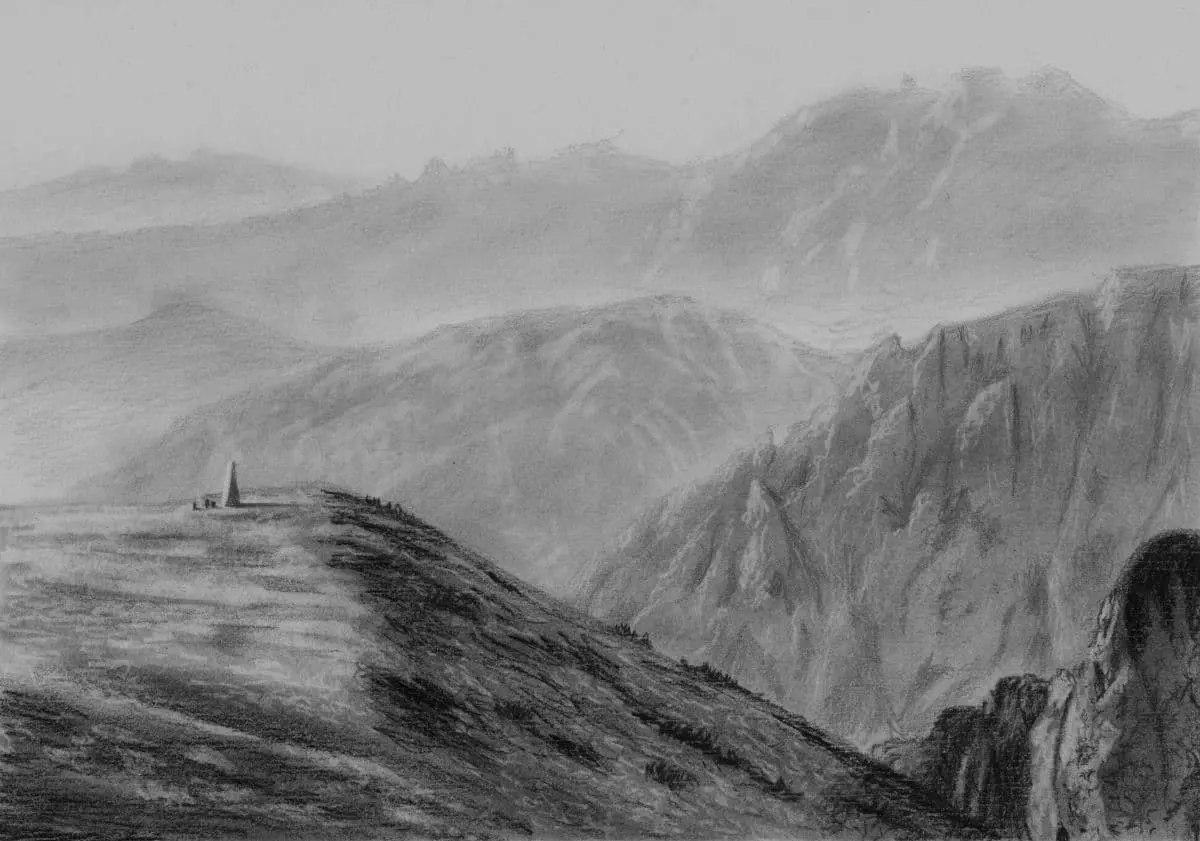
Atmospheric perspective is a technique used in art to create the illusion of depth by mimicking how the atmosphere affects the appearance of distant objects. As things recede into the distance, they appear lighter in value, less saturated in color, and lose fine detail due to particles suspended in the air.
On this page
Why does atmospheric perspective happen
The phenomenon occurs because light must travel through an increasing density of air, moisture, and dust particles before reaching the viewer’s eye. As distance increases, these suspended particles scatter shorter wavelengths of light, specifically blue and violet, while allowing longer wavelengths like red and yellow to pass through more easily. This physical interaction is the same principle responsible for the blue appearance of distant mountains and the sky itself.
Artists utilize this scientific reality to translate three-dimensional space onto a two-dimensional surface. By intentionally reducing the contrast and saturation of background elements, the brain perceives those objects as being further away. This depth cue is essential for landscape painting and photography, as it provides a sense of scale and vastness that flat, uniform colors cannot achieve. Without these subtle shifts, a scene would appear compressed and lack a clear focal point.
How to use atmospheric perspective in art
To effectively implement this technique, painters must adjust their color palette as they move from the foreground to the background. Foreground elements should possess the highest contrast, the darkest shadows, and the most intense, warm colors. As you move toward the horizon, colors should shift toward cooler tones, such as pale blues, grays, or violets, while the overall contrast between light and dark values should diminish significantly.
- Establish your foreground with sharp edges and high-saturation pigments.
- Mix a small amount of white or a cool gray into your background colors to desaturate them.
- Soften the transitions between shapes as they move further away to mimic the loss of detail.
- Keep the horizon line light and hazy to emphasize the maximum distance in the composition.
Best tools for atmospheric perspective
Achieving the right level of haze requires specific materials that allow for blending and layering. For oil painters, transparent glazes are the gold standard for creating the illusion of air. By applying thin, semi-transparent layers of cool-toned paint over a dried underpainting, you can simulate the effect of looking through a veil of atmosphere. This allows the underlying texture to remain visible while subtly altering its color and value.
For those working in digital media or watercolor, the approach changes slightly. Digital artists rely on opacity sliders and soft-edged brushes to gradually fade background elements into the sky color. Watercolorists, conversely, utilize the "wet-on-wet" technique to allow colors to bleed into one another, creating naturally soft edges. Regardless of the medium, the goal remains the same:
- Use transparent layers to build subtle color shifts.
- Employ soft brushes or blending tools to eliminate harsh outlines.
- Maintain a consistent light source to ensure the depth feels logical.
Common mistakes when painting distance
One of the most frequent errors is maintaining the same level of detail throughout the entire canvas. Beginners often obsess over drawing every leaf on a distant tree, which effectively pulls that tree into the foreground and ruins the sense of scale. If the human eye cannot perceive fine detail at a distance in real life, your painting should reflect that limitation by simplifying shapes into broader, flatter masses.
Another common pitfall is the misuse of color temperature. Many artists mistakenly believe that all distant objects should simply be made darker, but this often makes the background look like a storm cloud rather than a distant landscape. Instead, focus on value and saturation. If you make an object too dark, it will appear to advance toward the viewer. Always check your values by squinting at your work; if the background looks just as "heavy" as the foreground, you need to lighten your distant tones.
History of atmospheric perspective in painting
The technique gained prominence during the Renaissance, as artists sought to move beyond the flat, symbolic representations of the Middle Ages. Leonardo da Vinci was a pioneer in this field, famously documenting his observations in his notebooks. He noted that the air is not perfectly transparent and that the color of distant objects is modified by the intervening atmosphere. His masterpiece, the Mona Lisa, serves as a prime example, featuring a hazy, blue-tinted landscape that recedes into an infinite distance.
Following the Renaissance, the technique became a staple of landscape painting, particularly during the 19th-century Romantic movement. Artists like J.M.W. Turner pushed the boundaries of atmospheric perspective, using it to create ethereal, light-filled scenes that focused more on mood than rigid accuracy. Today, the technique remains a foundational skill for anyone interested in visual storytelling. By mastering the relationship between light, air, and distance, you can transform a simple sketch into a window that invites the viewer into a vast, believable world.
Key facts
- Atmospheric perspective is a technique used by artists to create the illusion of depth by mimicking how the atmosphere scatters light.
- Objects appear lighter, less saturated, and lower in contrast as they recede into the distance.
- Distant features lose fine detail and edges become softer compared to foreground elements.
- The color of distant objects shifts toward the color of the sky, typically appearing cooler or more bluish.
- Leonardo da Vinci famously documented this phenomenon in his notebooks, calling it the "perspective of disappearance."
- To practice this, paint foreground objects with high contrast and warm tones, while keeping background elements muted and pale.
The bottom line
Atmospheric perspective is a vital optical principle that artists use to translate three-dimensional depth onto a two-dimensional surface. By reducing contrast, softening edges, and shifting colors toward the cool tones of the sky, you can effectively simulate the vastness of space. Mastering this technique allows you to guide the viewer’s eye through a composition, creating a convincing sense of scale and distance in any landscape painting.
People also ask
Why do distant mountains look blue?
Light from the sun is scattered by particles in the atmosphere, a process known as Rayleigh scattering. Because blue light travels in shorter, smaller waves, it is scattered more easily, creating a blue haze over distant landscapes.
Is atmospheric perspective the same as linear perspective?
No, these are distinct techniques. Linear perspective uses converging lines and vanishing points to create spatial depth, while atmospheric perspective relies on changes in color, tone, and clarity.
Can atmospheric perspective be seen on a clear day?
Yes, but it is less pronounced than on a hazy or humid day. Even on clear days, the sheer volume of air between the viewer and a distant object is enough to slightly reduce contrast and color intensity.
What is the most common mistake when painting distance?
Artists often make the mistake of keeping background colors too bright or saturated. To fix this, mix your background colors with a small amount of white or the color of the sky to desaturate them.
Does atmospheric perspective apply to indoor scenes?
It is rarely applicable indoors because the distance is usually too short for the atmosphere to significantly alter light. It is primarily a tool for landscape artists depicting vast outdoor spaces.
How does humidity affect atmospheric perspective?
Higher humidity increases the amount of water vapor and particulates in the air, which intensifies the scattering of light. This makes distant objects appear even lighter and more obscured than they would in dry air.
This answer was created with the help of AI research tools and reference sources. Spotted an error? Let us know — we correct mistakes quickly. See our editorial policy.