What is an idiom?
Short answer
An idiom is a phrase or expression whose meaning cannot be understood from the literal definitions of its individual words. These figurative linguistic units are culturally specific, meaning their significance is derived from common usage within a particular language community rather than the dictionary definitions of the words that compose them.
On this page
What is an idiom and how does it work?
An idiom functions as a fixed expression where the collective meaning transcends the sum of its parts. For example, when someone says they are "under the weather," they are not physically beneath a meteorological phenomenon; they are simply feeling ill. Because these phrases rely on shared cultural knowledge, they often confuse non-native speakers who attempt to translate them word-for-word.
These expressions are deeply embedded in the history and social fabric of a language. They often originate from historical events, literature, or folklore that have faded from collective memory, leaving only the phrase behind. While the literal origin may be obscure, the figurative usage remains standardized. Understanding them requires learning the phrase as a single, indivisible unit of vocabulary rather than analyzing its grammatical structure.
Why do we use idioms in daily life?
Idioms serve as linguistic shortcuts that allow speakers to convey complex emotions or situations with brevity. They add color, personality, and nuance to communication, often softening a message or providing a vivid mental image. By using a familiar idiom, a speaker can establish rapport and signal belonging to a specific cultural or linguistic group.
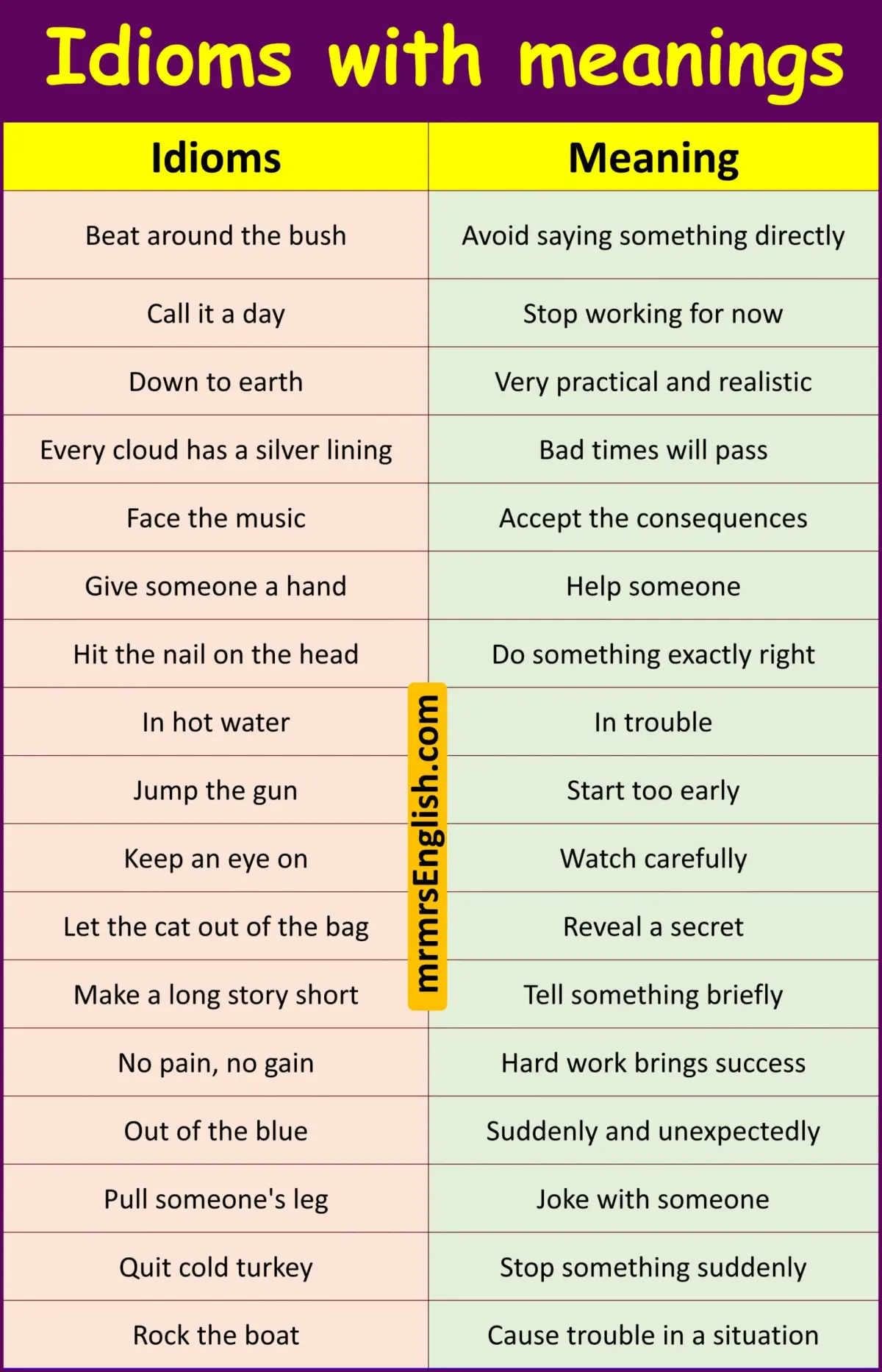
In professional and casual settings, idioms help bridge the gap between abstract concepts and relatable imagery. They function as a form of social shorthand, allowing for more efficient communication among people who share the same background. Common examples include:
- "Break a leg": Used to wish someone good luck, especially before a performance.
- "Piece of cake": Describes a task that is incredibly easy to complete.
- "Bite the bullet": Refers to enduring a painful or difficult situation with courage.
- "Barking up the wrong tree": Indicates that someone is pursuing a mistaken line of thought.
How to identify idioms in conversation
Identifying an idiom often involves noticing a breakdown in literal logic. If a sentence seems nonsensical or grammatically sound but semantically impossible in a literal sense, it is likely an idiom. Listeners should look for context clues provided by the speaker’s tone and the surrounding conversation to determine if a figurative meaning is intended.
When you encounter a phrase that leaves you confused, follow these steps to determine if it is an idiom:
- Analyze the individual words: Do the definitions make sense in the current context?
- Check for figurative intent: Is the speaker describing a physical action or a metaphorical state?
- Consult a dictionary or idiom database: Look for the phrase as a whole entry rather than searching for individual words.
- Observe the reaction of others: If the audience responds to the phrase with understanding, it is likely a common idiomatic expression.

Common mistakes when using idioms
The most frequent error is using idioms too literally or in the wrong social register. Because many idioms are informal, using them in highly formal documents or academic writing can make the text appear unprofessional. Additionally, non-native speakers often attempt to "fix" the grammar of an idiom, which renders the expression unrecognizable to native speakers.
Another common mistake is misquoting the phrase. Idioms are fixed, meaning you cannot substitute words without losing the intended meaning. For instance, saying "break an arm" instead of "break a leg" fails to convey the traditional sentiment of good luck. To avoid these pitfalls, keep the following rules in mind:
- Avoid modifying the adjectives or nouns within a standard idiom.
- Be cautious of using idioms in high-stakes professional environments.
- Do not assume that an idiom in one language has an exact equivalent in another.
- Ensure your audience is familiar with the cultural context of the phrase.
Best ways to learn idioms for beginners
Learning idioms is a gradual process that requires exposure to authentic language, such as movies, literature, and casual conversation. Rather than memorizing long lists of phrases, focus on learning them in context. When you hear a new expression, write down the sentence where it appeared to help you remember how it is applied in real-world scenarios.
To improve your proficiency, try incorporating these strategies into your daily study routine:
- Keep an idiom journal: Record new phrases you hear and write a brief note about the situation in which they were used.
- Use visual aids: Draw a picture of the literal meaning versus the figurative meaning to reinforce the difference.
- Practice with native speakers: Ask for clarification when you hear a phrase you do not understand.
- Read diverse materials: Consuming various forms of media will expose you to a wider range of regional and situational idioms.
By consistently engaging with the language as it is spoken, you will naturally develop an intuitive sense for when and how to use these colorful expressions effectively.
Key facts
- An idiom is a phrase where the figurative meaning differs entirely from the literal definition of its individual words.
- Idioms are culturally specific, meaning they often do not translate word-for-word into other languages.
- English contains an estimated 25,000 idioms, ranging from common expressions to obscure regional sayings.
- To identify an idiom, try replacing the words with synonyms; if the sentence loses its intended meaning, it is likely idiomatic.
- Avoid using idioms in formal technical writing or international correspondence, as they can cause confusion for non-native speakers.
- Context is essential; an idiom's meaning is derived from social usage rather than dictionary definitions of its components.
The bottom line
Idioms are essential components of natural language that rely on shared cultural knowledge rather than literal word definitions. While they enrich communication by adding nuance and flavor to speech, they pose significant challenges for language learners and professional clarity. By recognizing these phrases as fixed units of meaning, you can improve your comprehension and choose the right words to ensure your message remains clear and professional.
People also ask
How do I know if a phrase is an idiom?
If the literal interpretation of a phrase makes no sense in the context of your conversation, it is likely an idiom. For example, "break a leg" does not literally mean to injure someone, but rather to wish them good luck.
Can idioms be translated into other languages?
Most idioms cannot be translated literally because they rely on cultural history and metaphors that do not exist elsewhere. You must instead find the functional equivalent in the target language to convey the same sentiment.
Why are idioms so common in daily speech?
Idioms function as linguistic shortcuts that convey complex emotions or situations quickly. They add color, personality, and brevity to everyday communication between native speakers.
Should I use idioms in professional emails?
It is generally safer to avoid idioms in business settings, especially when communicating with people from different cultural backgrounds. Clear, direct language prevents misunderstandings and ensures your message is interpreted exactly as intended.
Are metaphors and idioms the same thing?
While all idioms use figurative language, not all metaphors are idioms. A metaphor is a comparison, whereas an idiom is a fixed phrase that has become a standard part of a language's vocabulary.
How can I learn to use idioms correctly?
The best way to learn is by observing how native speakers use them in movies, books, and conversations. Pay attention to the specific situations where the phrase is used to understand its underlying tone and intent.
This answer was created with the help of AI research tools and reference sources. Spotted an error? Let us know — we correct mistakes quickly. See our editorial policy.