What is the Ashcan School?
Short answer
The Ashcan School was an early 20th-century American art movement characterized by realistic portrayals of gritty urban life. Led by Robert Henri, these painters rejected the polished, idealized academic style of the era. They focused on the daily struggles and vitality of New York City’s working class, laborers, and immigrants.
On this page
What defined the Ashcan School style?
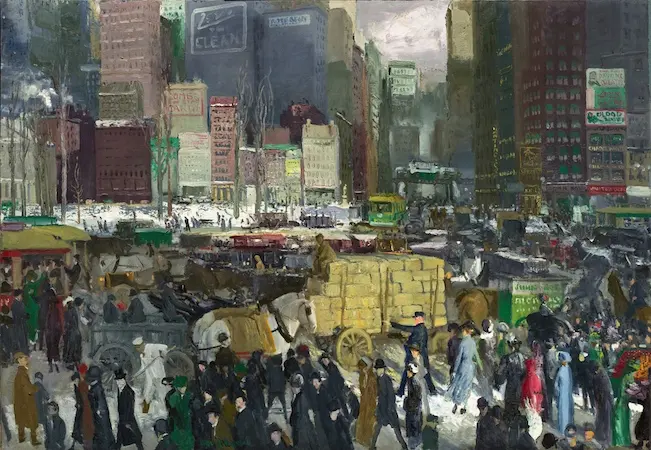
The Ashcan School, originally known as "The Eight," emerged in New York City around 1908. These artists favored a dark, muddy palette and loose, energetic brushwork, which critics at the time mockingly compared to the contents of an ashcan. They sought to capture the raw, unvarnished truth of the modern metropolis rather than the refined portraits favored by the National Academy of Design.
By focusing on the mundane and the marginalized, these artists shifted the subject matter of American painting toward the street level. Their work often featured bustling tenements, crowded docks, and dimly lit saloons. This approach provided a stark contrast to the Impressionist landscapes that were popular during the same period. Key stylistic elements included:
- High-contrast lighting inspired by Old Masters like Rembrandt and Velázquez.
- Spontaneous, sketch-like application of paint to convey movement.
- A preference for somber, earth-toned colors to reflect the industrial environment.
- An emphasis on human interaction and the psychological weight of city living.
Who were the key Ashcan School artists?
Robert Henri, a charismatic teacher and painter, served as the primary leader and mentor for the group. He encouraged his students to paint what they saw with honesty, regardless of how "ugly" the subject might appear to the elite art world. Alongside Henri, several other prominent figures defined the movement's aesthetic and philosophy.
The core members of the group included John Sloan, George Luks, William Glackens, and Everett Shinn. These men often worked as newspaper illustrators, a background that heavily influenced their ability to quickly capture the essence of a scene. Other notable artists associated with the broader circle included George Bellows and Edward Hopper, who later expanded the movement’s themes. Their collective efforts ensured that the urban experience remained a central pillar of American art for decades.
How to identify an Ashcan School painting
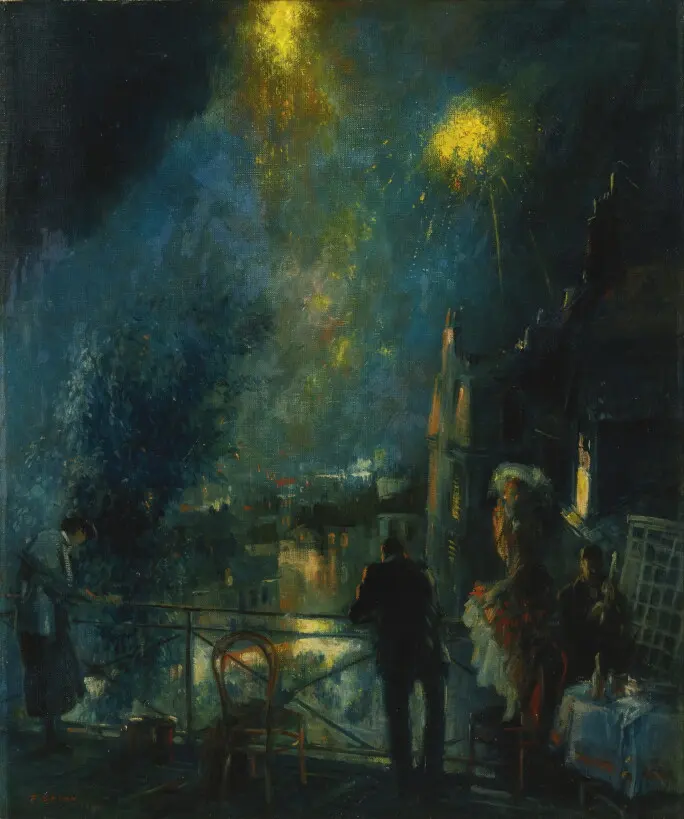
Identifying an Ashcan work requires looking for specific thematic and technical markers. If you are examining a painting from the early 1900s, look for scenes that depict New York City's lower-middle-class life. The focus is rarely on the wealthy; instead, the subjects are typically street urchins, boxers, laundry-hanging housewives, or weary commuters.
When analyzing the technical aspects, observe the following:
- Check for a lack of formal composition; the scene should feel like a snapshot of a fleeting moment.
- Look for "painterly" brushstrokes that remain visible on the canvas rather than being blended into a smooth surface.
- Assess the color palette for dominance of blacks, grays, browns, and deep reds.
- Verify the setting; most works are explicitly tied to the architecture and social geography of turn-of-the-century New York.
Why the movement changed American art
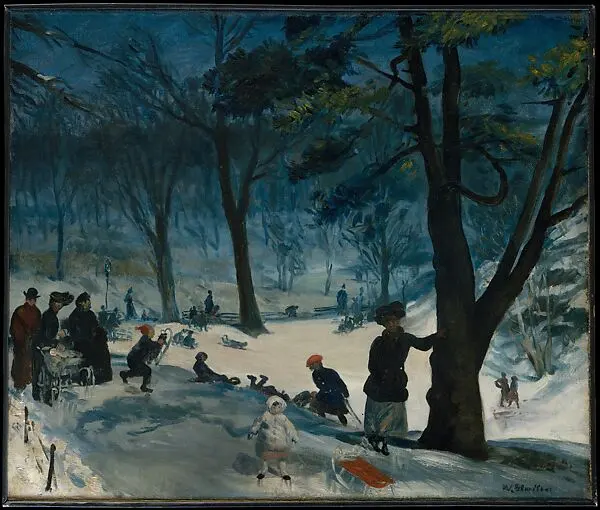
The Ashcan School was revolutionary because it democratized art. Before their emergence, American art was largely restricted to landscapes, historical epics, or portraits of the wealthy. By bringing the "common man" into the gallery, these artists challenged the social hierarchy of the Gilded Age and forced the public to acknowledge the reality of urban poverty and vitality.
This shift paved the way for later movements, such as Social Realism and the Regionalist movement of the 1930s. By proving that contemporary life was a worthy subject for serious art, they broke the dominance of European academic standards in the United States. Their legacy persists in the way modern photographers and filmmakers document urban environments, prioritizing authenticity over aesthetic perfection. They essentially taught American artists that beauty could be found in the grit of a crowded alleyway.
Common mistakes when studying the Ashcan School
A frequent error is assuming that the Ashcan artists were purely political activists. While their work depicted the struggles of the working class, they were primarily interested in the visual and emotional experience of the city, not necessarily in promoting a specific socialist agenda. Their art was an observation of life, not a manifesto for reform, which is a distinction often missed by modern viewers.
Another common mistake is confusing the Ashcan School with the later Precisionist movement. While both focused on the city, Precisionists emphasized the clean, geometric lines of skyscrapers and machinery. Conversely, the Ashcan artists focused on the human element and the chaotic, messy nature of humanity within that architecture. To avoid these misunderstandings, keep these tips in mind:
- Do not mistake the dark palette for a lack of skill; the muddiness was a deliberate aesthetic choice.
- Remember that the group was not a formal organization with strict rules, but rather a loose association of friends.
- Always consider the context of the newspaper illustration industry, which demanded speed and narrative clarity from these painters.
Key facts
- The Ashcan School was an early 20th-century American artistic movement known for portraying scenes of daily life in New York City’s poorer neighborhoods.
- The group was initially dubbed "The Eight" after a landmark 1908 exhibition at the Macbeth Gallery in New York.
- Key artists included Robert Henri, John Sloan, George Luks, Everett Shinn, and William Glackens.
- Their style rejected the polished, idealized academic art of the time in favor of gritty, realistic, and often dark color palettes.
- The term "Ashcan" was derogatory, coined by critics who felt the artists were obsessed with the "ashcans" or trash of urban life.
- To identify these works, look for candid depictions of tenements, saloons, boxing matches, and bustling street crowds.
The bottom line
The Ashcan School revolutionized American art by turning the gaze of the painter toward the vibrant, messy, and often overlooked realities of urban existence. By rejecting academic constraints, these artists captured the heartbeat of early 20th-century New York City with unprecedented honesty. Their legacy remains a testament to the power of artistic rebellion, proving that everyday life is a subject worthy of serious aesthetic consideration.
People also ask
Why were they called the Ashcan School?
The name was coined by critics who were offended by the artists' focus on the grittier, less glamorous aspects of urban life. They felt the painters were essentially "painting trash" rather than traditional, elevated subjects.
How did the Ashcan School differ from Impressionism?
While Impressionists often focused on light, color, and leisure, the Ashcan artists prioritized social realism and the raw energy of the city. They utilized darker tones and looser brushwork to capture the psychological weight of poverty and labor.
Who was the leader of the Ashcan School?
Robert Henri is widely considered the leader and primary mentor of the group. He encouraged his students to paint what they saw in the streets rather than following the rigid rules of the National Academy of Design.
What is the most famous painting associated with this movement?
John Sloan’s The Hairdresser’s Window (1907) is a quintessential example of the style. It captures a mundane, humorous street scene that reflects the authentic, unvarnished character of New York City.
Did the Ashcan School influence later American art?
Yes, the movement paved the way for American Modernism and the later Social Realism of the 1930s. It shifted the focus of American art toward local, relatable subject matter rather than European imitation.
Where can I see Ashcan School paintings today?
Major collections are housed at the Whitney Museum of American Art, the Metropolitan Museum of Art, and the Philadelphia Museum of Art. Many regional museums across the United States also feature works by these artists.
This answer was created with the help of AI research tools and reference sources. Spotted an error? Let us know — we correct mistakes quickly. See our editorial policy.