How does a bicycle stay upright?
Short answer
A bicycle stays upright primarily through the rider's active steering adjustments, which keep the wheels aligned under the center of mass. While gyroscopic effects and frame geometry provide minor stabilizing influences, they are insufficient on their own. Constant, subtle corrections made through the handlebars are the essential mechanism for maintaining balance while moving.
On this page
Why does a bicycle stay upright while moving?
The fundamental reason a bicycle remains upright is the rider’s ability to steer into a fall. When a bike begins to tilt to the left, the front wheel naturally or intentionally turns to the left. This movement creates a centrifugal force that pushes the bike back toward the center, effectively counteracting the tilt. This process happens so quickly that experienced cyclists perform these micro-adjustments subconsciously.
Contrary to popular belief, the gyroscopic effect of the spinning wheels is not the primary stabilizer. While the angular momentum of the wheels does resist tilting, it is too weak to keep a bike upright at low speeds. Similarly, the "trail"—the distance between where the steering axis hits the ground and where the tire touches the ground—helps the front wheel self-center. However, these passive mechanical features only assist the rider; the active steering input remains the dominant force in maintaining equilibrium.
How does frame geometry affect stability?
Bicycle geometry is engineered to balance maneuverability with stability. The "head tube angle" and the "fork offset" determine the trail of the bike. A bike with more trail is generally more stable and tracks straight easily, while a bike with less trail is more responsive and twitchy. Engineers carefully calculate these dimensions to ensure the bike feels natural to ride at various speeds.
Beyond the front end, the overall length of the wheelbase influences how a bike handles. A longer wheelbase provides a more stable platform, which is why touring bikes are often longer than racing bikes. The center of gravity also plays a critical role, as a lower center of gravity makes it easier for the rider to control the bike’s lean. These factors work together to create a predictable feedback loop for the cyclist.
- Head tube angle: A shallower angle increases trail and stability.
- Fork offset: Adjusting this distance fine-tunes how much effort is needed to steer.
- Wheelbase: A longer distance between axles prevents the bike from feeling overly sensitive to input.
Common mistakes when learning to balance
Many beginners struggle because they attempt to hold the handlebars too tightly. A rigid grip prevents the bike from making the tiny, necessary movements required to stay upright, leading to over-correction and instability. Relaxing the shoulders and arms allows the bike to "float" slightly, which is essential for the self-correcting nature of the steering geometry to function properly.
Another frequent error is looking directly at the front wheel. When a rider focuses on the ground immediately in front of the bike, they lose their sense of balance and direction. Looking ahead at the horizon helps the brain process the bike's lean and adjust the steering accordingly. Maintaining a forward gaze is one of the most effective ways to improve stability instantly.
- Gripping the bars with excessive force.
- Looking down at the front tire instead of the path ahead.
- Sitting too far back, which lightens the front wheel and reduces steering control.
- Trying to balance while moving too slowly to generate effective steering force.
How does speed influence stability?
Speed is a significant factor in how easily a bicycle stays upright. At higher speeds, the steering response is more effective because the centrifugal force generated by a small turn is much greater. This is why it is paradoxically easier to balance a bicycle when moving at a moderate pace than when crawling at a walking speed. The bike essentially becomes a self-correcting system at speed.
When the bike moves slowly, the rider must provide more manual input to keep the bike upright. This requires greater physical effort and better coordination. If a cyclist stops moving entirely, the steering mechanism loses its ability to generate the forces needed to restore balance. At this point, the rider must put a foot down to prevent the bike from falling over due to gravity.
Best practices for maintaining control
To maintain control, always ensure your bicycle is properly maintained. A loose headset or a misaligned fork can interfere with the bike's natural steering geometry, making it feel unstable even when the rider is doing everything correctly. Regularly checking that the handlebars move smoothly and that the tires are inflated to the recommended pressure will ensure the bike behaves as it was designed to.
Practicing in a controlled environment is the best way to master balance. Start on a flat, paved surface away from traffic to get a feel for how the bike responds to your body weight and steering inputs. By shifting your weight slightly and observing how the bike reacts, you will develop the muscle memory needed for effortless riding. Consistent practice turns these complex physical interactions into an intuitive skill that lasts a lifetime.
Key facts
- A bicycle stays upright primarily due to the rider's active steering adjustments rather than gyroscopic effects.
- The "trail" of the front fork, where the steering axis hits the ground ahead of the contact patch, provides self-centering stability.
- Gyroscopic forces from spinning wheels contribute to stability only at higher speeds, not when starting from a standstill.
- Moving the handlebars slightly in the direction of a lean allows the bike to steer back underneath the rider's center of gravity.
- Bicycle frames are designed with specific geometry to naturally resist tipping when the bike is rolling forward.
- To maintain balance, keep your eyes on the horizon rather than the front wheel to improve your natural equilibrium.
The bottom line
A bicycle stays upright because of a combination of steering geometry and the rider’s constant, subtle corrections. While gyroscopic forces provide minor assistance at high speeds, the primary mechanism is the "trail" of the front fork, which naturally aligns the wheel. By keeping your eyes on the road ahead and maintaining forward momentum, you allow the bike’s design to handle the physics of balance for you.
People also ask
Does the weight of the rider affect bicycle stability?
Yes, a lower center of gravity generally makes a bicycle easier to balance. When a rider sits lower, the bike becomes less prone to sudden tipping, which is why mountain bikes often have lower frame designs.
Why is it harder to balance a bike when it is moving slowly?
At low speeds, the rider has less time to make the necessary steering corrections to counter a lean. The bike lacks the momentum required to make small, effective adjustments to the steering angle.
Can a bicycle stay upright without a rider?
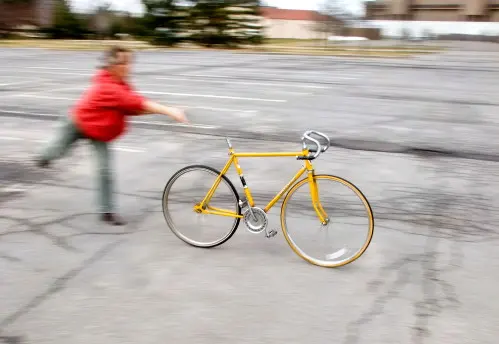
Yes, a properly designed bicycle can remain upright while rolling forward on its own due to its self-correcting geometry. This phenomenon was famously demonstrated in experiments where unmanned bicycles stayed balanced until their forward momentum faded.
What is the role of the front fork angle in stability?
The angle of the head tube and the offset of the fork determine the "trail," which acts like a caster wheel on a shopping cart. This design forces the front wheel to align with the direction of travel, preventing the bike from wobbling.
Should I look at the ground to keep my balance?
No, looking down at the front wheel often causes a rider to overcorrect their steering. Looking ahead allows your brain to process the path and make subtle, subconscious adjustments to keep the bike upright.
Does tire pressure affect how a bike handles?
Correct tire pressure ensures a consistent contact patch with the road, which is vital for predictable steering. Under-inflated tires can feel "squishy" and make the bike feel unstable or sluggish during turns.
This answer was created with the help of AI research tools and reference sources. Spotted an error? Let us know — we correct mistakes quickly. See our editorial policy.