What is a group of tigers called?
Short answer
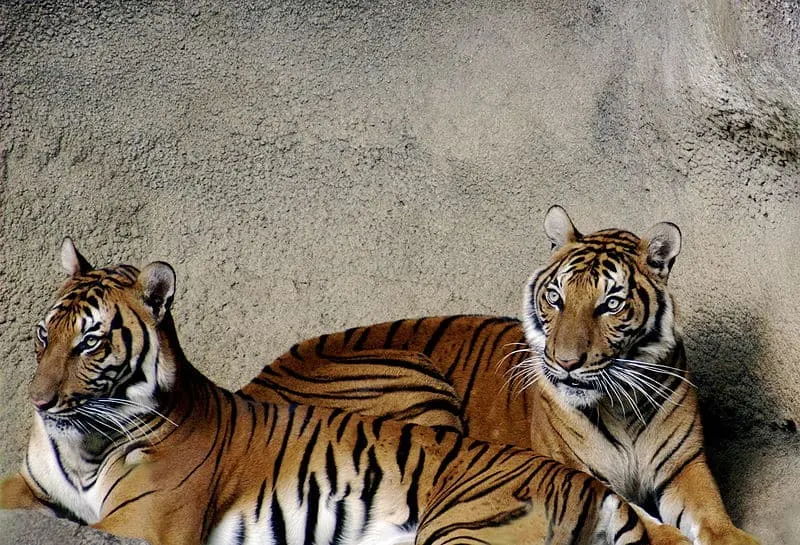
A group of tigers is called an ambush or a streak. While these terms exist in the English language, they are rarely used in scientific contexts because tigers are solitary animals. Unlike lions, which live in prides, tigers do not form social groups and typically only interact for mating or rearing cubs.
On this page
Why are tigers considered solitary animals?
Tigers are apex predators that rely on stealth and ambush tactics to hunt prey. Because they require vast territories to find enough food, living in groups would create too much competition for resources. A single tiger may roam a range spanning dozens or even hundreds of square miles, depending on the availability of deer, wild boar, and other ungulates.
Social structures like those seen in lions are absent in the tiger world. While a mother tiger will raise her cubs for approximately 18 to 24 months, the cubs eventually disperse to establish their own independent territories. Once they reach maturity, they live almost entirely alone, marking their boundaries with scent and vocalizations to avoid direct physical confrontations with other tigers.
What is the difference between an ambush and a streak?
The terms "ambush" and "streak" are collective nouns used to describe tigers, but they are largely poetic or linguistic curiosities rather than biological descriptors. "Ambush" refers to the tiger’s primary hunting strategy, where it hides in dense vegetation before launching a surprise attack. "Streak" is a reference to the distinctive vertical black stripes that provide camouflage in tall grass and forest shadows.
These collective nouns are part of a tradition of "terms of venery," which originated in late medieval hunting manuals. Many of these terms were invented for amusement rather than scientific accuracy. In the wild, you will never witness a "streak" of tigers moving together as a pack. If you see multiple tigers in one location, it is almost certainly a mother with her sub-adult cubs or a temporary mating pair.

How do tigers interact with one another?
Although tigers are solitary, they are not entirely anti-social. They maintain a complex system of communication to navigate their shared environment without needing to physically meet. They use several methods to signal their presence and status to others in the vicinity:
- Scent marking: Tigers spray urine or rub their bodies against trees to leave chemical messages.
- Vocalizations: Roars and chuffing sounds allow tigers to communicate over long distances.
- Visual cues: Scratches on tree trunks serve as physical markers of a tiger's size and territory.
- Fecal deposits: These are often left in prominent places to define borders clearly.
These signals allow tigers to occupy overlapping home ranges while minimizing the risk of injury from fighting. By reading these signs, a tiger can determine the age, sex, and reproductive status of a neighbor, effectively managing social distance without ever having to engage in a formal group gathering.

Common mistakes when describing tiger behavior
A frequent error is assuming that all big cats share the same social habits as lions. Because lions are the only truly social wild cats, people often project this behavior onto tigers. Believing that tigers hunt in packs is a significant misunderstanding that ignores the evolutionary adaptations required for solitary hunting.
Another mistake is misinterpreting the rare instances where tigers are seen together. Observing two tigers near a carcass does not mean they are a "pride" or a "pack." It is usually a female and her nearly full-grown offspring sharing a meal. If you are researching or writing about tigers, it is essential to follow these guidelines to ensure accuracy:
- Use the term "solitary" to describe their natural social structure.
- Refer to a mother and her young as a "litter" or a "family unit."
- Avoid using group nouns like "ambush" in scientific or conservation-focused writing.
- Distinguish between territorial overlap and social grouping.
How to observe tigers safely in the wild
If you are planning an expedition to see tigers in their natural habitat, such as in India or the Russian Far East, you must understand that sightings are unpredictable. Because they are solitary and elusive, they do not congregate at water holes in the way that herd animals do. Patience and an experienced guide are the most important tools for a successful observation.
When visiting a national park, follow these professional protocols to ensure your safety and the welfare of the animals:
- Stay inside your vehicle at all times, as tigers view humans as potential threats or prey.
- Maintain a respectful distance and avoid making loud noises that could disturb a hunting tiger.
- Follow the instructions of your park ranger, who is trained to read the signs of an animal's agitation.
- Never attempt to attract a tiger with food or calls, as this encourages dangerous habituation.
By respecting their solitary nature and keeping a distance, you can witness the majesty of these animals without disrupting the delicate balance of their forest homes. Observing a tiger in the wild is a rare privilege that requires understanding their need for privacy and space.
Key facts
- A group of tigers is most commonly referred to as an "ambush" or a "streak."
- Unlike lions, tigers are solitary animals and rarely form permanent social groups.
- The term "ambush" is used because tigers rely on stealth and surprise to hunt their prey.
- A "streak" refers to the distinctive dark vertical stripes that provide camouflage in tall grass.
- Mothers and their cubs are the only stable social unit, staying together for about two years.
- Adult tigers are territorial and typically only interact during mating season or when defending boundaries.
The bottom line
While English provides collective nouns like "ambush" or "streak" to describe a group of tigers, these terms are rarely used in nature. Because tigers are solitary apex predators, they do not form herds or packs. Aside from a mother raising her cubs, you will almost never see tigers together in the wild. Their survival strategy relies entirely on stealth, individual hunting, and maintaining exclusive territorial boundaries.
People also ask
Do tigers ever live in prides like lions?
No, tigers are strictly solitary creatures. While lions are social felids that hunt and live in groups, tigers maintain individual territories and hunt alone.
Why do tigers live alone?
Their solitary nature is an evolutionary adaptation for hunting in dense forests. Being alone allows them to stalk prey silently without the noise and competition of a group.
How large is a typical tiger territory?
Territories vary greatly depending on prey availability. A male tiger may roam over 40 to 400 square miles, while females typically occupy smaller, more stable areas.
Do tigers ever share food?
Tigers generally do not share kills. The only exception is a mother sharing her prey with her dependent cubs until they are old enough to hunt independently.
How do tigers communicate if they are solitary?
They use indirect communication such as scent marking, clawing trees, and vocalizations like roars or chuffs. These signals warn other tigers to stay away from their territory.
Can tigers be kept in groups in captivity?
It is generally discouraged to keep adult tigers together in captivity. Doing so often leads to severe aggression and fighting because they lack the social instincts to coexist peacefully.
This answer was created with the help of AI research tools and reference sources. Spotted an error? Let us know — we correct mistakes quickly. See our editorial policy.