How many babies do whales have?
Short answer
Whales almost always give birth to a single calf at a time. Twins are extremely rare and often do not survive in the wild. Because whales invest significant energy into gestation and nursing, they typically reproduce only once every two to five years, depending on the specific species and environmental conditions.

On this page
How often do whales give birth?
Most whale species follow a slow reproductive cycle, which is a survival strategy known as K-selection. Instead of producing many offspring, whales focus their energy on ensuring the survival of one highly developed calf. Because the gestation period lasts between 10 and 18 months, a female whale cannot physically produce offspring more than once every few years.
The interval between births varies by species and the health of the mother. Larger whales, such as the blue whale or the North Atlantic right whale, often wait three to five years between pregnancies. This recovery period allows the mother to regain body fat lost during the intensive process of nursing. During this time, the calf stays close to its mother, learning essential migration routes and hunting techniques required for adulthood.
- Blue whales: 2–3 years
- Humpback whales: 2–3 years
- North Atlantic right whales: 3–5 years
- Killer whales (orcas): 3–5 years
Why do whales only have one calf?
The primary reason whales produce a single calf is the extreme physical demand of gestation and lactation. A whale fetus grows rapidly inside the womb, requiring massive amounts of nutrients from the mother. If a mother were to carry multiple fetuses, the caloric burden would likely exceed her ability to sustain herself and the developing young, leading to a high risk of miscarriage or maternal death.
Furthermore, the aquatic environment presents unique challenges for newborn mammals. A calf must be strong enough to swim to the surface for its first breath immediately after birth. A mother whale must provide constant protection and guidance to her calf, which is a full-time job. Managing two calves simultaneously would split her attention and energy, significantly decreasing the likelihood that either calf would survive the vulnerable early months of life.
What is the survival rate of whale calves?
Survival rates for whale calves are influenced by environmental factors, predator threats, and the health of the mother. In the first year of life, calves are particularly susceptible to predation by sharks or killer whales, as well as the risk of separation from their mothers during long migrations. Despite these dangers, whales exhibit strong maternal instincts, with mothers often pushing their calves to the surface to breathe or shielding them from threats.
Human activity also plays a significant role in calf survival. Entanglement in fishing gear, collisions with large vessels, and noise pollution that disrupts communication between mother and calf are major hazards. Conservation efforts focus on protecting calving grounds and migratory corridors to reduce these risks. When a mother is well-nourished and the habitat is undisturbed, the survival rate of the calf increases substantially, ensuring the long-term stability of the population.
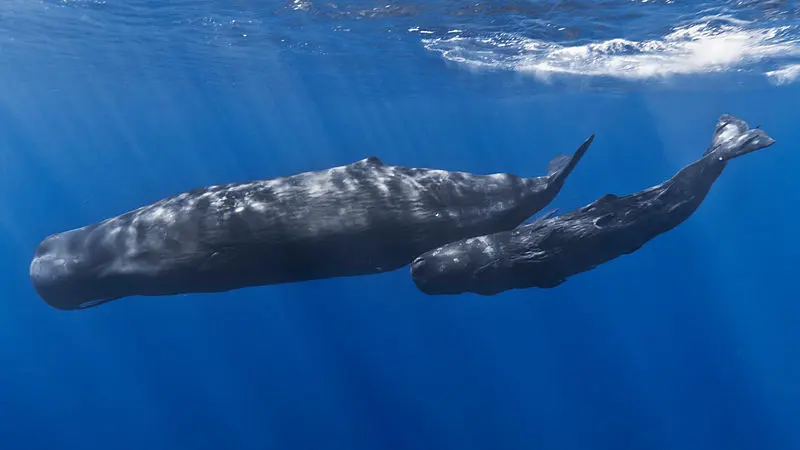
How to identify a mother whale and her calf
If you are observing whales in the wild, you can identify a mother-calf pair by watching their behavior and proximity. The calf will almost always remain within a few body lengths of the mother, often swimming in her "slipstream" to save energy. This positioning allows the calf to draft behind the mother’s larger body, making it easier to keep up during travel.
- Look for a smaller whale swimming very close to a larger adult.
- Observe the synchronized surfacing patterns; the calf will often surface just after the mother.
- Watch for "nursing" behavior, where the calf stays positioned near the mother’s ventral side.
- Note if the pair avoids interaction with other whales, as mothers are often protective and solitary.
Common mistakes when observing include getting too close, which can stress the mother and cause her to abandon the calf, or misidentifying a young whale as a calf when it is actually a juvenile of a smaller species. Always maintain a respectful distance to avoid disrupting their natural behaviors.
Common mistakes when researching whale reproduction
A frequent error in understanding whale reproduction is the assumption that whales have large litters like many terrestrial mammals. Because humans are accustomed to seeing animals like dogs or cats have multiple offspring, it is easy to assume large marine mammals follow a similar pattern. However, the constraints of the ocean and the need for high-level maternal care make single births the evolutionary standard for all cetaceans.
Another misunderstanding involves the frequency of breeding. People often assume that whales mate every year, but this ignores the biological reality of energy depletion. A female whale must accumulate vast stores of blubber to survive the months of nursing, as she often migrates to feeding grounds where food is abundant but then moves to warmer, nutrient-poor waters to give birth. Failing to account for this energy budget leads to inaccurate conclusions about population growth rates. By recognizing these constraints, researchers can better predict how environmental changes will impact the future of whale populations worldwide.
Key facts
- Most whale species give birth to only one calf at a time, as twins are exceptionally rare.
- Female whales typically have a gestation period ranging from 10 to 18 months, depending on the species.
- Calves are born tail-first to prevent them from drowning during the delivery process.
- Mothers provide high-fat milk to their calves, which allows the young whales to grow rapidly in cold waters.
- Whales generally have long intervals between pregnancies, often waiting two to five years before reproducing again.
- Avoid disturbing whale pods during calving season, as mothers are highly protective and need to conserve energy for nursing.
The bottom line
Whales are K-strategists, meaning they focus on the survival of a single offspring rather than producing large numbers of young. By giving birth to one calf every few years and providing nutrient-rich milk, mothers ensure their calves grow quickly and learn vital migration routes. This reproductive strategy makes whale populations vulnerable to environmental changes, as they cannot recover their numbers as rapidly as smaller marine animals.
People also ask
How long do whale calves stay with their mothers?
Most whale calves remain with their mothers for one to two years. During this time, the mother teaches the calf essential survival skills, such as how to migrate and find food.
Do whales nurse their young underwater?
Yes, whales nurse underwater by squirting milk directly into the calf's mouth. Because the milk is extremely thick and high in fat, it does not dissipate quickly in the ocean water.
Why do whales have so few babies?
Whales invest a massive amount of energy into gestation and lactation. Having only one calf at a time ensures that the mother can provide enough resources for the offspring to reach a size capable of surviving in the open ocean.
At what age do whales reach sexual maturity
Sexual maturity varies significantly by species, ranging from 5 to 15 years. Larger species, such as the bowhead whale, may take longer to mature compared to smaller species like the minke whale.
Can you tell the age of a whale by its size?
Size is a general indicator of age, but it is not precise because growth rates vary based on food availability and health. Scientists more accurately determine age by examining earplugs or teeth, which form growth layers similar to tree rings.
Are there any whale species that have multiple calves?
While single births are the biological standard, there have been rare documented cases of twins in species like humpback whales. However, these instances often result in the mother struggling to provide enough milk for both calves to survive.
This answer was created with the help of AI research tools and reference sources. Spotted an error? Let us know — we correct mistakes quickly. See our editorial policy.