How long do crocodiles live?
Short answer
Most crocodile species live between 30 and 70 years in the wild. While some larger species, such as the saltwater crocodile, can occasionally exceed 70 or 80 years, their lifespan is heavily influenced by environmental conditions, habitat quality, and the availability of prey. Captivity can sometimes extend these estimates due to consistent care.
On this page
How long do different crocodile species live?
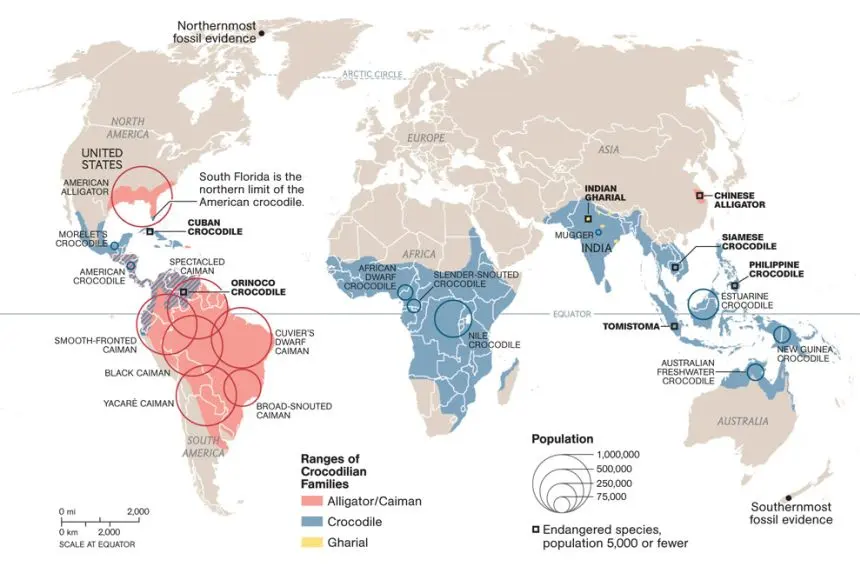
The lifespan of a crocodile varies significantly depending on its specific species and size. Smaller species, such as the dwarf crocodile, typically have shorter lifespans, often ranging from 30 to 40 years. Conversely, larger species like the Nile crocodile and the saltwater crocodile are known for their longevity, frequently reaching 60 to 70 years in healthy environments. These larger predators have fewer natural threats once they reach maturity, allowing them to survive for many decades.
While anecdotal reports sometimes claim crocodiles live for over a century, these accounts are rarely verified by scientific data. Most experts agree that 70 to 80 years represents the upper limit for even the most robust individuals. Factors such as genetic health, metabolic rate, and the ability to avoid injury during territorial disputes play a critical role in determining the actual age an individual reaches.
Why do crocodiles live so long?
Crocodiles possess a highly efficient metabolism that allows them to conserve energy for long periods. By remaining relatively inactive for much of the day, they minimize wear and tear on their bodies. This physiological adaptation is supported by a remarkably strong immune system, which helps them recover from severe infections and injuries sustained during fights with other crocodiles or prey.
Their longevity is also linked to their role as apex predators. Because they occupy the top of the food chain, they have few natural predators once they grow past the vulnerable hatchling stage. This lack of external pressure allows them to focus their biological resources on growth and maintenance rather than constant defense. Their armored, scaly skin also provides a durable barrier against environmental hazards and physical trauma.
How does captivity affect crocodile lifespans?
Crocodiles kept in zoos or research facilities often benefit from consistent veterinary care and a steady food supply. In these controlled environments, individuals are protected from the risks of starvation, territorial combat, and habitat destruction. Consequently, some crocodiles in captivity have been documented living into their 80s or even 90s, surpassing the average life expectancy of their wild counterparts.
However, captivity also introduces specific challenges that can impact health. If an enclosure is not managed correctly, crocodiles may suffer from:
- Poor water quality leading to skin infections.
- Obesity caused by overfeeding or lack of exercise.
- Chronic stress due to inadequate space or social overcrowding.
- Metabolic bone disease from improper dietary supplementation.
To ensure long-term health in managed care, professionals prioritize maintaining precise temperature gradients and providing diverse, nutrient-rich diets that mimic the variety of prey found in nature.
What are the biggest threats to crocodile survival?
In the wild, the primary threat to a crocodile's lifespan is human activity. Habitat loss remains the most significant danger, as the drainage of wetlands and the destruction of nesting sites prevent populations from thriving. Additionally, pollution and the contamination of waterways can lead to long-term health issues, reducing the reproductive success and overall vitality of the population.
Beyond human influence, the early stages of life are the most perilous. Hatchlings face immense pressure from various predators, including birds, fish, and larger reptiles. Only a small percentage of crocodiles survive their first year of life. Those that do survive must navigate:
- Competition for food resources within their territory.
- Territorial conflicts with larger, dominant males.
- Severe weather events that can destroy nests or alter water levels.
- Exposure to pathogens in stagnant or polluted water bodies.
Common mistakes when estimating crocodile age
A common mistake is assuming that a crocodile's size is a direct indicator of its exact age. While growth is rapid during the first few years, it slows down significantly as the animal matures. Environmental factors, such as the abundance of food, can cause two crocodiles of the same age to have vastly different body lengths. Relying solely on physical measurements often leads to inaccurate age assessments.
Another frequent error is the assumption that all crocodiles grow indefinitely. While they exhibit indeterminate growth, their rate of growth plateaus as they reach physical maturity. Observers should avoid:
- Overestimating age based on skin thickness or scarring.
- Assuming that large size equates to extreme old age.
- Ignoring the impact of local climate on growth rates.
- Failing to account for species-specific variations in size.
To accurately determine age, researchers must use specialized techniques like skeletochronology, which involves analyzing growth rings in the bone tissue, similar to counting rings in a tree.
Key facts
- Most large crocodile species have an average lifespan of 60 to 70 years in the wild.
- The saltwater crocodile, the world's largest reptile, can live to be over 70 years old.
- Captive crocodiles often live longer than wild counterparts due to consistent veterinary care and lack of predators.
- A Nile crocodile named Cassius, living in Australia, is currently estimated to be over 120 years old.
- Crocodiles continue to grow throughout their lives, meaning size is often a reliable indicator of age.
- Avoid approaching wild crocodiles to estimate their age, as they are highly territorial and dangerous predators.
The bottom line
Crocodiles are remarkably long-lived reptiles, frequently surviving for seven decades or more in their natural habitats. Their longevity is supported by their status as apex predators and their ability to keep growing throughout their lives. While exceptional individuals can surpass a century, most wild crocodiles face significant environmental pressures. Understanding their biological resilience highlights the importance of preserving the wetlands and river systems they call home.
People also ask
How can you tell the age of a crocodile?
Scientists determine a crocodile's age by counting the growth rings found in their bones or teeth, similar to how one counts rings in a tree. This is a scientific procedure and cannot be done by observing a living animal in the wild.
Do crocodiles stop growing when they reach adulthood?
Unlike mammals, crocodiles exhibit indeterminate growth, meaning they continue to grow slowly throughout their entire lives. Very large individuals are almost always among the oldest members of their population.
Are there crocodiles that live over 100 years?
While rare, some individual crocodiles have been documented reaching or exceeding 100 years of age. These instances are more common in controlled environments where the animals are protected from disease and injury.
Does the species of crocodile affect its lifespan?
Yes, different species have varying longevity expectations based on their size and environment. Smaller species, such as the dwarf crocodile, generally have shorter lifespans than massive apex predators like the Nile or saltwater crocodile.
What is the biggest threat to a crocodile's lifespan?
In the wild, the primary threats to an adult crocodile's life are human activity, habitat loss, and conflict with other dominant crocodiles. Younger crocodiles face significantly higher mortality rates due to predation by birds, fish, and larger reptiles.
Can you keep a crocodile as a pet to ensure it lives a long life?
Keeping a crocodile as a pet is dangerous, illegal in many jurisdictions, and highly discouraged. They require massive, specialized enclosures and professional care that the average person cannot provide, leading to poor health outcomes for the animal.
This answer was created with the help of AI research tools and reference sources. Spotted an error? Let us know — we correct mistakes quickly. See our editorial policy.