How do you study effectively?
Short answer
Effective studying relies on active engagement rather than passive review. By utilizing techniques like spaced repetition and active recall, you strengthen neural pathways for long-term retention. Organize your environment, manage your time with structured intervals, and prioritize deep focus over prolonged, unfocused sessions to maximize cognitive efficiency and academic performance.
On this page
How to study effectively using active recall
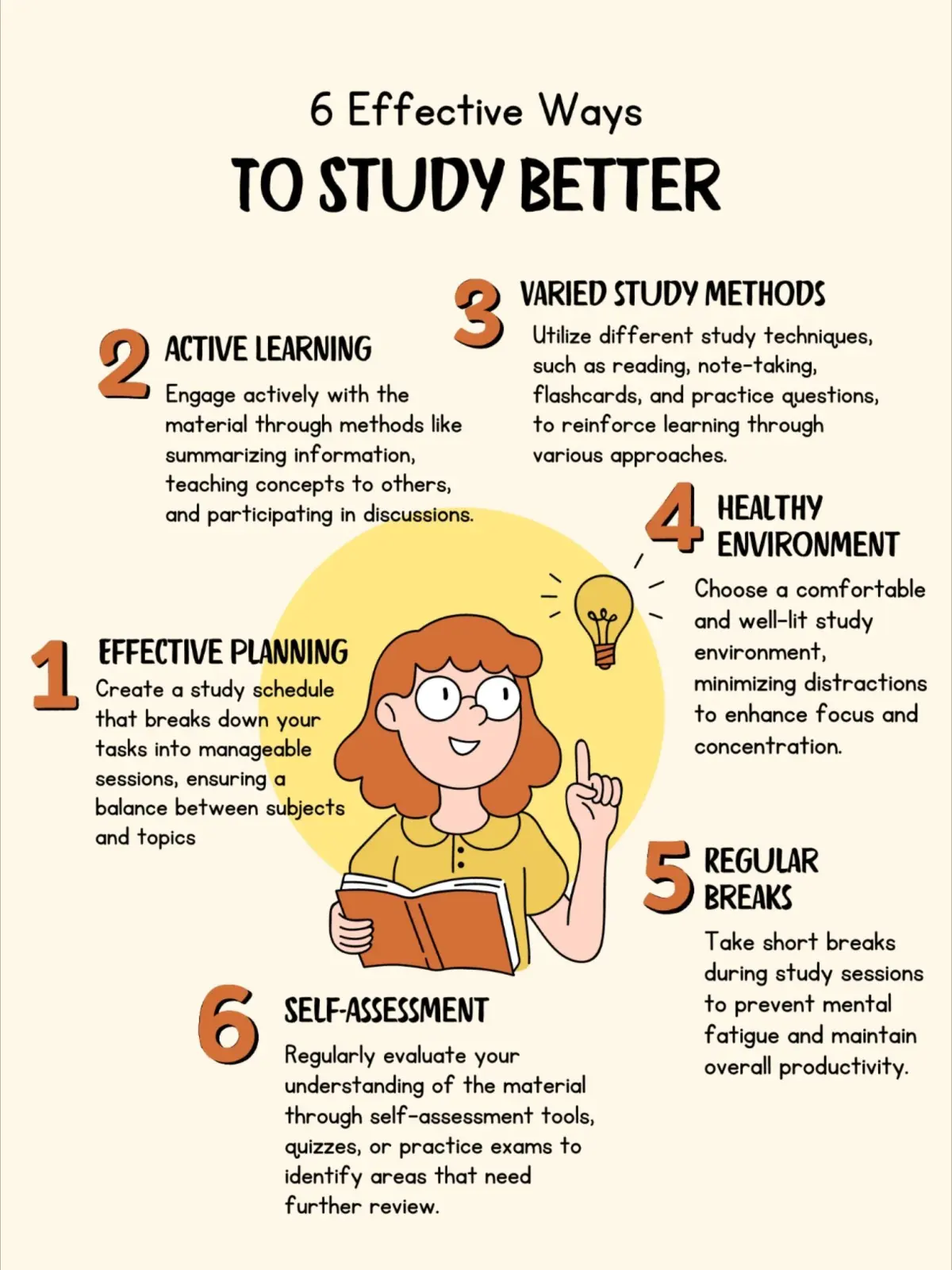
Active recall is the process of testing yourself rather than simply re-reading notes or textbooks. When you force your brain to retrieve information, you strengthen memory traces and identify gaps in your understanding. This method is significantly more effective than passive review because it demands cognitive effort, which signals to the brain that the information is important to store.
To implement active recall, close your source material after reading a section and attempt to summarize the main points aloud or in writing. You can also create flashcards or generate questions during your initial reading to quiz yourself later. Research suggests that students who use self-testing perform substantially better on exams than those who rely on highlighting or re-reading.
- Read a passage of text.
- Close the book or hide your notes.
- Write down everything you remember.
- Compare your summary to the source to check for accuracy.
- Repeat the process for the sections you missed.
How long should you study at once
The Pomodoro Technique is a popular time management method that breaks study sessions into manageable intervals. Typically, you focus on a single task for 25 minutes, followed by a five-minute break. After four cycles, take a longer break of 15 to 30 minutes. This structure prevents mental fatigue and maintains high levels of concentration throughout your session.
Long, uninterrupted study marathons often lead to diminishing returns, as the brain struggles to maintain focus beyond 45 to 90 minutes. By incorporating regular breaks, you allow your brain to consolidate information and reset your attention span. This approach is particularly useful for complex subjects that require intense mental energy, such as mathematics or learning a new language.
- Use a timer to track your 25-minute work intervals.
- Step away from your desk during the five-minute break to stretch or hydrate.
- Avoid checking social media or email during breaks, as these activities can distract your focus.
- Adjust the interval lengths if you find that 25 minutes is too short for your specific task.

Why spaced repetition improves memory
Spaced repetition is a learning technique that involves reviewing information at increasing intervals over time. Instead of cramming for an exam the night before, you revisit the material after one day, then three days, then a week, and eventually a month. This strategy leverages the "spacing effect," a psychological phenomenon where information is better encoded into long-term memory when study sessions are spread out.
This method combats the "forgetting curve," a concept first described by psychologist Hermann Ebbinghaus in 1885. Ebbinghaus discovered that memory retention drops sharply within the first 24 hours unless the information is reviewed. By timing your reviews to coincide with the moments just before you are likely to forget, you reinforce the neural connections and extend the duration of your memory.
- Create a schedule for reviewing your notes at specific intervals.
- Use digital flashcard apps that automatically schedule reviews based on your performance.
- Focus your review sessions on the material you find most difficult to remember.
- Keep a log of your progress to see how your retention improves over time.
Common mistakes when studying
One of the most frequent errors is relying on passive study habits, such as highlighting entire pages or reading notes repeatedly. These methods create an "illusion of competence," where the material feels familiar simply because you have seen it before, not because you have mastered it. This often leads to poor performance during exams, as the brain has not practiced retrieving the information under pressure.
Another mistake is multitasking, such as checking notifications or listening to music with lyrics while studying. The brain cannot effectively focus on two complex tasks simultaneously, leading to "context switching" that drains your cognitive resources. Additionally, failing to prioritize sleep is a major error. Sleep is essential for memory consolidation, meaning that pulling an all-nighter often undoes the work you put in during the day.
- Avoid highlighting more than one or two sentences per paragraph.
- Eliminate digital distractions by turning off notifications or using website blockers.
- Prioritize at least seven to eight hours of sleep to ensure your brain can process new information.
- Do not prioritize easy topics; spend your energy on the concepts that challenge you most.
Best study environment for beginners
Your physical environment plays a critical role in your ability to concentrate. A dedicated study space should be quiet, well-lit, and free from clutter. By using this space exclusively for academic work, you create a psychological association between the location and the act of studying, which helps you enter a "flow state" more quickly when you sit down to begin.
When setting up your space, ensure that you have all the necessary supplies within reach to avoid unnecessary interruptions. Ergonomics also matter; a comfortable chair and a desk at the right height prevent physical discomfort that can distract from your work. If you find it difficult to study at home, consider visiting a library or a quiet café where the environment is designed for productivity and focus.
- Keep your desk clear of items unrelated to the subject you are currently studying.
- Use comfortable lighting to reduce eye strain during long sessions.
- Keep a bottle of water and healthy snacks nearby to maintain your energy levels.
- Establish a consistent routine by studying at the same time and in the same place every day.
Key facts
- Use spaced repetition by reviewing material at increasing intervals to move information into long-term memory.
- Implement the Pomodoro Technique by studying in 25-minute focused blocks followed by five-minute breaks.
- Practice active recall by closing your book and reciting or writing down what you just learned.
- Feynman Technique involves explaining a complex concept in simple terms to identify gaps in your understanding.
- Interleaving involves mixing different subjects or topics in a single session to improve problem-solving skills.
- Prioritize sleep, as the brain consolidates memories and processes information during deep REM cycles.
The bottom line
Effective studying relies on active engagement rather than passive review. By utilizing evidence-based techniques like active recall, spaced repetition, and the Feynman Technique, you shift from simply recognizing information to truly mastering it. Consistency and adequate rest are the final pillars, ensuring your brain has the time and energy to solidify new connections. Focus on deliberate practice to maximize your learning efficiency every single day.
People also ask
How many hours should I study per day?
Quality matters more than quantity, but most experts suggest 2 to 4 hours of intense, focused work. Beyond this threshold, cognitive fatigue typically diminishes the effectiveness of your retention.
Is it better to study in the morning or at night?
Research suggests that morning study sessions often benefit from a rested brain and higher alertness. However, night study can be effective if it aligns with your natural circadian rhythm and includes adequate sleep afterward.
Does listening to music help with studying?
Instrumental music or ambient noise can improve focus for some, but lyrical music often interferes with language processing. Silence or low-frequency white noise is generally the most reliable choice for deep concentration.
How can I stop procrastinating?
Break large tasks into tiny, manageable steps that take less than 10 minutes to complete. Starting the first small task reduces the psychological barrier that often leads to avoidance.
Should I re-read my notes to study?
Re-reading is considered a passive, low-impact strategy that often leads to the illusion of competence. Instead, use active methods like flashcards or practice tests to force your brain to retrieve information.
How do I manage study stress?
Incorporate physical activity and mindfulness breaks to lower cortisol levels. Maintaining a structured schedule also reduces anxiety by providing a clear sense of progress and control over your workload.
This answer was created with the help of AI research tools and reference sources. Spotted an error? Let us know — we correct mistakes quickly. See our editorial policy.