How do you draw with confidence?
Short answer
Drawing with confidence requires shifting your focus from the final result to the physical process of mark-making. By practicing deliberate, fluid strokes and accepting that errors are essential learning tools, you reduce performance anxiety. Consistent repetition of basic shapes builds the muscle memory necessary to execute lines with conviction and clarity.
On this page
How to build muscle memory for drawing
Confidence in drawing is fundamentally a physical skill rooted in muscle memory. When you hesitate, your lines appear shaky or "hairy," which signals a lack of intent to the viewer. To overcome this, you must train your arm to move as a single unit rather than relying solely on your wrist. Professional illustrators often emphasize the importance of "ghosting" a line, which involves moving your hand in the air above the paper to rehearse the stroke before letting the pencil touch the surface.
- Anchor your shoulder to provide stability for long, sweeping lines.
- Practice drawing circles and ellipses daily to improve hand-eye coordination.
- Use your entire arm to move the pencil, keeping your wrist relatively stiff to maintain consistent pressure.
- Execute each stroke in one quick, decisive motion rather than sketching in tiny, overlapping segments.
By repeating these movements, you internalize the spatial relationship between your hand and the paper. Over time, your brain stops overthinking the mechanics, allowing your focus to shift toward the subject matter itself.
How to overcome fear of making mistakes
The most significant barrier to confident drawing is the fear of ruining the page. This perfectionism leads to tentative, light marks that lack structural integrity. To combat this, treat your early sketches as disposable explorations rather than finished masterpieces. Many artists adopt a "quantity over quality" mindset, such as the 100-sketch challenge, which forces you to prioritize speed and volume over individual accuracy. When you accept that a single drawing is merely one of thousands you will create, the pressure to be perfect dissipates.
- Use cheaper materials like newsprint or standard printer paper to lower the stakes of every mark.
- Set a timer for five minutes to complete a drawing, which prevents you from obsessing over minor details.
- Embrace "ugly" drawings as necessary steps in the learning process.
- Focus on the overall gesture or silhouette of the object rather than the internal textures.
When you remove the expectation of immediate perfection, you gain the freedom to take risks. Confident drawing is often the result of being willing to make a wrong mark and then correcting it with a bold, right one.
Common mistakes when learning to draw
Beginners often fall into the trap of "noodling," which is the act of obsessively detailing a small area before the overall structure is established. This creates a disjointed drawing where the proportions are inevitably wrong. Another common error is drawing what you think you see rather than what is actually there. For example, when drawing a face, people often draw a symbolic eye shape they learned in childhood instead of observing the specific shadows and angles of the actual subject.
- Avoid pressing too hard with your pencil, as this makes erasing difficult and creates permanent indentations.
- Stop holding the pencil too close to the tip, as this restricts your range of motion and obscures your view.
- Do not ignore the negative space, which is the empty area around your subject, as it provides crucial information about scale.
- Refrain from smudging your graphite with your fingers, as this creates a muddy, unprofessional appearance.
Recognizing these habits allows you to consciously correct them. By maintaining a light touch and focusing on the whole composition first, you ensure that your drawing remains balanced and intentional.
Why drawing with confidence happens
Confidence in art is a psychological state achieved through the mastery of basic principles like perspective, anatomy, and light. When you understand how a form occupies space, you no longer have to guess where a line should go. This knowledge provides a roadmap for your hand. Furthermore, confidence is reinforced by the "feedback loop" of practice. Every time you successfully render a difficult angle or a complex shadow, your brain stores that success, making it easier to approach similar challenges in the future with less apprehension.
The transition from amateur to confident artist is marked by a decrease in hesitation. When you know the rules of structure, you can choose to follow them or break them intentionally for artistic effect. This autonomy is the hallmark of a confident creator. You are no longer fighting the medium; you are collaborating with it to translate your vision onto the page.
Best exercises for drawing practice
To solidify your skills, incorporate structured exercises into your daily routine. Start with contour drawing, where you trace the edges of an object without looking down at your paper. This exercise forces your eyes to track the subject accurately, improving your observational skills. Another effective method is gesture drawing, which involves capturing the movement and weight of a subject in under two minutes. These exercises strip away the distraction of detail and force you to commit to the essential lines that define an object.
- Spend 10 minutes daily on blind contour drawing to synchronize your hand and eye.
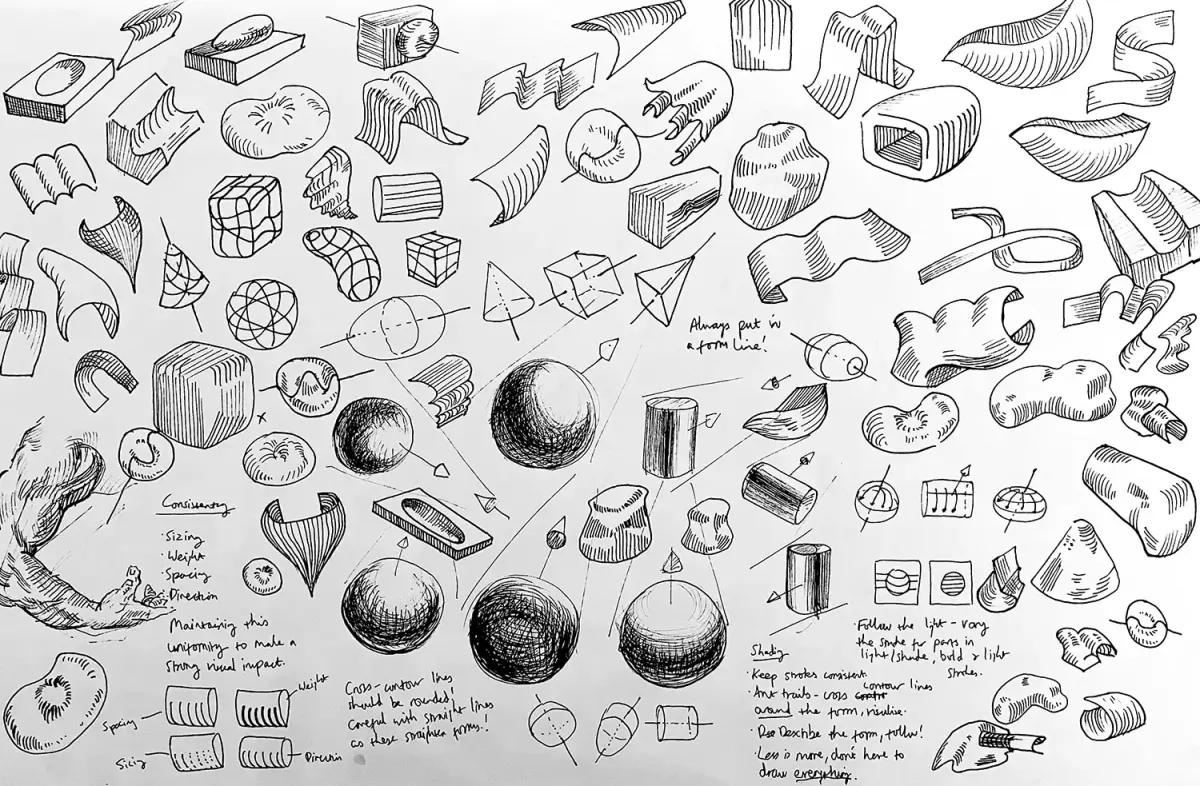
- Practice drawing simple geometric primitives like cubes, spheres, and cylinders from different angles.
- Use a pen instead of a pencil for some sessions to eliminate the possibility of erasing.
- Study the work of masters like Leonardo da Vinci or Egon Schiele to observe how they used line weight to convey depth.
By consistently applying these techniques, you will find that your lines become more deliberate and your overall confidence in your artistic ability grows substantially.
Key facts
- Hold your pencil further from the tip to encourage fluid, shoulder-driven movements rather than cramped finger motions.
- Practice "ghosting" by moving your hand in the air over the paper to rehearse the stroke before letting the lead touch the surface.
- Use a timer to complete quick gesture drawings, such as 30-second poses, to force decisive, instinctual mark-making.
- Prioritize long, continuous lines over short, "hairy" lines to create a clean, professional aesthetic.
- Accept that every artist makes mistakes; use a kneaded eraser to lift errors rather than scrubbing the paper aggressively.
- Study the concept of "line weight" to vary the thickness of your strokes, which adds depth and visual interest to a flat drawing.
The bottom line
Drawing with confidence is a skill built through repetitive, intentional practice rather than innate talent. By shifting your focus from perfection to the quality of your movement, you allow your hand to become more fluid and decisive. Embrace mistakes as essential data points for improvement, prioritize bold strokes over timid ones, and maintain a consistent daily habit to transform your hesitation into a steady, authoritative artistic voice.
People also ask
Why do my drawings look shaky or hesitant?
Hesitant lines usually result from drawing too slowly or focusing too much on individual details. Try increasing your speed and focusing on the overall shape to build muscle memory and fluidity.
Should I use a hard or soft pencil for sketching?
Use an HB or 2B pencil for initial sketches, as they provide a balance between darkness and erasability. Harder leads like 4H are better for technical work, while softer leads like 6B are ideal for bold, confident shading.
How can I overcome the fear of ruining a blank page?
Treat the first few drawings of a session as "warm-ups" rather than finished masterpieces. Lowering your expectations allows you to experiment freely without the pressure of perfectionism.
Does drawing from life help with confidence?
Drawing from real objects forces you to observe proportions and light accurately, which builds technical competence. This foundation makes it easier to draw with authority because you understand the underlying structure of your subjects.
How often should I practice to improve my lines?
Consistency is more important than duration, so aim for 15 to 30 minutes of daily practice. Regular repetition trains your hand-eye coordination, making confident strokes feel natural over time.
What is the best way to correct a line I drew incorrectly?
Instead of erasing immediately, draw the correct line right over the mistake. This helps you analyze your error and teaches your hand the right path for the next attempt.
This answer was created with the help of AI research tools and reference sources. Spotted an error? Let us know — we correct mistakes quickly. See our editorial policy.