How do you draw a skateboard for beginners?
Short answer
Drawing a skateboard involves sketching a long, rounded rectangle for the deck and adding two T-shaped truck assemblies underneath. By focusing on perspective and basic geometric shapes, beginners can build a realistic outline. Refine your sketch by adding wheels, grip tape texture, and shading to create depth and a professional appearance.
On this page
How to draw a skateboard deck shape
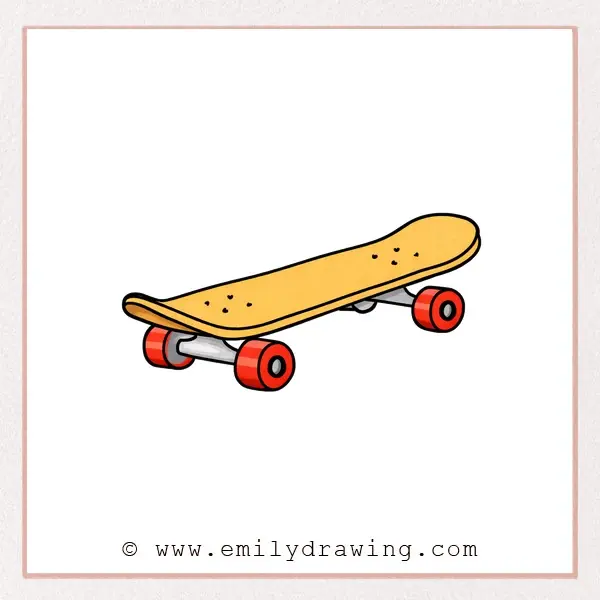
The foundation of a skateboard drawing is the deck, which is essentially an elongated oval with flattened ends. Start by drawing a long, horizontal rectangle with rounded corners to represent the board's surface. To give it a three-dimensional look, draw a slightly curved line along the top edge to indicate the board's thickness. Beginners often make the mistake of drawing the deck too perfectly straight, but real skateboards have a slight "camber" or arch.
To refine the shape, follow these steps:
- Sketch a long, thin rectangle with rounded ends.
- Add a second, thinner line following the top edge to show the side profile.
- Draw small, curved lines at the nose and tail to represent the kicktails.
- Ensure the nose is slightly wider than the tail for a standard popsicle-shape deck.
How to draw skateboard trucks and wheels
Trucks are the metal components that connect the wheels to the deck. Draw two rectangular blocks centered beneath the deck, positioned about one-quarter of the way in from each end. From these blocks, draw a horizontal line representing the axle, with a small circle at each end to serve as the wheels. Keep the wheels in proportion to the deck; if they are too large, the skateboard will look like a toy.
When drawing the wheels, remember that they are cylinders viewed from the side. Draw them as ovals to create a sense of perspective. If you are drawing the skateboard from a side angle, the wheels on the far side of the board should be partially obscured by the deck. This technique, known as overlapping, is essential for creating a realistic sense of depth in your technical drawings.
How to add details and texture
Once the basic structure is complete, adding details makes the drawing look authentic. Add a layer of "grip tape" to the top surface by shading the deck with a dark gray or black pencil. You can use a cross-hatching technique to suggest the rough, sandpaper-like texture of the tape. Adding small bolts where the trucks attach to the deck is another crucial detail that beginners frequently overlook.
Consider these finishing touches to enhance your illustration:
- Draw four small circles on the deck to represent the mounting hardware.
- Add a logo or graphic design to the bottom of the deck to personalize your board.
- Use a white gel pen or eraser to add highlights on the wheels to simulate light reflection.
- Vary your line weight by pressing harder on the board's outline and lighter on the internal hardware.
Common mistakes when drawing skateboards
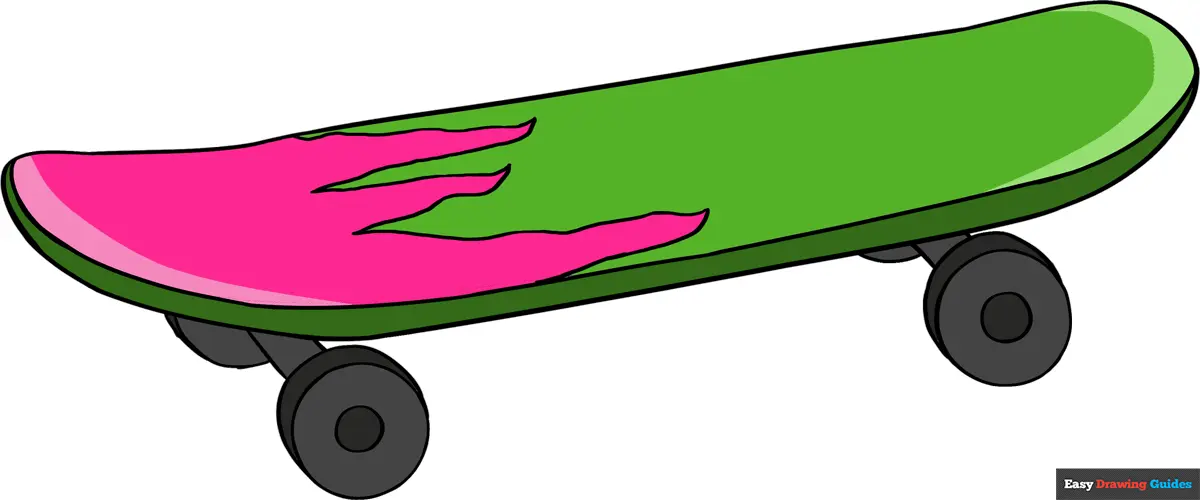
The most common error for beginners is failing to maintain consistent perspective. If the deck is drawn from a high angle, the trucks and wheels must also reflect that viewpoint. Another frequent mistake is drawing the wheels at different sizes or misaligning them with the axle. Always use a ruler or a straight edge to ensure the axle line is parallel to the deck, as crooked trucks will make the entire drawing look unstable and unrealistic.
Avoid these specific pitfalls during your drafting process:
- Drawing wheels that are perfectly circular instead of oval, which flattens the image.
- Forgetting to show the "kick" or upward curve of the nose and tail.
- Placing the trucks too close to the center of the board, which would make the skateboard unrideable.
- Using too many heavy lines, which can make the drawing look cluttered and messy.
Best tools for drawing skateboards
You do not need expensive equipment to create a high-quality skateboard drawing. A standard HB pencil is perfect for the initial layout, while a 2B or 4B pencil works well for adding depth through shading. A fine-liner pen is excellent for outlining the final shape, as it provides a clean, professional edge that makes the skateboard pop off the page. Use a kneaded eraser to lift graphite and create soft highlights on the wheels.
When choosing your paper, select a smooth, medium-weight sketchbook. Rough paper can make it difficult to draw crisp, straight lines for the trucks and axles. If you want to add color, consider using alcohol-based markers, which provide a smooth, streak-free finish that mimics the glossy surface of a skateboard deck. By practicing these techniques and using the right tools, you will be able to render a convincing skateboard drawing with ease and accuracy.
Key facts
- A standard skateboard deck is shaped like a pill with rounded ends, known as a "popsicle" shape.
- Use a ruler to draw a long, thin horizontal rectangle as a guide for the deck's length.
- The front (nose) of the board is typically slightly wider and steeper than the back (tail).
- Draw two small rectangles underneath the deck to represent the trucks, which hold the wheels.
- Add four circles at the ends of the trucks to represent the wheels, ensuring they are aligned.
- Use a light pencil for your initial sketch so you can easily erase guidelines before adding ink.
The bottom line
Drawing a skateboard is an exercise in basic geometric shapes and perspective. By starting with a simple pill-shaped rectangle and adding structural details like trucks and wheels, you can build a convincing illustration. Focus on the subtle differences between the nose and tail to ensure your drawing looks authentic. With practice, you can refine these proportions and add custom graphics to reflect your own personal style.
People also ask
Why is one end of a skateboard wider than the other?
The wider end is the nose, which provides more surface area for flicking tricks like ollies. The narrower tail allows for quicker, more responsive snaps against the ground.
How do I make the wheels look three-dimensional?
Draw a small oval inside each circle to represent the wheel's core or bearing. Adding a tiny shadow on one side of each wheel creates depth and volume.
Should I draw the grip tape on top of the board?
Yes, you can shade the top surface of the deck with a dark gray or black pencil. This represents the sandpaper-like texture used to provide traction for the rider's feet.
What is the best angle to draw a skateboard?
A three-quarter perspective is the most dynamic angle for beginners. It shows the length of the deck, the thickness of the side, and the position of the wheels simultaneously.
How long should the wheelbase be?
The wheelbase, or the distance between the two sets of wheels, should occupy about two-thirds of the board's total length. Keeping this ratio accurate makes the drawing look realistic.
Can I add graphics to the underside of the deck?
Absolutely, the bottom of the board is a blank canvas for art. Many skaters personalize their boards with stickers, paint pens, or professional screen-printed designs.
This answer was created with the help of AI research tools and reference sources. Spotted an error? Let us know — we correct mistakes quickly. See our editorial policy.