How do you draw a bat?
Short answer
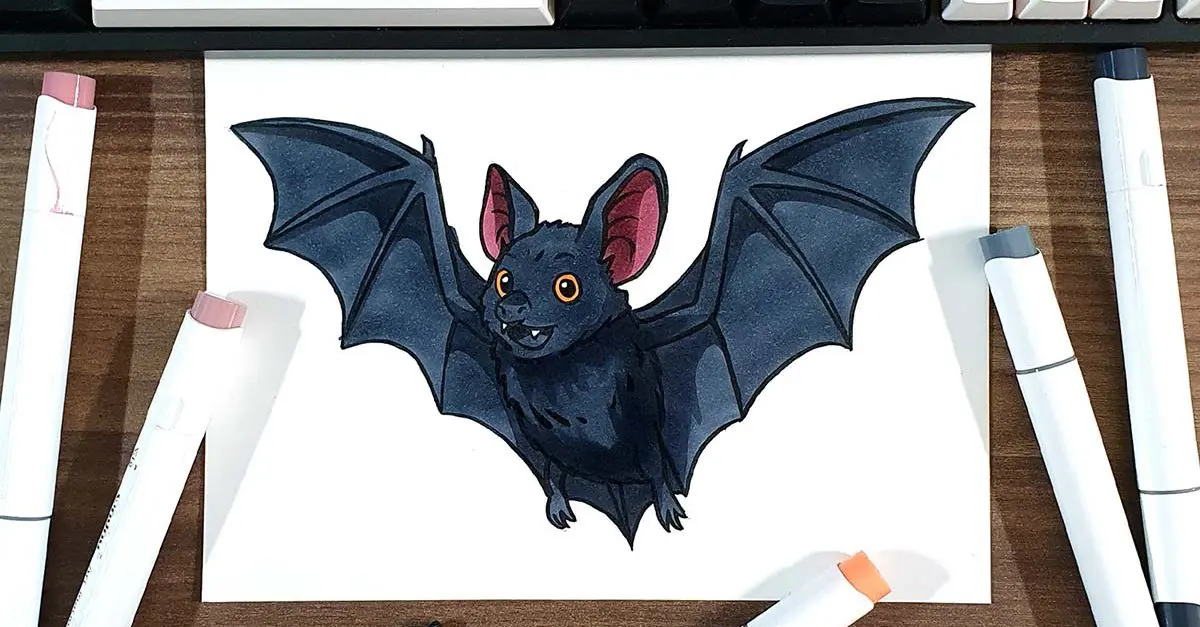
Drawing a bat requires capturing its distinct silhouette, characterized by elongated finger bones supporting thin, leathery wings. Begin by sketching a central body mass, then extend symmetrical, webbing-filled arm structures outward. Focus on the triangular ears and pointed snout to define the head, ensuring the wings appear flexible rather than stiff or rigid.
On this page
How to draw a bat step by step
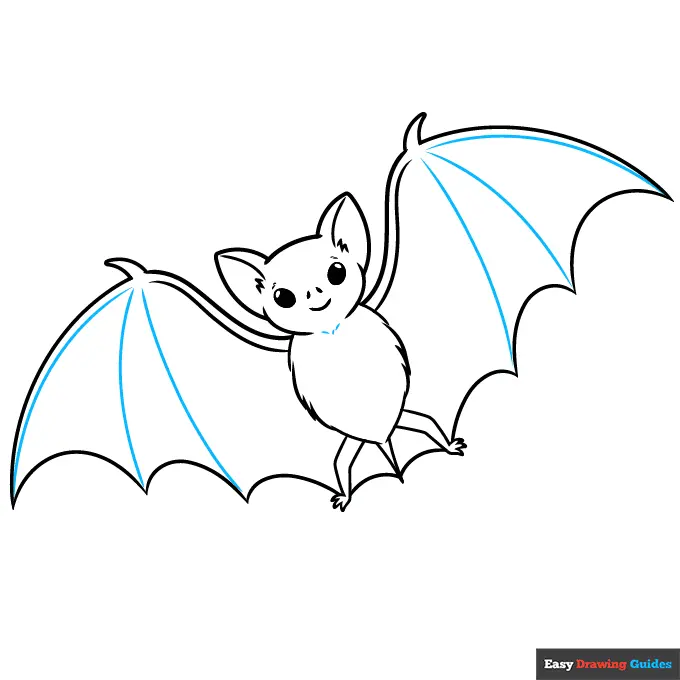
To begin your drawing, start with a simple oval for the body. Place a smaller circle slightly overlapping the top of the oval to represent the head. From the shoulders, draw two long, thin lines extending outward on each side to serve as the primary framework for the wings. These lines should curve slightly downward to mimic the natural posture of a resting bat.
Once the skeleton is established, connect the wing tips back to the lower body with sweeping, scalloped lines. This creates the iconic "leathery" appearance of the wing membrane. Add triangular ears at the top of the head and a small, pointed snout to complete the basic shape. Remember to keep your initial pencil strokes light so you can easily refine the anatomy before adding final details like fur texture or facial features.
- Sketch a central oval for the torso and a smaller circle for the head.
- Extend two long, angled lines from the shoulders to represent the arm bones.
- Use scalloped, curved lines to connect the arm tips to the body, forming the wing membrane.
- Add triangular ears and a small nose to define the face.
- Erase the inner construction lines and refine the outline with darker strokes.
Best drawing techniques for beginners
When approaching animal anatomy, focus on the geometric shapes that compose the creature. Bats are essentially a collection of triangles and ovals; mastering these basic forms will make your drawings look more professional and accurate. Use a 2B pencil for your initial sketch, as it is soft enough to be erased without damaging the paper surface. Always work from the center of the figure outward to maintain proper proportions.
For the wings, avoid drawing perfectly straight lines. Bat wings are supported by elongated digits, which create a natural, slightly jagged edge when the wings are partially folded. Observe how the membrane drapes between the fingers, creating soft, sagging curves. If you are struggling with symmetry, try drawing a faint vertical guideline down the center of your page to ensure both wings match in length and angle.
- Use light, fluid strokes to capture the organic movement of the wings.
- Practice drawing different wing positions, such as fully extended or tightly wrapped.
- Keep your reference images handy to study the specific spacing of the finger bones.
- Focus on the negative space between the wings and the body to improve your composition.
Why bat wings look difficult to draw
The complexity of bat wings often stems from the misconception that they are simple, flat sheets of skin. In reality, they are complex biological structures consisting of thin, flexible skin stretched over elongated finger bones. If you draw the wings as stiff, triangular flaps, the bat will look unnatural or static. To improve, visualize the bones as the "tent poles" of the wing, with the skin sagging slightly between them due to gravity.
Another factor is the perspective of the wings. When a bat is in flight, the wings are often curved or twisted, which requires an understanding of foreshortening. Start by drawing the wing closest to the viewer slightly larger and more detailed than the one in the background. By varying the line weight—using thicker lines for the foreground and thinner lines for the background—you can create a convincing sense of depth and three-dimensional space.
Common mistakes when drawing bats
One of the most frequent errors is giving the bat human-like proportions. Bats have very small bodies in comparison to their massive wingspans. If you draw the body too large, the wings will look stunted and out of place. Always ensure the wingspan is at least three to four times the width of the body. Additionally, beginners often forget to include the thumbs, which are small, clawed digits located at the top edge of the wing.
Another mistake involves the facial features. Bats are not just flying mice; they have unique, specialized snouts and large, expressive ears. Avoid drawing generic round ears, as most species have distinctively pointed or rounded shapes that vary significantly. Take time to research specific species, such as the fruit bat or the little brown bat, to understand how their ear shapes and snout lengths differ, which adds character and realism to your final artwork.
How to add texture and detail
Once the structure is solid, you can add depth through shading and texture. Use short, quick pencil strokes to indicate fur, particularly around the chest and neck area. The wings, however, should remain smooth, with only subtle lines to suggest the veins and the underlying bone structure. Focus your shading on the areas where the wings meet the body, as this is where shadows naturally gather, giving the drawing a sense of weight.
Finally, consider the environment. A bat in flight looks more dynamic if you add a suggestion of movement, such as wind lines or a blurred background. If you are drawing a resting bat, focus on the talons gripping a branch, which provides a grounding element to the composition. By paying attention to these small, realistic details, you transform a simple sketch into a sophisticated study of one of nature's most fascinating and unique flying mammals.
Key facts
- Bats are the only mammals capable of true flight, which is defined by the unique structure of their elongated finger bones supporting a thin membrane.
- When drawing a bat in a resting position, remember that they hang upside down, meaning their head points toward the ground.
- The wing of a bat is anatomically similar to a human hand, with a thumb that remains free and distinct from the rest of the wing membrane.
- A common mistake is drawing bat wings like bird feathers; bat wings are composed of leathery, hairless skin stretched over bony digits.
- To create a sense of movement, draw the wings in an arched "M" shape, which mimics the upward stroke of a bat in flight.
- Focus on the ears, which are often disproportionately large in many species to facilitate echolocation, a biological sonar system used for navigation.
The bottom line
Drawing a bat requires balancing anatomical precision with stylized movement. By focusing on the unique hand-like structure of the wing and the large, functional ears, you can create a recognizable and accurate depiction. Avoid the common pitfall of adding feathers, and instead emphasize the leathery texture of the membrane. With practice, capturing the distinct silhouette of a bat in flight becomes an intuitive and rewarding artistic exercise.
People also ask
Why do bats hang upside down?
Bats hang upside down because their hind legs are too weak to support their weight for standing, and this position allows them to take flight instantly by simply dropping into the air.
How many fingers does a bat have?
A bat has five digits on each wing, consisting of a short, clawed thumb and four long, thin fingers that act as the structural struts for the wing membrane.
What is the best way to draw bat ears?
Draw the ears as large, slightly curved triangles or ovals that sit prominently on top of the head, as these are essential for the animal's echolocation.
Should I draw fur on the wings?
No, you should avoid drawing fur on the wings because the patagium, or wing membrane, is a smooth, leathery skin surface that is entirely devoid of hair.
How do I make the bat look realistic?
To achieve realism, study the skeletal structure of a bat's wing, focusing on how the joints bend and how the skin folds when the wings are partially closed.
Are all bat faces the same?
No, bat faces vary significantly; some species have flat, pug-like noses, while others have long, pointed snouts or leaf-shaped nose appendages used to direct sound pulses.
This answer was created with the help of AI research tools and reference sources. Spotted an error? Let us know — we correct mistakes quickly. See our editorial policy.