Are sharks endangered?
Short answer
Many shark species are currently threatened with extinction due to overfishing and habitat loss. According to the International Union for Conservation of Nature (IUCN), approximately one-third of all shark and ray species are classified as threatened. While some populations remain stable, the global decline of these apex predators poses a significant risk to ocean health.
On this page
Why are sharks endangered?
The primary driver of global shark decline is overfishing, both as a targeted industry and as accidental bycatch. Millions of sharks are killed annually, often to meet the demand for shark fin soup, a luxury dish in several Asian markets. Because sharks grow slowly, mature late, and produce few offspring, they cannot replenish their populations quickly enough to withstand current levels of industrial fishing pressure.
Habitat destruction and climate change further exacerbate these pressures. Coastal development often destroys mangrove forests and seagrass beds, which serve as vital nursery grounds for many shark species. Additionally, rising ocean temperatures and acidification alter the distribution of prey, forcing sharks to migrate into unfamiliar territories where they face new threats from commercial longline and gillnet fisheries.
Which shark species are most at risk?
The conservation status of sharks varies dramatically across the more than 500 known species. Large, migratory species are generally at the highest risk because they cross international borders, making it difficult for any single nation to enforce protective regulations. The IUCN Red List provides the most comprehensive data on these trends, categorizing species based on their survival probability.
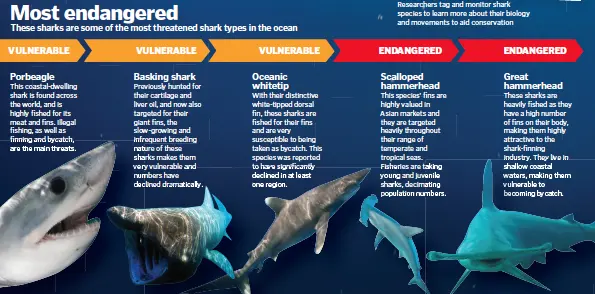
- Scalloped Hammerhead: Critically Endangered due to high demand for their large fins.
- Oceanic Whitetip: Critically Endangered, having suffered massive population collapses from bycatch.
- Shortfin Mako: Endangered, often targeted by sport and commercial fisheries for their meat and fins.
- Great White Shark: Vulnerable, facing threats from trophy hunting and entanglement in shark nets.
While these species face dire circumstances, others, such as the Small-spotted Catshark, remain relatively abundant and are currently classified as Least Concern.
How do scientists track shark populations?
Researchers utilize a variety of modern techniques to monitor shark health and movement. Satellite tagging is perhaps the most effective method, allowing scientists to track individual sharks across thousands of miles. This data helps identify "hotspots" where sharks congregate, which can then be proposed as Marine Protected Areas (MPAs) to limit human interference during critical breeding or feeding cycles.
- Capture and tag individuals to monitor migration patterns.
- Use environmental DNA (eDNA) sampling to detect shark presence in water columns.
- Analyze landing data at fish markets to estimate total mortality rates.
- Implement acoustic monitoring arrays to track local movements in coastal reefs.
These methods allow for evidence-based policymaking, ensuring that conservation efforts are directed toward the areas where they will have the most significant impact on population recovery.

What are the common mistakes when discussing shark conservation?
A frequent error is the assumption that all sharks are man-eaters that must be culled for human safety. In reality, unprovoked shark attacks on humans are statistically rare, and lethal culling programs often disrupt the ecological balance of the reef without significantly reducing risk. Misunderstanding the role of sharks as apex predators leads to public apathy regarding their extinction.
Another mistake is focusing solely on shark finning while ignoring the broader issue of bycatch. While finning is a brutal practice, millions of sharks die annually simply because they are caught in nets intended for tuna or swordfish. Effective conservation requires addressing the systemic issues within global commercial fishing fleets rather than focusing on a single product or market. Public perception often oversimplifies the problem, ignoring the complex economic realities that drive small-scale fishers to rely on sharks for their livelihoods.
How can individuals help protect sharks?
Individual actions can influence the global market and support broader conservation initiatives. The most impactful step is to avoid purchasing products derived from sharks, such as shark fin soup, cartilage supplements, or leather made from shark skin. Because demand drives supply, reducing personal consumption sends a clear signal to retailers and distributors that these products are no longer socially or ethically acceptable.
- Support sustainable seafood initiatives by checking labels for certifications like the Marine Stewardship Council.
- Donate to reputable marine conservation organizations that lobby for international trade bans.
- Participate in citizen science projects that allow divers and snorkelers to log shark sightings.
- Advocate for local policies that restrict the sale of shark-derived products in your region.
By educating others about the ecological importance of sharks, individuals help shift the narrative from fear to stewardship. Protecting these ancient predators is essential for maintaining the biodiversity and resilience of the world’s oceans for future generations.
Key facts
- Over 30% of all shark species are currently threatened with extinction according to the IUCN Red List.
- Overfishing is the primary driver of decline, with an estimated 100 million sharks killed annually by commercial fisheries.
- Sharks are apex predators that regulate marine ecosystems, and their removal leads to the collapse of coral reefs and seagrass beds.
- The scalloped hammerhead and oceanic whitetip shark are among the species listed as critically endangered.
- Avoid purchasing products containing shark cartilage or squalene, as these often contribute to unsustainable harvesting practices.
- Support sustainable seafood choices by using apps like Seafood Watch to ensure your consumption does not inadvertently harm shark populations.
The bottom line
Sharks are not a single endangered entity, but a diverse group facing a global crisis due to human exploitation. With nearly one-third of species threatened, their disappearance would destabilize ocean health. By avoiding shark-derived products and supporting sustainable fishing policies, individuals can help mitigate these pressures. Protecting these ancient predators is vital, as their presence ensures the resilience and balance of our planet's marine environments.
People also ask
Why are sharks being overfished?
Sharks are primarily targeted for their fins, which are used in shark fin soup, a luxury dish in some cultures. They are also frequently caught as bycatch in global tuna and swordfish fisheries.
Do sharks have any natural predators?
Adult sharks have few natural enemies, though larger sharks, orcas, and occasionally crocodiles may prey upon them. Their primary threat remains human activity rather than natural predation.
How long do sharks live?
Lifespans vary greatly by species, ranging from about 20 years for some smaller sharks to over 400 years for the Greenland shark. This slow maturation rate makes them highly vulnerable to population depletion.
Read the full answer →Are all sharks dangerous to humans?
No, the vast majority of the more than 500 shark species are harmless to humans. Only a small number, such as the great white, tiger, and bull shark, are responsible for the majority of unprovoked attacks.
What is shark finning?
Shark finning is the practice of removing a shark's fins while it is still alive and discarding the rest of the body at sea. This cruel process prevents the shark from swimming, leading to death by suffocation or blood loss.
Can sharks recover if fishing stops?
Shark populations can recover, but their slow growth and low reproductive rates mean recovery takes decades. Effective international protections and protected marine areas are essential for their long-term survival.
This answer was created with the help of AI research tools and reference sources. Spotted an error? Let us know — we correct mistakes quickly. See our editorial policy.