Who invented the radio?
Short answer
The invention of the radio cannot be credited to a single person, as it resulted from the cumulative work of several scientists. Guglielmo Marconi is widely recognized for developing the first practical, long-distance wireless telegraphy system in the 1890s, building upon theoretical foundations established by James Clerk Maxwell and Heinrich Hertz.
On this page
Who actually invented the radio?
The development of radio was an evolutionary process rather than a singular "eureka" moment. In the 1860s, Scottish physicist James Clerk Maxwell predicted the existence of electromagnetic waves. Two decades later, German physicist Heinrich Hertz successfully demonstrated these waves in a laboratory, proving that energy could be transmitted through the air without wires.
While Hertz proved the science, he did not see a practical application for his discovery. It was Guglielmo Marconi, an Italian inventor, who recognized the potential for long-distance communication. In 1895, Marconi successfully transmitted a wireless signal over a distance of 1.5 miles. By 1901, he achieved the first transatlantic radio transmission, effectively launching the era of wireless communication.
Other figures also played critical roles in the technology's maturation. Nikola Tesla held several key patents for radio components, and Reginald Fessenden achieved the first voice transmission in 1906. Because so many scientists contributed to the underlying physics and engineering, the "invention" of the radio is best understood as a collaborative achievement spanning several decades and multiple nations.
How did early radio technology work?
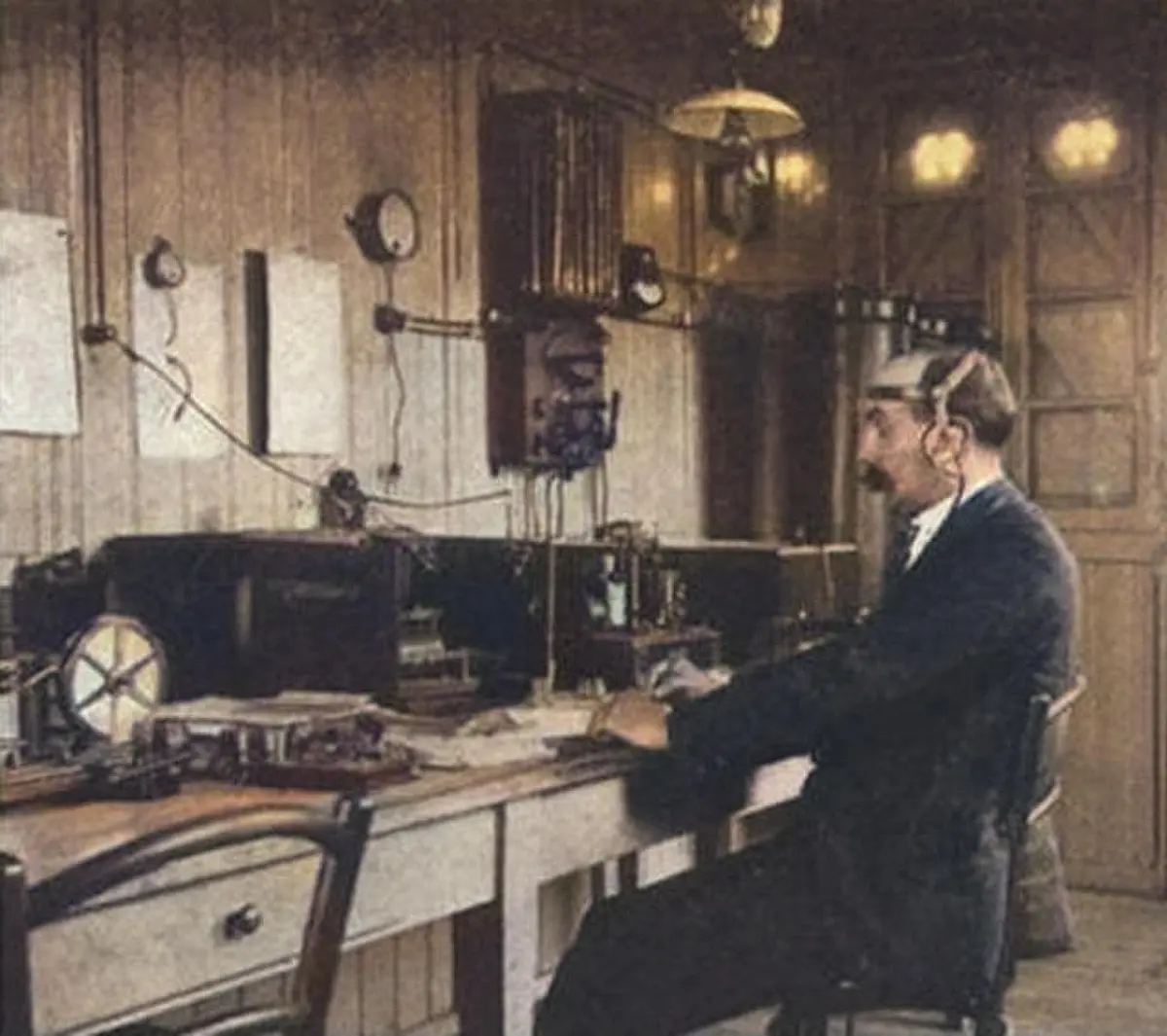
Early radio systems utilized spark-gap transmitters to generate electromagnetic waves. These devices created a high-voltage spark that produced a burst of radio frequency energy. This signal was then picked up by a primitive receiver, often consisting of a metal antenna and a device called a coherer, which acted as a crude switch to detect the presence of the waves.
The process relied on Morse code, where the length and spacing of these electromagnetic bursts represented dots and dashes. Because these early systems lacked the ability to transmit complex audio signals, they were primarily used for maritime communication and military signaling. The technology was bulky, inefficient, and prone to significant interference from atmospheric conditions.
Key components of these early systems included:
- Spark-gap transmitters to generate signals.
- Coherers or crystal detectors to receive signals.
- Large wire antennas to capture electromagnetic energy.
- Telegraph keys to manually encode messages.
Why was Marconi credited with the invention?
Marconi is frequently cited as the inventor because he was the first to package the technology into a commercially viable system. While others focused on laboratory experiments, Marconi focused on creating a reliable service for the shipping industry. He established the Marconi Wireless Telegraph Company, which standardized equipment and trained operators to ensure consistent communication across oceans.
His business acumen allowed him to secure patents and funding that his contemporaries often lacked. In 1909, Marconi shared the Nobel Prize in Physics with Karl Ferdinand Braun, specifically for their contributions to the development of wireless telegraphy. This international recognition solidified his status in the public imagination as the primary inventor of the radio.
Despite this fame, legal battles persisted for years. In 1943, the United States Supreme Court ruled in favor of Nikola Tesla’s estate regarding certain radio patents. The court determined that Tesla’s earlier work had anticipated some of Marconi’s designs. This ruling served to acknowledge that the radio’s history is a complex web of overlapping discoveries rather than the work of one man.
How to learn about radio history for beginners
If you are interested in the origins of wireless technology, the best approach is to study the timeline of electromagnetic theory. Start by reading about the transition from wired telegraphy to wireless systems. Understanding how the telegraph functioned provides essential context for why early radio was essentially "wireless Morse code."
To gain a deeper appreciation of the technology, consider these steps:
- Visit a local science museum that features early 20th-century communication equipment.
- Research the life and experiments of Heinrich Hertz to understand the physics of waves.
- Listen to archives of early 20th-century radio broadcasts to hear how the medium evolved.
- Build a simple crystal radio kit to experience how airwaves are converted into sound without batteries.
Many educational resources now offer virtual tours of historical laboratories where these experiments took place. Engaging with primary sources, such as original patent filings or old newspaper reports, can help you distinguish between historical fact and popular myth. Focusing on the specific technical challenges faced by early inventors will provide a much clearer picture than general biographies.
Common mistakes when researching radio history
A frequent error is assuming that radio was invented overnight. Many people mistakenly believe that one individual sat down and designed a finished radio unit in a single attempt. In reality, the technology progressed through incremental improvements, moving from spark-gap transmitters to vacuum tubes and eventually to the transistors found in modern electronics.
Another common mistake is ignoring the contributions of non-Western scientists or those whose work was sidelined by patent disputes. History often favors the person who files the first patent, but the science usually belongs to those who published the first research papers. When researching, avoid relying on single-source biographies, as these often gloss over the intense legal and professional rivalries that defined the era.
Finally, do not confuse the invention of radio transmission with the invention of radio broadcasting. While Marconi invented the method of sending signals, the development of entertainment-based radio broadcasting did not occur until the 1920s. Distinguishing between point-to-point telegraphy and mass-media broadcasting is essential for understanding the full scope of how the radio changed the world.
Key facts
- Guglielmo Marconi is widely credited with inventing the first practical radio system in 1895.
- Nikola Tesla held several key patents for radio technology and won a Supreme Court case regarding them in 1943.
- Heinrich Hertz proved the existence of electromagnetic waves in 1887, providing the scientific foundation for radio.
- Radio works by converting sound waves into electromagnetic waves, transmitting them through the air, and converting them back into sound.
- Avoid placing radio antennas near large metal objects, as these can block or distort the incoming signal.
- Always ensure your antenna length is matched to the frequency you are trying to receive for the best clarity.
The bottom line
The invention of the radio was not the work of a single person but rather a collaborative evolution of scientific discovery. While Guglielmo Marconi is celebrated for his commercial success and long-distance transmissions, he built upon the foundational physics of Heinrich Hertz and the electrical innovations of Nikola Tesla. Understanding this history reveals that modern communication relies on the cumulative efforts of many brilliant engineers.
People also ask
How does a radio actually work?
A radio transmitter sends electromagnetic waves through the air, which are then captured by an antenna. The receiver circuit filters these waves and converts them back into electrical signals that drive a speaker to produce sound.
Did Marconi steal his ideas from Tesla?
There was a long-standing legal battle between the two inventors over patent priority. While Marconi successfully commercialized the technology first, the U.S. Supreme Court eventually recognized Tesla’s earlier contributions to radio design.
What was the first message sent by radio?
In the late 1890s, Marconi successfully transmitted Morse code signals over short distances. By 1901, he achieved a major milestone by sending a signal across the Atlantic Ocean from England to Canada.
Why are there AM and FM radio stations?
AM stands for amplitude modulation, which changes the strength of the signal to carry sound. FM stands for frequency modulation, which changes the frequency of the wave, resulting in higher sound quality and less interference.
Can I build my own radio at home?
Yes, a simple crystal radio can be built using a coil of wire, a diode, and an earphone. It requires no battery because it draws all its power directly from the radio waves it receives.
Why do some radios have better reception than others?
Reception quality depends on the sensitivity of the internal tuner and the quality of the antenna. Radios with digital tuners generally lock onto signals more precisely than older analog dials.
This answer was created with the help of AI research tools and reference sources. Spotted an error? Let us know — we correct mistakes quickly. See our editorial policy.