What were hieroglyphics?
Short answer
Hieroglyphics were a formal writing system used by ancient Egyptians, combining logographic, syllabic, and alphabetic elements. Consisting of over 1,000 distinct characters, this script adorned temple walls, tombs, and monuments for over 3,000 years. It functioned as both a practical administrative tool and a sacred medium for religious and royal inscriptions.
On this page
What were hieroglyphics used for?
Ancient Egyptians primarily utilized hieroglyphics for monumental, religious, and official purposes. The term itself derives from the Greek words "hieros" (sacred) and "glypho" (carving), reflecting the script's status as the "words of the gods." These symbols were meticulously carved into stone on temple walls, obelisks, and funerary monuments to ensure the immortality of pharaohs and deities. By documenting historical events, religious hymns, and offering lists, the script served to bridge the gap between the earthly realm and the divine.
Beyond religious contexts, hieroglyphics were essential for maintaining the state's bureaucratic functions. Scribes used the script to record tax assessments, land ownership, and military campaigns. While a more cursive form known as Hieratic eventually replaced hieroglyphics for everyday administrative tasks, the formal script remained the standard for prestige projects. The permanence of stone inscriptions ensured that the names and deeds of the elite would endure for eternity.
How did hieroglyphics work?
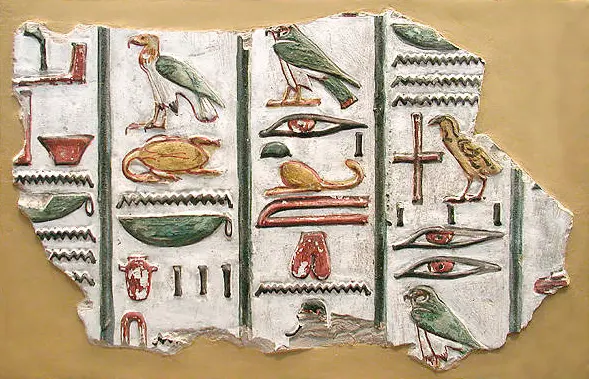
Hieroglyphics are not merely a system of pictograms; they function through a complex combination of three distinct types of signs. Understanding these categories is essential for deciphering the script's logic:
- Phonograms: Signs representing specific sounds or combinations of consonants.
- Ideograms: Symbols that represent the actual object depicted, such as a drawing of a sun representing the sun itself.
- Determinatives: Silent signs placed at the end of words to clarify the meaning or category of the preceding term.
The system does not include vowels, which often makes the exact pronunciation of ancient Egyptian words a subject of academic reconstruction. Scribes could write in various directions, including left to right, right to left, or top to bottom. Readers determined the direction of the text by observing the orientation of human or animal figures; the characters always face toward the beginning of the line. This flexibility allowed artists to arrange signs aesthetically to fit within specific architectural spaces or artistic compositions.
How to read hieroglyphics for beginners
Learning to read hieroglyphics requires patience and a systematic approach to identifying the phonetic values of individual signs. Because the script evolved over millennia, beginners should focus on the Middle Egyptian phase, which is the most well-documented and widely studied version of the language. To start your study, follow these foundational steps:
- Identify the direction of the text by looking at the direction the faces of the figures are turned.
- Recognize the phonetic signs, which represent one, two, or three consonants.
- Look for the determinative at the end of a word to understand the general context of the term.
- Consult a standard sign list, such as the Gardiner’s Sign List, to identify specific characters.
One common mistake is assuming that every image is a literal representation of an object. In reality, most signs function as phonetic indicators rather than pictures. Beginners often struggle because they try to translate the script word-for-word as if it were a simple picture-based code. Focusing on the phonetic structure rather than the artistic imagery will significantly improve your accuracy. Always verify the context, as the same sign can function differently depending on its placement within a word.
Why did hieroglyphics disappear?
The decline of hieroglyphics was a gradual process influenced by shifting political and religious landscapes in Egypt. Following the conquest of Egypt by Alexander the Great and the subsequent Ptolemaic period, Greek became the dominant language of administration and culture. As the Egyptian priesthood lost its traditional influence and the Roman Empire took control, the knowledge required to read and write the complex hieroglyphic system became restricted to a shrinking elite.
The final known hieroglyphic inscription was carved at the Temple of Philae in 394 CE. As Christianity spread throughout the region, the traditional pagan temples were closed, and the script—viewed as a relic of ancient polytheistic practices—fell into disuse. For over a millennium, the meaning of the symbols remained a mystery to the outside world. It was not until the discovery of the Rosetta Stone in 1799, which featured the same text in hieroglyphics, Demotic, and Greek, that scholars like Jean-François Champollion finally cracked the code in 1822.
Common mistakes when studying hieroglyphics
Many enthusiasts approach the study of hieroglyphics with misconceptions that hinder their progress. A frequent error is the belief that the script is a universal language that can be deciphered intuitively. In truth, it is a sophisticated linguistic system that requires rigorous study of grammar and vocabulary. Another mistake is ignoring the importance of the "silent" signs, which are crucial for distinguishing between words that share the same phonetic structure.
- Avoid assuming that the script is strictly pictorial or symbolic.
- Do not neglect the study of the cursive Hieratic and Demotic scripts, as they provide context for the evolution of the language.
- Be wary of "pop-culture" translations that often assign arbitrary meanings to symbols.
- Always cross-reference your findings with established academic lexicons to ensure accuracy.
By avoiding these pitfalls and committing to a structured learning path, you can gain a deeper appreciation for the nuance of ancient Egyptian communication. Remember that hieroglyphics were a living, breathing language for thousands of years, and treating them with the same academic respect as any other classical language is the best way to master their intricate beauty.
Key facts
- Hieroglyphics were a formal writing system used by ancient Egyptians that combined logographic, syllabic, and alphabetic elements.
- The term "hieroglyph" comes from the Greek words hieros (sacred) and glypho (carving), translating to "sacred carvings."
- The system utilized over 700 distinct signs, including birds, tools, and human figures, to represent both sounds and concepts.
- Hieroglyphics were primarily used for monumental inscriptions on temple walls and tombs rather than for everyday administrative record-keeping.
- The Rosetta Stone, discovered in 1799, provided the crucial key for Jean-François Champollion to decipher the script in 1822.
- To read hieroglyphs, look at the direction the animals or people are facing; the signs are read from that direction toward the other side.
The bottom line
Hieroglyphics represent one of humanity's earliest and most sophisticated writing systems, serving as the visual language of ancient Egyptian culture for over 3,000 years. By blending phonetic sounds with symbolic imagery, these "sacred carvings" preserved the history, religious beliefs, and royal decrees of a civilization. Today, they remain a vital window into the past, bridging the gap between ancient stone monuments and modern historical understanding.
People also ask
How did Egyptians write everyday documents?
For daily records, scribes used a simplified, cursive script known as Hieratic, which was much faster to write with a reed pen on papyrus. Later, a more abbreviated script called Demotic replaced Hieratic for secular documents around 650 BCE.
Were hieroglyphics a picture-based language?
While they look like pictures, hieroglyphics are not merely pictograms. Many signs represent specific consonant sounds, while others function as determinatives to clarify the meaning of a word without being pronounced.
Did everyone in ancient Egypt know how to read hieroglyphics?
Literacy was restricted to a small elite, primarily professional scribes, priests, and government officials. The complexity of the system required years of rigorous training to master the thousands of possible sign combinations.
Why did the use of hieroglyphics stop?
As Christianity spread through Egypt in the 4th century CE, the traditional religious associations of the script led to its decline. The last known hieroglyphic inscription was carved at the Temple of Philae in 394 CE.
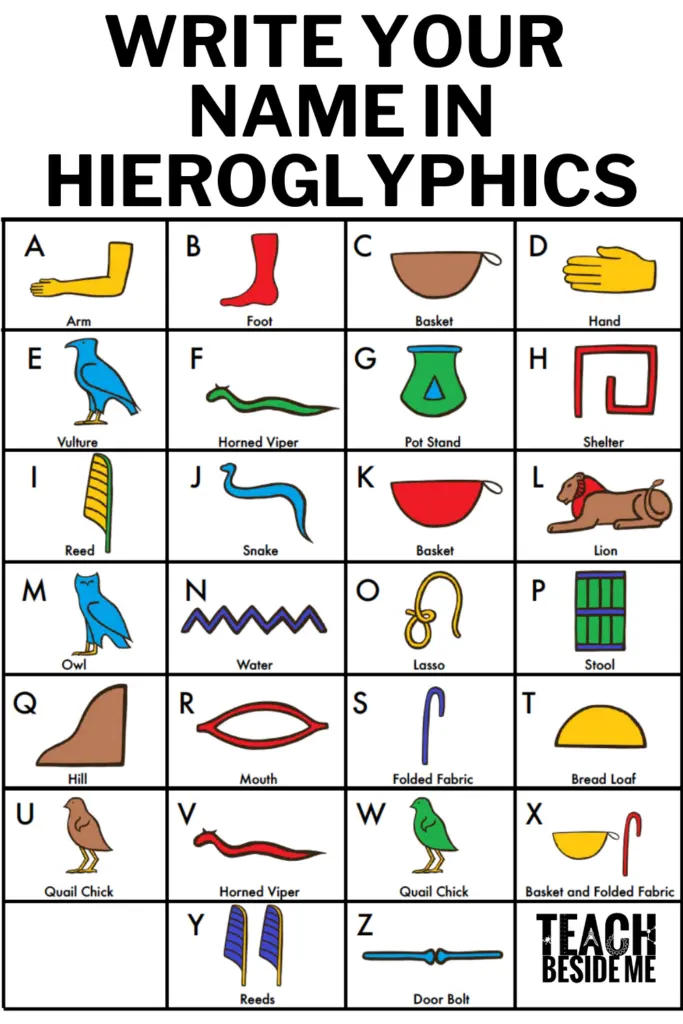
Can I learn to write my name in hieroglyphics?
Yes, you can use a transliteration chart to match English letters to their closest Egyptian phonetic equivalents. Note that vowels were generally omitted in ancient Egyptian, and you must place your signs inside an oval border called a cartouche to signify a royal name.
Is there a difference between hieroglyphics and hieratic?
Hieroglyphics were the formal, artistic characters used for permanent stone inscriptions, while Hieratic was a shorthand version. Hieratic allowed scribes to write quickly on portable surfaces like papyrus, making it the practical choice for business and literature.
This answer was created with the help of AI research tools and reference sources. Spotted an error? Let us know — we correct mistakes quickly. See our editorial policy.